
The learning center
Learn powerful and proven direct response marketing strategies that will help you grow your business fast.

%2Ballan%20dib%20%2B%20leanmarketing.png)
How to Stop Small Business Marketing Burnout in 7 Simple Steps (2026)
Seven steps to stop marketing burnout by building a plan you can actually follow, even on your busiest weeks.
You started your business with energy and a clear vision. Now you're posting content at midnight, chasing every new tactic, and working longer hours for fewer results. Something has gone wrong, and it's not your effort.
Marketing burnout is one of the most common things I see in founder-led businesses. It almost always traces back to the same cause: no documented plan, too many channels, and no way to tell what's actually working.
This guide gives you seven steps to prevent marketing burnout by building practical systems that reduce overwhelm. You'll get clear on what matters, cut what drains you, and end up with a plan you can follow even on your busiest weeks.
Quick Answer: Marketing burnout usually comes from chasing too many channels without a clear plan. The fix is working from a written strategy that tells you exactly what to do each week. These seven steps show you how to build that rhythm so marketing runs on a system, not on willpower.
Quick guide: How to stop small business marketing burnout in 7 steps
- Identify the root cause of your burnout: Diagnose whether you're burning out from lack of strategy, too many channels, or unclear priorities.
- Define your target market: Get specific about who you serve so you stop wasting energy on the wrong audience.
- Build a 1-Page Marketing Plan: Simplify your strategy into one clear document that tells you exactly what to do next.
- Choose two primary marketing channels: Focus your energy on two platforms instead of spreading yourself across six.
- Create repeatable systems and written processes: Document your marketing activities so tasks become predictable and delegatable.
- Set a sustainable weekly rhythm: Establish a realistic schedule that doesn't require heroic effort to maintain.
- Delegate and automate low-value tasks: Remove friction by handing off repeatable work and using automation tools.
How to prevent small business marketing burnout with a lean plan
1. Identify the root cause of your burnout

Marketing burnout rarely comes from doing too much. It comes from doing too much of the wrong things. Before you change anything, you need to diagnose why you're exhausted.
Ask yourself three questions.
- Do you have a documented marketing plan, or are you making decisions as you go?
- How many channels are you trying to maintain?
- Do you know which activities produce results and which ones just feel productive?
Most business owners I work with discover the same pattern. They're chasing tactics without a strategy underneath. They're trying to be everywhere at once. And they can't tell what's working because they're not measuring anything meaningful.
Write down everything you did for marketing last month. Circle the activities that generated leads or sales. Be honest. If your circles are sparse, you've found your problem.
2. Define your target market

Trying to market to everyone guarantees burnout. When your message is broad, you need more content, more channels, and more effort just to get noticed. Narrowing your focus lets you do less and connect more.
Your target market isn't "small business owners" or "people who need my service." It's a specific person with specific problems in a specific situation. The tighter your definition, the easier your marketing becomes.
Here's what to pin down:
- What industry are they in? What's their role?
- What problem keeps them up at night?
- What have they already tried that didn't work?
- When you can answer these questions, your marketing nearly writes itself.
Start with your best existing customers.
- What do they have in common?
- Why did they choose you?
Use their language, their frustrations, and their desires as the foundation for everything you create.
3. Build a 1-Page Marketing Plan
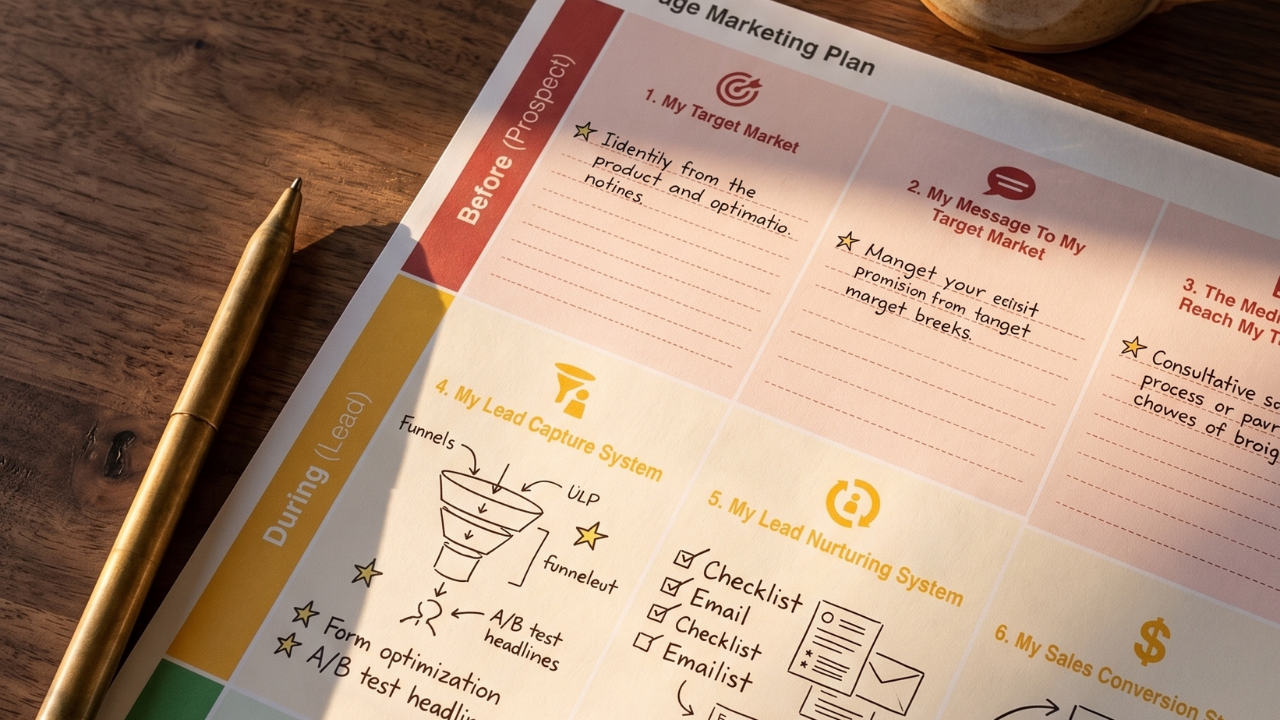
The fastest way to reduce marketing overwhelm is to get your entire strategy onto a single page. When you can see everything at once, you stop second-guessing what to do next.
The 1-Page Marketing Plan breaks your marketing into three phases:
- Before (attracting prospects)
- During (converting leads), and
- After (creating repeat customers).
Each phase has three steps. Nine total boxes. That's your entire marketing strategy.
This isn't about oversimplifying. It's about clarity. Complex plans get ignored. Simple plans get executed. When you know exactly who you're targeting, what message connects, and which channels to use, you stop wasting hours on activities that don't move the needle.
Block 30 minutes this week to draft your first version. It won't be perfect. It doesn't need to be. What matters is having something written down that you can refine as you learn what works.
4. Choose two primary marketing channels

If you're posting on five platforms, running ads, writing blogs, sending emails, and networking, you're heading for collapse.
Pick two channels. Just two. Master those before adding anything else.
How do you choose? Ask your customers where they found you. Look at where your competitors are getting traction. Consider which platforms suit how you communicate naturally. A local service business might focus on Google Business Profile and email. A B2B consultant might choose LinkedIn and a podcast.
The goal isn't to be everywhere. It's to be consistent somewhere. Two channels done well beats six channels done sporadically, every time. Your audience learns when to expect content from you. Algorithms reward accounts that show up regularly. And you stop feeling like you're drowning.
Give your two-channel approach 90 days before judging results. Quick changes based on short-term numbers are another path to burnout.
5. Create repeatable systems and written processes
Every task you do more than twice should have a written process. Documented steps turn marketing from a creative challenge into a fill-in-the-blank exercise. They save hours every week and make it possible to hand work off later.
Start with your most common marketing activities.
- How do you write a blog post?
- What's your process for creating social content?
- How do you follow up with leads?
Write each step out in simple bullet points.
Your written processes don't need to be elaborate. A checklist in a Google Doc works fine. The point is removing the mental load of figuring out what to do each time you sit down to work. When you have a process, you execute instead of deliberating.
Systems also protect your marketing when life gets chaotic. A sick week, a family emergency, or a busy season won't derail you because the playbook is already written.
6. Set a sustainable weekly rhythm

Marketing burnout happens when there's no finish line. If every day feels like you're behind, you'll eventually stop trying. A weekly rhythm gives you structure and permission to rest.
A realistic schedule that works for most small business owners: one hour reviewing your numbers, 90 minutes improving one marketing asset, one hour creating content, two 30-minute blocks for distribution. That's roughly four hours of focused marketing time per week.
Notice what's not on the list: checking social media five times a day, responding to every comment immediately, or constantly tweaking ads. Those activities feel productive but rarely move your business forward.
Schedule your marketing time the same way you'd schedule a client meeting. Block it in your calendar. Protect it from interruptions. When the session ends, you're done for the day. That boundary is what keeps burnout from coming back.
7. Delegate and automate low-value tasks

The work that drains you most is often not the work that grows your business. Reporting, graphic design, scheduling posts, sending follow-up emails: these tasks pull you back into the details when you should be focused on decisions.
You don't need to hire full-time help to start. Two to five hours per week from a freelancer is enough. Outsource the repeatable tasks first: content repurposing, basic design, review requests, or data entry. Keep the high-judgment work for yourself.
If you’re looking for help with your next marketing hire, download our ultimate hiring toolkit with the exact process we’ve used for 1,000+ marketing hires.
Automation handles the rest. Email sequences can nurture leads between your check-ins. Scheduling tools can publish your content across platforms. A CRM can track your contacts without manual updates. The goal is removing friction from consistent execution.
If you've done something more than five times, it's a process. If it's a process, someone or something else can run it.
Why does marketing cause so much burnout for business owners?
Running marketing as a founder means being five different things at once: creative, strategic, technical, analytical, and consistent. That combination would stretch a team. For a solo founder, it's a recipe for exhaustion.
The constant switching makes it worse. Writing content requires a different mental mode than analyzing ad performance or responding to comments. Moving between these tasks throughout the day fragments your attention and drains your energy faster than focused work would.
Add platform changes to the mix. Algorithms shift constantly. New features launch every few weeks. Staying current feels like a second job on top of running your actual business. And the penalty for inconsistency is steep: step away for a week and your reach drops.
The real cost is opportunity. Every hour spent on marketing is an hour not spent serving customers, improving your product, or resting. When marketing feels endless, something has to give.
What should you track to know if your marketing plan is working?
Follower counts and likes feel good but rarely connect to revenue. Track numbers that show your marketing is generating business, not just attention.
Start with three.
- Lead volume: how many potential customers entered your pipeline this month?
- Conversion rate: what percentage of leads became paying customers?
- Customer acquisition cost: how much did you spend in time and money to get each new customer?
Review these once a month. If lead volume is low, your visibility or message needs work. If conversion rate is weak, your follow-up or sales process needs attention. If acquisition cost is too high, you're using channels that aren't efficient for your business.
One number most business owners overlook is customer lifetime value. A customer who buys once is worth far less than one who returns and refers others. Build that number into your planning, and you'll make smarter decisions about where to put your energy.
Who is this for?
This approach works for founders who:
- Are running a business with real customers but no documented marketing plan
- Are managing too many channels and seeing scattered results
- Have tried agencies or hired help but want to own the system themselves
- Are stuck in the details of marketing when they should be running the business
- Want a rhythm that's sustainable rather than one that requires constant heroic effort
Who is this not for?
- Founders still working out whether people want what they sell. Get clear on your offer first, then build the system around it.
- Businesses looking for results by next month. Simplifying your strategy creates clarity in weeks. The compounding happens over months.
- Founders not willing to measure anything. Without tracking, you can't tell what's working, and burnout is almost guaranteed.
How does Lean Marketing help you escape the burnout cycle?
Lean Marketing gives business owners a practical approach to simplify marketing, get clear, and grow without running on empty. The 1-Page Marketing Plan, trusted by over a million founder-led businesses, puts your entire strategy on one page so you always know what to focus on next.
Instead of chasing tactics and hoping something works, you build a systematic approach that produces consistent results. Lean Marketing's operating systems give you repeatable processes for every stage: targeting, messaging, lead capture, follow-up, conversion, and retention.
The whole approach is built on doing more with less. That means cutting what doesn't move the needle, focusing on activities that generate leads and sales, and creating systems that run without constant personal attention. When your marketing runs on a system, you can step back without everything falling apart.
If you're tired of chasing tactics that drain your energy without filling your pipeline, start with a plan. Download the free 1-Page Marketing Plan and start building a marketing system that supports your business instead of consuming it.
Frequently Asked Questions about small business marketing burnout
How do I know if I'm experiencing marketing burnout?
You're likely burned out if you're working longer hours but seeing fewer results, avoiding marketing tasks you used to enjoy, or feeling dread when you think about creating content. The first thing to check is whether you have a documented marketing plan. Without one, every decision becomes a source of stress.
Can I fix marketing burnout without hiring help?
Yes, but only by changing your approach. The fastest path is simplifying your strategy with a tool like the 1-Page Marketing Plan. Focus on two channels, create written processes for repeatable tasks, and set clear boundaries around your marketing time. You can do less and still grow.
How much time should I spend on marketing each week?
Four to five focused hours per week is sustainable for most small business owners. The key is making those hours count by working from a written plan. Without one, you'll spend ten hours on activities that could be done in two with clear direction on what matters.
What's the biggest mistake that leads to marketing burnout?
Trying to be on every platform and chasing every new tactic. This spreads your energy too thin and almost always produces inconsistent results. The opposite approach is to go deep on two channels and build consistency before adding more.
How does a marketing plan reduce burnout?
A written plan removes daily decision-making from your plate. You already know who you're targeting, what message to use, and which channels matter. The 1-Page Marketing Plan gives you that clarity in nine boxes. When you're not constantly figuring out what to do next, your energy goes further.
What's the difference between marketing burnout and just being busy?
Busy feels productive even when it's overwhelming. Burnout feels pointless. If you're working hard on marketing but can't point to what it's actually producing, that's the clearest sign something needs to change. The fix isn't doing less. It's doing the right things in the right order with a plan that tells you both.
What's the quickest way to reduce my marketing workload right now?
Cut to two channels and stop everything else. This single decision removes the majority of the mental load immediately. Then spend 30 minutes writing down your target market, your core message, and what you want people to do when they encounter your marketing. You now have the start of a plan.
Ready to stop chasing and start building?
If you're managing multiple marketing channels without clear processes, or you've been working harder without seeing more results, the 1-Page Marketing Plan is where it starts. Download it free and spend 30 minutes getting your strategy on one page.
7 Things to Know About AI Marketing Systems
What to evaluate in an AI marketing system before you buy, so you stop collecting tools and start building something that keeps running.
Most founders start with tools. A content writer here, an email automator there, maybe a scheduling platform. Six months later, they have four subscriptions and workflows that don't talk to each other.
That's organized chaos with a monthly invoice, not a system.
An AI-powered marketing system is different. It includes the sequence, the integration, and the guidance that turns individual tools into something that compounds. Here are seven things to evaluate before you invest.
Quick Answer: An AI-powered marketing system connects lead capture, follow-up, conversion, and tracking into one workflow you own. The difference between a system and a pile of subscriptions is the sequence holding them together. Done-with-you means you build it inside your own CRM with expert guidance, then keep running it after the engagement ends.
What should founders look for when evaluating AI marketing systems?
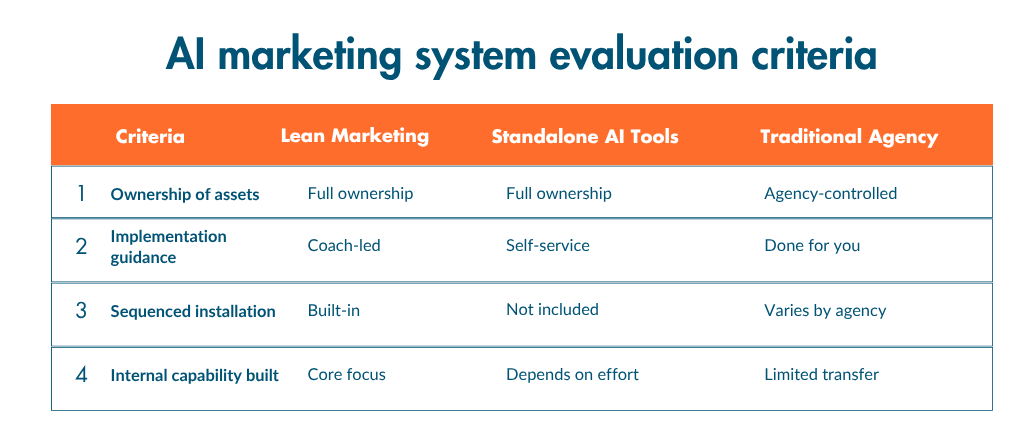
Founders face a specific challenge when evaluating AI-powered marketing systems. You want efficiency and scale, but you also want to understand what you're building and why. We focused on the criteria that separate systems that deliver results from tools that collect dust.
- Ownership model: Does the system live in your tools, or does it disappear when the subscription ends?
- Implementation support: Do you get a coach who walks you through installation, or just a login and documentation?
- Sequence clarity: Does the system tell you what to build first, second, and third—or leave you to figure it out?
- Integration capability: Can the AI tools connect to your CRM, email platform, and website without custom development?
- Time to value: How quickly can you get the core pieces running and start seeing results?
- Founder-friendly complexity: Is the system built for marketing experts, or can a business owner with limited marketing background follow along?
The 7 things founders should know about AI-powered marketing systems
1. Lean Marketing: The complete done-with-you marketing system for founders
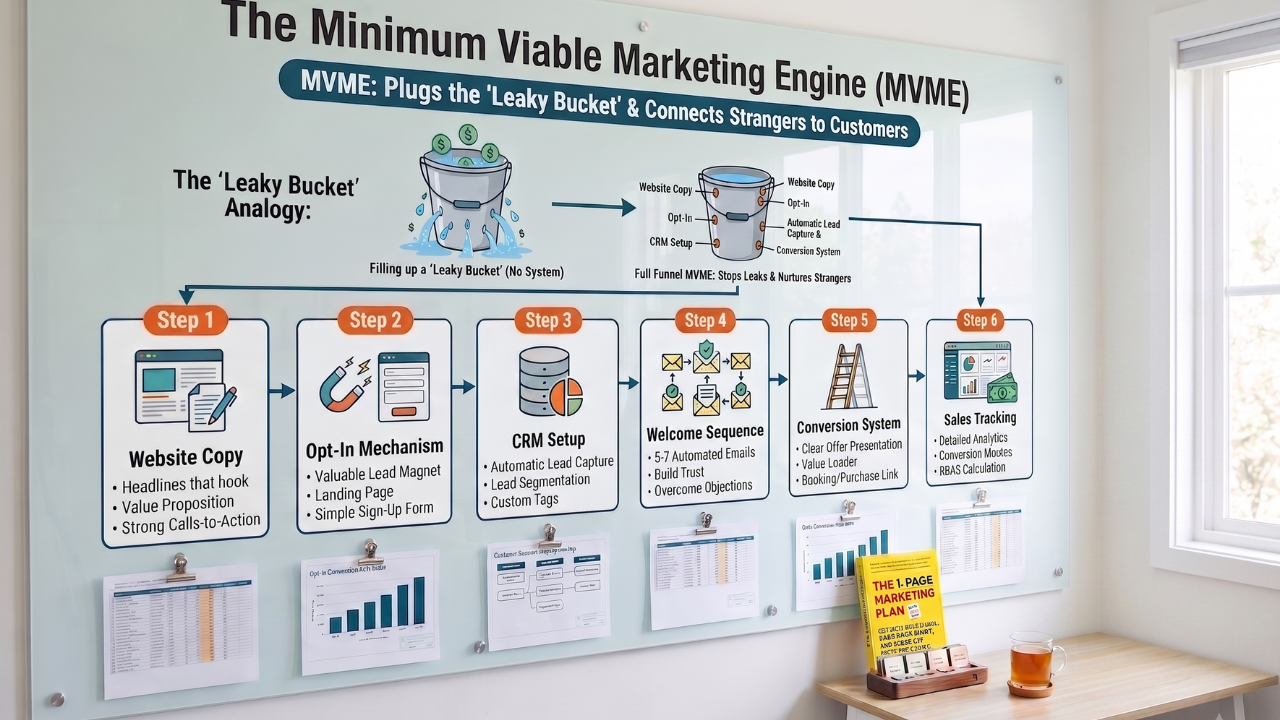
Lean Marketing delivers a structured approach to building your in-house marketing department with done-with-you support. The Minimum Viable Marketing Engine installs six core pieces in a specific order: website copy, opt-in mechanism, CRM, welcome sequence, conversion system, and sales tracking.
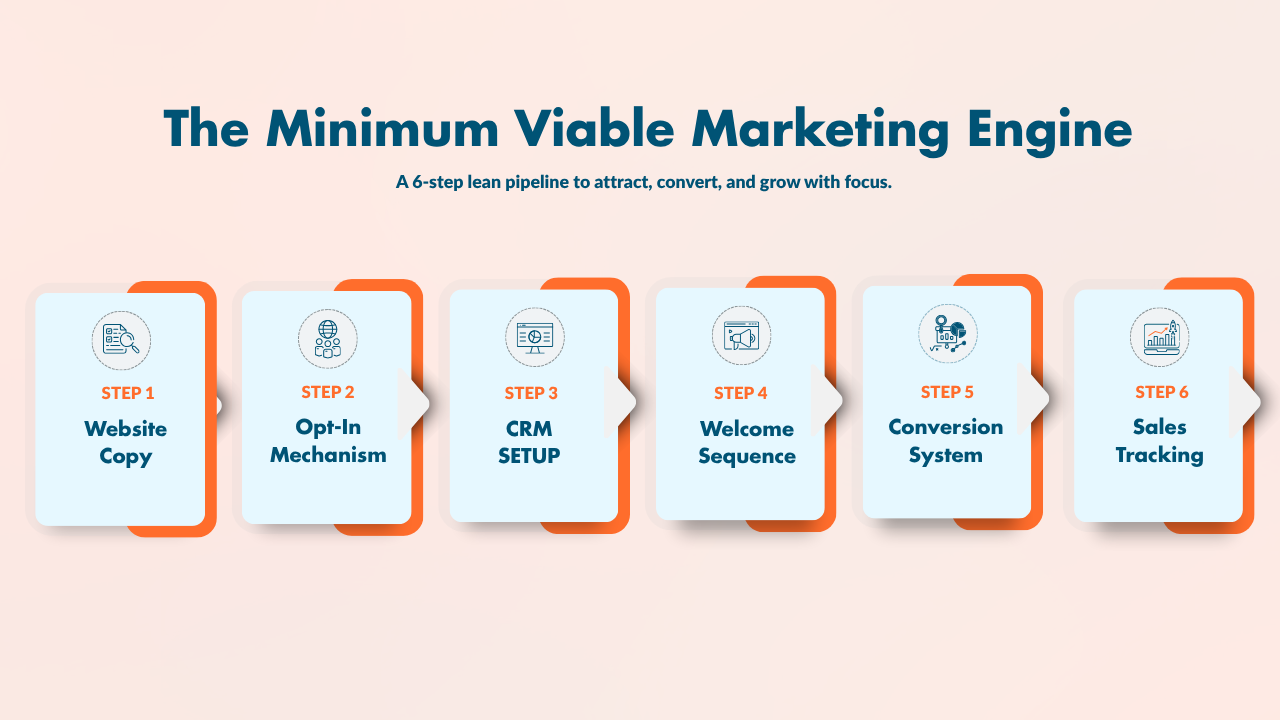
Built on the 1-Page Marketing Plan methodology trusted by over one million businesses, Lean Marketing focuses on message and offer first before moving to traffic. This sequencing prevents the most common founder mistake: paying for leads that go nowhere because the conversion system wasn't ready.
The coaching model means you build everything inside your own tools. When the engagement ends, you keep the system, the data, and the ability to run it yourself.
Lean Marketing benefits
- Full ownership: Everything lives in your CRM, your website, and your data, not a vendor's dashboard
- Sequenced installation: You know exactly what to build and in what order, so guessing is removed from the process
- Coach-guided implementation: A certified expert walks you through each phase while your team builds the system
- Proven methodology: The 1-Page Marketing Plan has helped over a million businesses get clear on their marketing strategy
- Scalable structure: The system grows with your business without requiring a complete rebuild
Pros:
- You own everything when the engagement ends—CRM data, email sequences, and documented processes
- The sequenced approach prevents wasted ad spend on a leaky funnel
- Coaches have run their own businesses and understand founder constraints
Cons:
- Requires active participation from you or a team member during installation
- The hands-on model demands weekly time commitment to strategy calls
- Initial setup takes longer than handing everything to an agency
2. Understand the difference between AI tools and AI systems
Most founders start their AI marketing journey by buying individual tools. A content generator, a social scheduler, an email automation platform. Six months later, they have multiple subscriptions and fragmented workflows that don't connect.
An AI-powered marketing system differs from standalone tools because it includes the sequence and integration strategy that makes each tool produce results. The system tells you which tool to use when, how to connect the data between platforms, and what numbers indicate success. Without that sequence, you're running random acts of marketing faster.
AI tools vs AI systems
- Methodology included: A system comes with a clear approach for deciding what to build and why
- Connected data: Information flows between your CRM, email platform, and analytics without manual exports
- Guided implementation: You get direction on what to set up first based on your specific business stage
Pros:
- Systems create repeatable processes that continue working when the founder steps back
- Integrated tools share data automatically, reducing manual work
- A framework prevents random acts of marketing that drain budget without results
Cons:
- Systems require more upfront planning than buying individual tools
- Integration between platforms may require initial configuration time
- Some founders prefer flexibility over structured approaches
3. Done-with-you support creates lasting capability
The done-with-you model sits between pure self-service and full agency delegation. You get expert guidance on what to build and in what order, while your team handles the actual installation inside your own tools.
This matters for founders because it builds internal capability. When the coaching engagement ends, you understand how every piece of your marketing system works. You can troubleshoot issues, train new team members, and adapt the system as your business changes.
Done-with-you benefits
- Knowledge transfer: You learn why each piece exists, not just how to operate it
- Internal ownership: Your team gains skills that stay with the company
- Adaptive capacity: You can modify the system without waiting on external support
Pros:
- Combines expert guidance with internal skill development
- Prevents the hostage situation where marketing stops when the agency contract ends
- Creates documentation and processes that new hires can follow
Cons:
- Requires more founder involvement than a fully managed service
- Progress depends on your team's implementation speed
- Initial results may take longer than agency-executed campaigns
4. Sequence matters more than speed
Most founders want to start with lead generation. Traffic, leads, sales conversations happening immediately. That instinct makes sense. New business feels like progress.
The problem is that running traffic to a broken funnel creates expensive data about how broken your funnel is. The right sequence starts with message and offer, moves to conversion and nurture, then adds traffic last. Fix the bucket before you fill it.
Why sequence determines success:
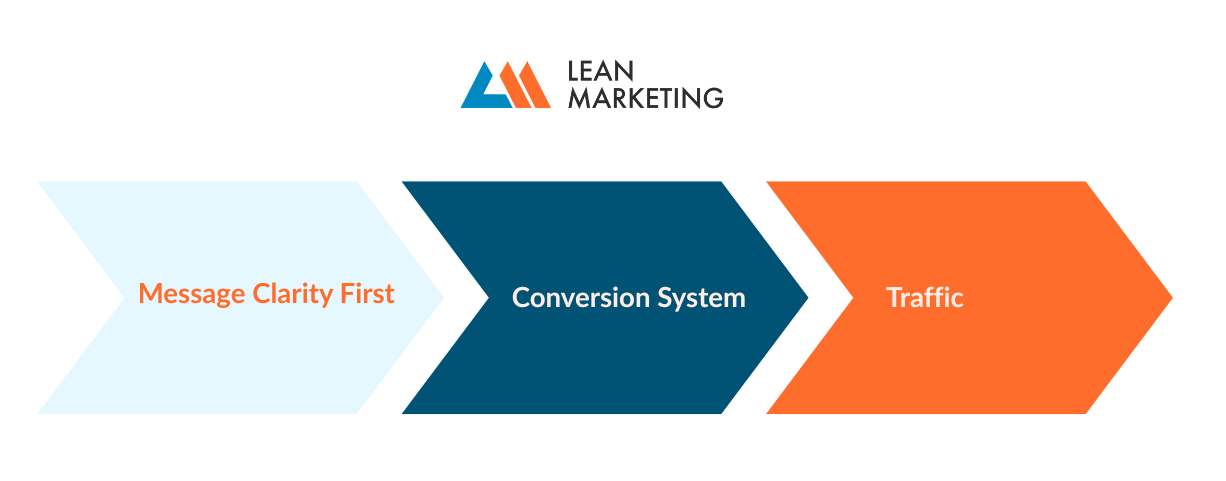
- Message clarity first: You know what makes you different before spending money to reach people
- Conversion systems second: You capture and nurture leads before scaling how many you attract
- Traffic last: Every dollar spent on ads goes into a system built to convert
Pros:
- Prevents wasted ad spend on landing pages that don't convert
- Builds a foundation that makes every future marketing investment more effective
- Creates clarity about your target market before you start reaching them
Cons:
- Requires patience during the foundational phases
- You may not see new leads during the first weeks of implementation
- Founders who want instant results may feel frustrated by the process
5. Ownership protects your business long-term
Many marketing vendors build campaigns inside their own platforms using their own accounts. When the relationship ends, you lose access to your email lists, automation sequences, and performance data.
A done-with-you marketing system installs everything inside your tools. Your CRM, your email platform, your analytics dashboard. The vendor guides the installation, but you hold the keys.
Ownership model benefits
- Data continuity: Your customer information and campaign history stay with you regardless of vendor changes
- Vendor flexibility: You can change coaches or consultants without rebuilding your marketing infrastructure
- Business value: Documented marketing systems add to the value of your company when it comes time to sell or bring on investment
Pros:
- Marketing continues running even if you change service providers
- Your customer data stays under your control for privacy and compliance
- Documented systems become a transferable business asset
Cons:
- You need to maintain your own tool subscriptions
- Technical issues become your responsibility to resolve
- Staff changes may require retraining on your specific setup
6. Integration determines whether AI tools actually produce results
An AI content tool that doesn't connect to your publishing workflow creates extra manual steps. A lead scoring tool that doesn't talk to your CRM requires double data entry. Each disconnected tool adds friction that makes consistent execution less likely.
When evaluating AI-powered marketing systems, ask how data flows between components. The best systems connect your content creation, distribution, lead capture, and follow-up sequences into a single workflow.
Integration benefits
- Less manual work: Data moves between tools automatically, freeing time for things that require judgment
- Consistent execution: Automated handoffs prevent tasks from falling through the gaps
- Accurate reporting: Connected systems create a single source of truth for your marketing numbers
Pros:
- Automation handles repetitive tasks without ongoing attention
- Connected data makes it easier to identify what's working
- New team members can follow established workflows without reinventing processes
Cons:
- Initial integration setup requires technical configuration
- Platform changes may break existing connections
- More connected systems create more potential points where issues can occur
7. A proven path removes trial and error from marketing
Founders who build marketing through experimentation typically spend years working out what produces results. They test tactics, abandon approaches that don't work, and gradually piece together a functional system through expensive trial and error.
A proven marketing path compresses that timeline. Instead of discovering the right sequence yourself, you follow something that has already worked for thousands of similar businesses. The mistakes have already been made. You don't have to repeat them.
Benefits of a proven path
- Compressed learning curve: You skip the mistakes that others have already made and documented
- Clearer priorities: The sequence tells you what matters now versus what can wait
- Predictable outcomes: Following a proven path produces more consistent results than scattered experimentation
Framework pros and cons
Pros:
- Reduces the cost of learning through failure
- Creates a shared language for discussing marketing with your team
- Makes it easier to diagnose what's not working when results disappoint
Cons:
- Frameworks require adaptation to your specific industry and situation
- Some founders prefer creating their own approach from scratch
- Following a framework still requires execution discipline
Comparison:
What should founders look for when evaluating AI marketing automation?
Start with your biggest constraint, not the longest feature list. Most founders who buy AI tools without a clear installation plan end up with expensive subscriptions they rarely use.
Work out the single bottleneck costing your business the most right now. Is it inconsistent follow-up? Unclear messaging? No system for capturing leads who aren't ready to buy immediately? Choose AI marketing automation that addresses that gap first.
Then check whether the platform connects to your existing tools. An AI email writer that doesn't integrate with your email platform creates extra steps that reduce how likely you are to use it consistently.
How do you know when you're ready for a marketing system?
Most founders wait too long because they think they need a larger team or more revenue first. In practice, a few signals tell you you're ready now rather than later.
If you're managing multiple marketing channels without clear processes, you're ready. If leads come in but follow-up happens inconsistently, you're ready. If you've tried agencies and ended up paying for work you didn't own, you're ready.
A simple diagnostic: if you stepped away from marketing for two weeks, would anything ship? If the answer is no, you need a system that runs without depending entirely on you.
Who is this for?
The Lean Marketing approach works for founders who:
- Run a business with real revenue, usually in the six or seven figure range
- Have at least a small team, or are ready to bring someone on
- Have been burned by an agency and don't want to start from scratch again
- Want to own their marketing capability long-term, not rent it from a vendor who takes it back when the contract ends
- Know what to build but can't get the system installed and running
- Are ready to move from being the person who does the marketing to the person who runs the business
Who is this not for?
- Founders who want hands-off marketing. Done-with-you means your team builds the system with guidance. If you want someone to run your marketing indefinitely, an agency is the right model.
- Businesses still working out whether people want what they sell. This installs a system around an offer that already works. It doesn't create demand for one that doesn't.
- Founders not willing to use a CRM. The Lean Business System runs on a CRM as its hub. Without one, the rest won't hold together.
- Founders who need it working by next month. Quick wins happen in the first weeks. The full system takes four months.
- Anyone who needs cash this week. This starts with message, offer, and conversion, then traffic. Emergency lead volume is a different problem with a different solution.
Why does Lean Marketing deliver the most complete AI-powered marketing system for founders?
Lean Marketing addresses the full challenge founders face, not just one piece. You get the methodology (the 1-Page Marketing Plan), the sequence (message first, conversion second, traffic last), and the guidance (a coach who has run their own business).
The done-with-you model means you understand every component of your marketing system when the engagement ends. You're not dependent on a vendor to keep things running. Your team can operate it, troubleshoot it, and build on it independently.
Lean Marketing also integrates AI tools within a proven installation sequence rather than expecting you to work out how the pieces fit together. The AI and CRM tools inside the Accelerator help you create content and automate follow-up that sounds like your brand, not generic output.
For founder-led businesses that want to build real marketing capability rather than rent temporary campaigns, Lean Marketing offers the most direct path to a system you actually own.
Frequently Asked Questions
What is a done-with-you AI marketing system?
A done-with-you AI marketing system pairs proven AI tools with a coach who guides you through installation. The system is built inside your own CRM, website, and email platform, so you keep everything when the engagement ends. You get expert direction without losing ownership of your marketing infrastructure.
How long does it take to install an AI-powered marketing system?
Most core pieces can be running within weeks when you follow the right sequence. The bottleneck is rarely time. Lean Marketing focuses on message and offer first, then conversion and nurture, then traffic. Businesses that follow this order often see results faster than those who try to build everything at once.
Should founders buy AI marketing tools before having a system?
In most cases, no. AI tools amplify whatever you point them at. Without a clear sequence, they amplify the wrong activities faster. Get your conversion and follow-up working first, then add AI tools to accelerate execution once you know what to execute.
What makes Lean Marketing different from hiring a marketing agency?
When you hire an agency, they build campaigns in their tools using their accounts. When the contract ends, marketing often stops. Lean Marketing installs the system in your tools with your team, so the capability stays with your business. You're building an asset, not renting a service.
How much should founders budget for AI marketing system implementation?
Budget varies by business stage. For the Lean Marketing Accelerator, plan for the program investment, a team member dedicated to marketing implementation, and ongoing marketing expenses. The Accelerator is $12,000 for the four-month build, or four payments of $3,500. The investment pays back faster than most agency retainers because you own the system when it's complete.
Can AI marketing systems work for service businesses?
Lean Marketing works particularly well for founder-led service businesses at six or seven figures in revenue. The methodology applies to professional services, trades, and e-commerce. The installation sequence adapts to your specific business while maintaining the proven order that prevents wasted marketing spend.
How do AI marketing systems connect to a CRM?
The CRM is the hub. Lead capture, follow-up sequences, conversion tracking, and reporting all run through it. An AI-powered marketing system either integrates with your existing CRM or installs one as part of the build. Without CRM integration, the tools stay disconnected and the data stays fragmented.
What happens to the marketing system after the engagement ends?
With done-with-you support, the system stays with you. It lives in your tools, your accounts, and your data. Your team knows how to run it because they built it alongside the coach. You can keep building on it, hand it to a new hire, or bring in a specialist to add to it. The capability belongs to your business, not the vendor.
Ready to build a marketing system you own?
If you're managing multiple marketing channels without clear processes, or you've paid agencies for work that stopped when the contract did, there's a cleaner path. One where you own every piece, you can see what's working, and your team runs the machine.
Step 1: Book a call and complete the short MRO diagnostic.
Step 2: We'll review your numbers and show you where growth is likely leaking.
Step 3: If it's a fit, we'll map your first 30 days and start building your Lean Business System.
Guessing is expensive. Systems are cheaper.
AI Marketing Tools vs AI Marketing Systems: Why the Difference Matters More Than the Technology
AI will do whatever you point it at. The question is whether you're pointing it at the right thing.
AI will follow wherever you point it. The question is whether you're pointing it in the right direction.
Small business owners now have access to AI marketing tools that would have required a full department a few years ago. ChatGPT writes email sequences in minutes. AI tools draft ad copy, score leads, summarize customer feedback, and handle first-line support around the clock.
So why are most small businesses still stuck in the same place they were before AI got good?
Because a tool isn't a system. And AI without a system doesn't solve the marketing problem. It just executes it faster.
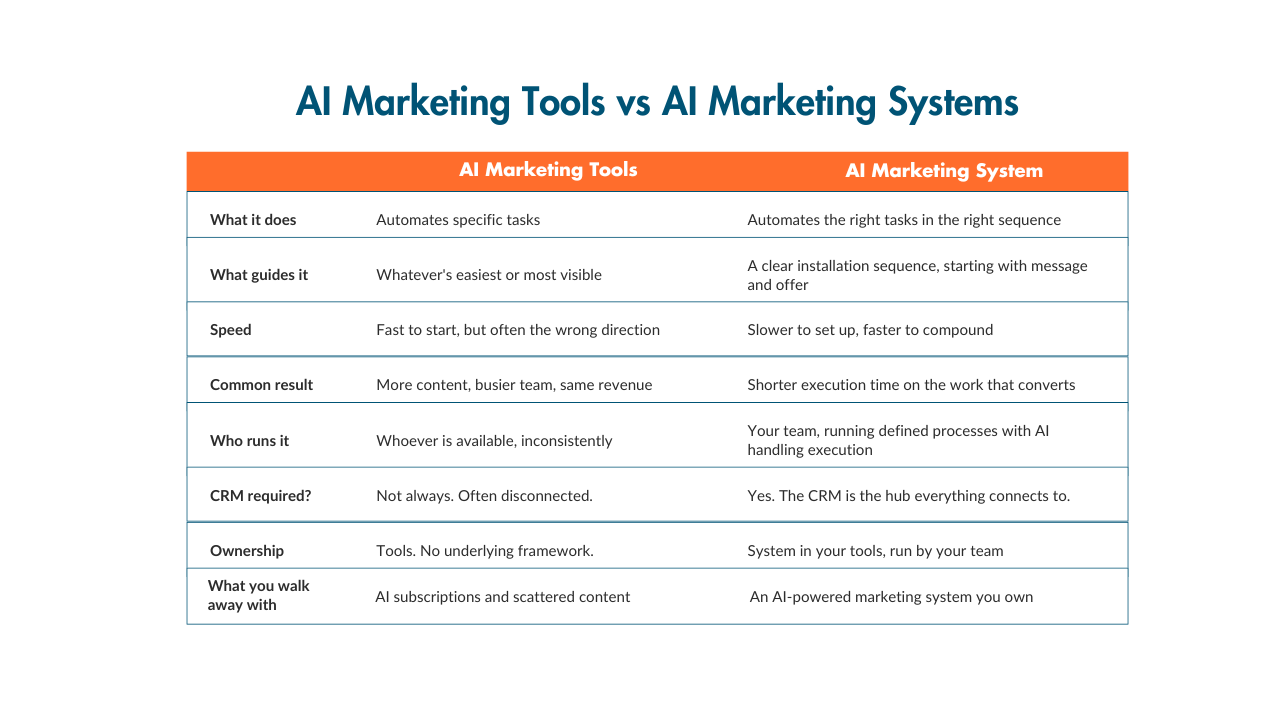
Quick Answer: AI marketing tools are software, ChatGPT, automation platforms, AI customer service agents, that handle specific marketing tasks: writing, sending, sorting, responding.
An AI marketing system is the strategy and sequence that tells those tools what to do, in what order, and why. Tools without a system automate whatever's easiest. A system ensures the AI is pointed at the actual bottleneck, usually starting with message and offer, then conversion and nurture, then traffic last. For most small businesses, adding AI tools without a system first produces faster random acts of marketing, not better results.
What Are AI Marketing Tools?
AI marketing tools are software products that use artificial intelligence to handle marketing tasks that previously required human time and skill. They fall into a few broad categories:
- Content creation tools: Write blog posts, social captions, email sequences, and ad copy
- Automation platforms: Trigger emails, segment contacts, and personalize campaigns based on behavior
- AI customer service and support tools: Handle first-line customer inquiries, route tickets, and respond to common questions
- Lead scoring and qualification tools: Use AI to identify which leads are most likely to convert, based on behavior signals
- Analytics and reporting tools: Summarize campaign performance, surface patterns, and flag anomalies
Each of these tools is genuinely capable. The problem is that none of these tools know anything about your business strategy. They'll automate whatever you point them at, including the wrong thing.
What Is an AI Marketing System?
An AI marketing system is the combination of AI tools with a proven sequence that tells those tools what to do, in what order, and why.
The sequence is the key word. A system doesn't start by asking "which AI tool should I use?" It starts by asking "what's the actual problem, and where in the customer journey is it leaking?" Then it maps the right AI tool to the right piece, in the right order.
For most small businesses, that sequence looks like this:
- Get the message and offer right first. AI can help draft and test messaging, but only after you've decided who you're targeting and what you're saying.
- Fix conversion and nurture. AI-assisted follow-up sequences and automated welcome campaigns compound over time, but only if the message behind them is right.
- Add lead capture. Once conversion is working, AI can automate the opt-in and intake process.
- Add traffic last. Once the system converts, AI-powered content and campaigns fill it with qualified prospects.
This is the Minimum Viable Marketing Engine (MVME) with AI plugged into each piece, in the right order.
The Problem With AI Tools Without a System
Here's what actually happens in most small businesses when they adopt AI marketing tools without a system in place:
They automate the easy thing first. Usually content. Social posts, blog drafts, email subject lines. These are visible, satisfying, and easy to hand to AI. They're also rarely the bottleneck. The conversion rate doesn't move because the bottleneck was never content volume. It was a weak message, a broken follow-up sequence, or leads falling out of a CRM nobody was maintaining.
They end up with faster noise. AI makes it possible to produce 10x as much content in the same amount of time. But 10x the content without any strategy doesn’t move the needle. Random acts of marketing, executed faster.
They can't tell what's working. Without sales tracking and a connected CRM, AI outputs become data that lives nowhere useful. Leads come in through five channels and land in five different places. The AI is running. The system isn't.
In short, the technology isn't the problem. The sequence is.
How an AI Marketing System Changes This
An AI marketing system starts with the question a tool can't answer: what's actually costing you money right now?
For most six-or seven-figure businesses, the answer is one of a small number of things:
- The message sounds like every other business in the category, so price becomes the deciding factor
- Leads are coming in, but the follow-up is slow or nonexistent, so warm prospects go cold
- No CRM means leads fall through the cracks and nobody can see the pipeline
- Traffic is running, but the funnel doesn't convert, so more traffic just costs more money
An AI marketing system finds the leak first, then builds the fix, then applies AI to run that fix faster and more consistently. The AI doesn't set the sequence. The system does. AI is the engine. The system is the road map.
How Lean Marketing Connects AI to the MVME
Lean Marketing's approach maps specific AI tools to each piece of the Minimum Viable Marketing Engine:
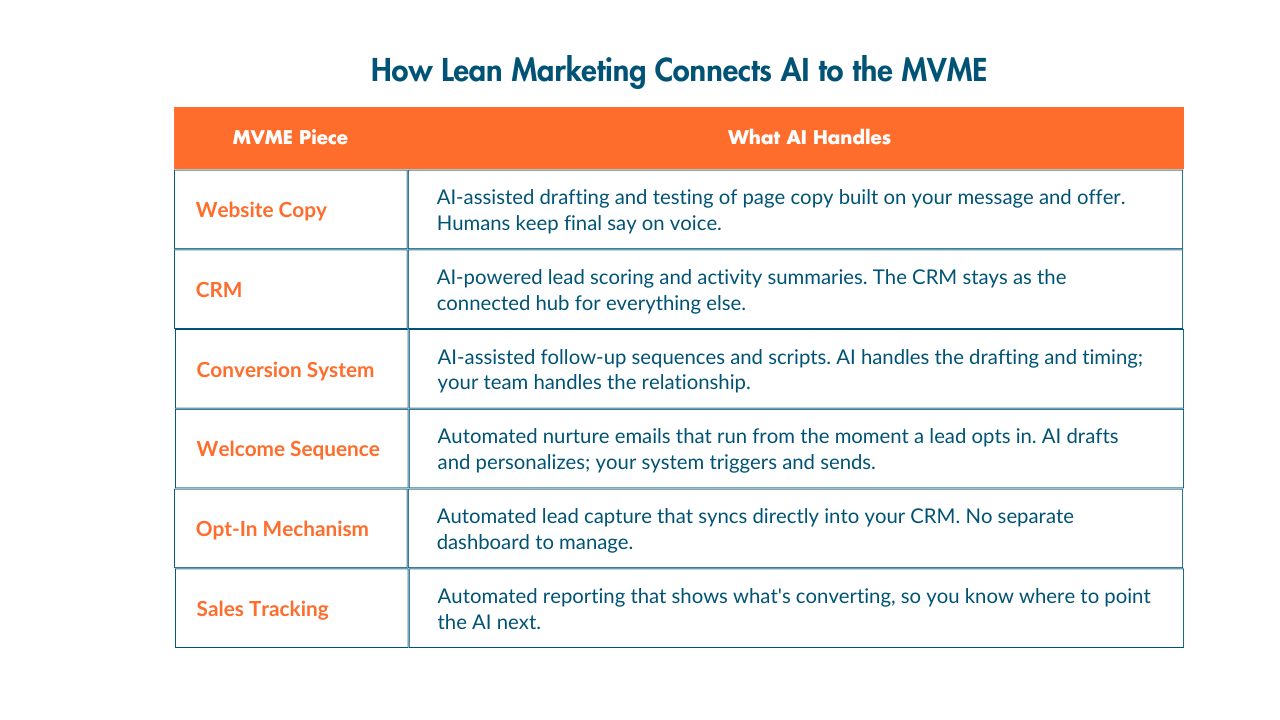
This is backed by a library of custom AI GPTs and 300+ channel-specific SOPs, which cut execution time on these tasks by roughly 70%. The AI handles the execution grind. The system handles the sequence. Your team stays in control of the decisions that matter.
Who Is an AI Marketing System For?
- Small business owners who've tried AI marketing tools and ended up with more content but the same revenue
- Founders who want their team, not an agency, to run AI-powered marketing day to day
- Businesses with an existing marketing system (or building one) that want AI to cut execution time without turning marketing into a black box
- Founders trying to move from operator to owner, where marketing runs on a system the team operates, not on the founder's personal attention
Who Is an AI Marketing System NOT For?
- Businesses that don't have a marketing system yet and aren't building one. AI amplifies whatever you point it at. Without a system, it amplifies chaos. Build the foundation first.
- Founders who want AI to replace the marketing team entirely. AI handles execution: drafting, sending, sorting, responding. Someone still needs to decide what the system should do and review what the AI produces.
- Businesses not using a CRM. An AI marketing system runs on a CRM as its hub. Without one, AI outputs have nowhere to connect and nothing to compound on.
- Founders looking for a fully hands-off solution. A connected AI marketing system is done-with-you. Your team runs it. If you want someone else to manage it indefinitely, that's a done-for-you AI agency, with the usual ownership tradeoffs.
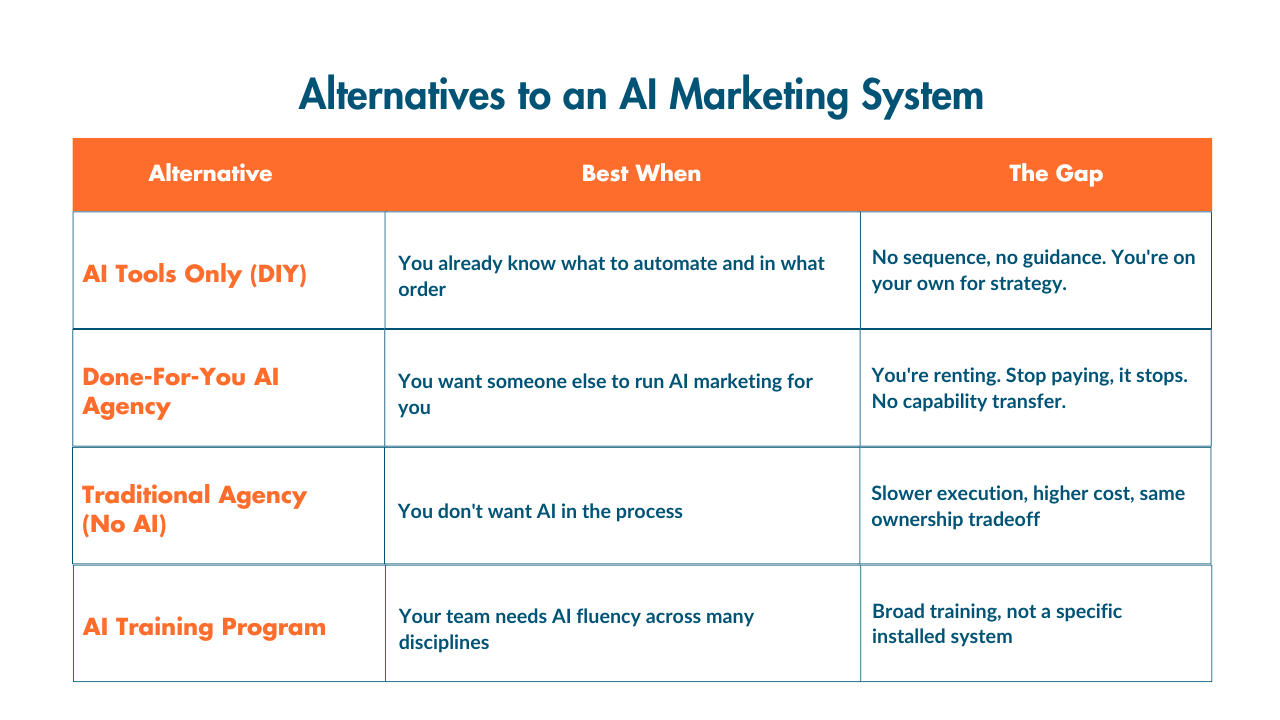
Frequently Asked Questions
What is the difference between AI marketing tools and an AI marketing system?
AI marketing tools are software that automate specific tasks: writing copy, sending emails, scoring leads, and handling customer inquiries. An AI marketing system is the sequence that tells those tools what to do, in what order, mapped to a proven marketing framework. Tools without a system automate whatever's easiest. A system ensures the AI is pointed at the actual bottleneck.
Can AI replace a marketing strategy?
No. AI can execute a strategy faster. It can't create one. An AI marketing tool given a blank prompt will produce generic output that sounds like every other business in your category. A marketing system, starting with a clear message and offer, gives AI the strategic direction it needs to produce output that's specific, differentiated, and actually converts.
What happens when you use AI marketing tools without a system?
You get faster random acts of marketing. AI produces more content, more emails, more campaigns, but pointed in the same directions as before. The bottleneck wasn't content volume. It was a weak message, a broken follow-up, or a funnel that doesn't convert. More AI output into a broken funnel just makes the leak more expensive.
What's the right order to add AI to a marketing system?
Start with the piece of your system that already has the most volume, usually follow-up sequences or welcome campaigns, and automate that first. The installation order should follow the system: message and offer first, then conversion and nurture, then lead capture, then traffic. AI tools work best when they're automating a process that already works, not when they're creating one from scratch.
Do I need a CRM to use AI marketing tools effectively?
Yes, if you want the tools to compound. Without a CRM, AI outputs (lead data, email responses, scoring signals) land in disconnected places and produce no cumulative value. The CRM is the hub that connects AI outputs to actual business data, so every automated action builds on a shared picture of the customer journey.
How much does an AI marketing system cost compared to hiring a marketing agency?
A done-with-you AI marketing system is typically structured as a defined investment for the build phase, often less than six months of a typical agency retainer. The system continues running afterward at no additional cost. A done-for-you AI agency runs on an indefinite retainer, usually $5,000–$15,000+ per month, and you don't own the system when the relationship ends.
What AI tools work best for small business marketing?
The best AI marketing tools for a small business are the ones mapped to your specific marketing bottleneck, not the most popular ones. For most small businesses, the highest-impact applications of AI are in follow-up sequences (converting warm leads faster), welcome campaigns (building trust with new leads automatically), and sales tracking (surfacing what's actually converting so you stop guessing). Start there, then layer in content and traffic automation once conversion is working.
Can I add AI to my existing marketing system without starting over?
Yes, and that's typically the best approach. A connected AI marketing system slots into your existing CRM, website, and email platform. You automate the pieces already in place, starting with the one handling the most volume. The goal isn't to rebuild from scratch. It's to take what's working and make it run faster, with less manual effort from your team.
Is done-with-you AI marketing better than a done-for-you AI agency?
For most founder-led businesses, yes. A done-for-you AI agency runs your marketing automation inside their accounts and tools. When you stop paying, the automation usually stops too. Done-with-you AI marketing installs the same tools inside your own systems, with a coach's guidance, so your team owns and runs it going forward. The capability stays with you even if the coaching relationship ends.
Ready to Point Your AI at the Right Problem?
The tools are ready. The question is whether you have a system to point them at. We map AI to every piece of your Minimum Viable Marketing Engine, in the right order, so the automation compounds on a foundation that actually converts.
Lean Marketing Accelerator vs Hiring a Marketing Agency: What's the Better Investment for a 6-Figure Business?
If your revenue has been stuck in the same range for the past two years, you've probably had this conversation with yourself: do I hire an agency to fix this, or do I find a coach who can help me build it myself?
One builds something you own. The other runs something you rent.
If your revenue has been stuck in the same range for the past two years, you've probably had this conversation with yourself: do I hire an agency to fix this, or do I find a coach who can help me build it myself?
Both feel like reasonable options. Both cost real money. And they produce completely different outcomes over a 12-month horizon.
Here's a clear-eyed look at both.
Quick Answer:
A marketing agency runs your marketing for you, in their tools, on their terms. The Lean Marketing Accelerator guides you through building your own marketing system, in your tools, starting with message and offer.
The difference comes down to ownership: with an agency, you're renting a service. With the Accelerator, you're building an asset. Most founder-led businesses in the six or seven figure range find that the Accelerator produces better long-term ROI, because the system keeps running after the engagement ends and the team learns to own it.
How a Marketing Agency Works
When you hire a marketing agency, you're paying for execution. Their team handles strategy, creative, copy, campaigns, and reporting. You get results, at least in theory, without having to manage the process yourself.
Most agencies charge between $5,000 and $15,000 per month on a retainer. At the lower end, you're getting one or two specialists handling a limited scope. At the higher end, you might have a team across creative, media buying, and account management.
The appeal is clear: you're busy running your business. Someone else handles the marketing. You review reports and approve campaigns.
But the model has a structural problem most agencies don't volunteer upfront: the system they build lives in their accounts and tools. If the relationship ends, you walk away with reports and maybe some creative files. The working infrastructure, the ad accounts, the automations, the CRM integrations, stays with them. You start over.
How the Lean Marketing Accelerator Works
The Lean Marketing Accelerator is a four-month intensive program where a dedicated Coach guides you through building your Minimum Viable Marketing Engine (MVME): the six pieces every growing business needs, installed in your own CRM and tools, in a specific order.
The order matters.
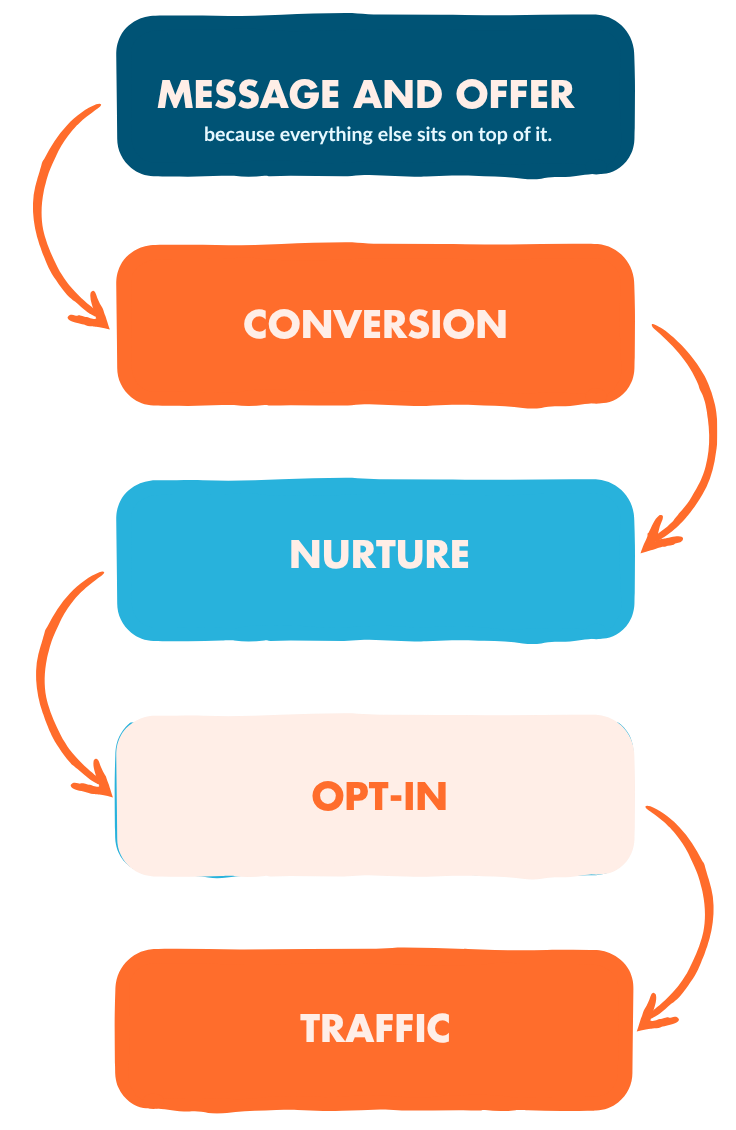

You and your team do the building, with the Coach reviewing pages and sequences, setting clear Action Items between sessions, and running Strategic Alignment Calls to keep everything pointed at one goal: a business that trades the hard work and guesswork of random acts of marketing for systems and frameworks, so revenue stops being a guessing game, you stay out of the weeds with your hands on the controls, and growth stops depending on you personally dragging every lead, sale, and follow-up across the line.
When the engagement ends, you own every piece. The system keeps running because it lives in your tools, not the Coach's accounts.
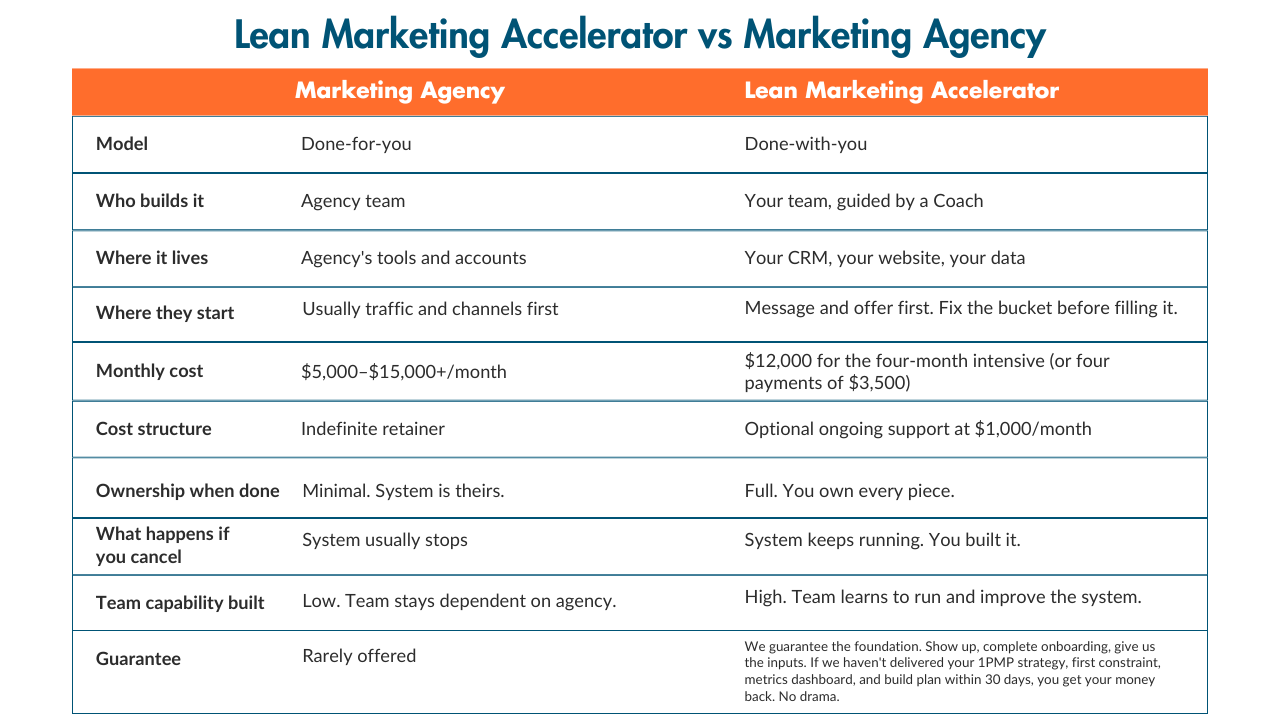
The Real Cost Comparison
This is where the math often surprises founders.
A typical agency retainer at $7,000/month costs $84,000 in year one. Year two is another $84,000. At the end of two years, you've spent $168,000 and you own none of the marketing infrastructure. If the agency relationship ends, you start over.
The Lean Marketing Accelerator is a four-month intensive at $12,000 paid in full (or four monthly payments of $3,500). At the end of four months, you have a working marketing system in your own tools. You keep it. Your team runs it. An optional $1,000/month ongoing engagement keeps the coaching relationship active after the initial build. Across 12 months, the Accelerator typically costs less than two months of a mid-range agency retainer, and you leave owning the asset.
The agency model costs less in month one and significantly more by month three or four, with nothing to show for it at the end. Guessing is expensive. Systems are cheaper.
The Ownership Problem Most Agencies Don't Mention
Most founders don't think about the ownership question until the agency relationship ends. Then they ask a few basic questions about their own marketing and realize they can't answer them:
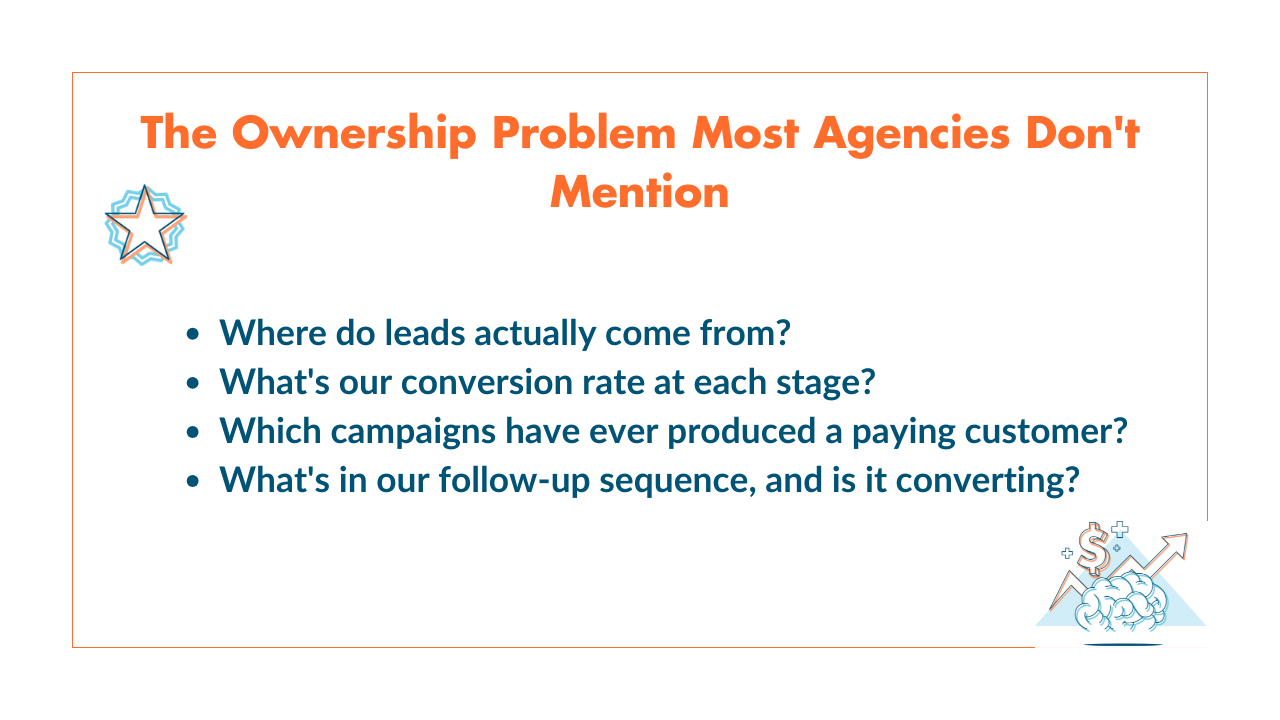
The data is in the agency's accounts. The automations are running in tools they manage. If you've been with an agency for two years and can't answer these questions without calling your account manager, you don't have a marketing system. You have a subscription.
The Accelerator is designed so this never happens. Every piece of the MVME gets built in your tools from day one. Your team knows how to access, update, and improve it. When the engagement ends, the knowledge and the infrastructure stay with you.
The Sequencing Problem Most Agencies Skip
Most agencies start where the money is: traffic. Ads, content, SEO, social. These things are visible, measurable, and easy to report on.
But most six or seven-figure businesses don't have a traffic problem. They have a leaky bucket. Leads are coming in, but a weak message or broken follow-up means most of them don't convert. More traffic just makes the leak more expensive.
The Accelerator starts with message and offer because everything else, including traffic, has to sit on top of something that converts. Fix the bucket before you fill it.
Who Is the Lean Marketing Accelerator For?
The Accelerator is built for founder-led businesses with real revenue and real customers, usually six or seven figures, who want to scale and step out of the day-to-day of marketing. It works best for founders who:
- Have at least a small team, or are ready to hire one. Someone has to take the controls. Founders with nobody to hand things to get far less from this, because there's no one to hand the system to.
- Have been burned by an agency before and don't want to rebuild from scratch again.
- Want to own their marketing capability long-term, not rent it from a vendor who takes it back when the contract ends.
- Are stuck on execution, not strategy. You know what to do. You just can't get the system built and running.
- Are ready to move from operator to owner, where the business runs on a system the team operates, not on the founder's personal attention and hustle.
Who Is the Lean Marketing Accelerator NOT For?
- Founders who want hands-off marketing. The Accelerator is done-with-you. Your team builds the system with guidance. If you want someone else to run your marketing indefinitely, an agency is the right model.
- Anyone who wants to disappear for four months and then wonder why nothing changed. The system gets built around your specific business. Your inputs are required, especially at the start.
- Businesses without product-market fit. The Accelerator installs a system around an offer that already works. It doesn't manufacture demand for one that doesn't.
- Founders not willing to use a CRM. The Lean Business System runs on a CRM as its hub. Without one, the rest won't hold together.
- Anyone who needs cash this week. The Accelerator starts with message, offer, and conversion, then traffic. Emergency lead volume is a different problem with a different solution.
When Does Hiring a Marketing Agency Make Sense?
A traditional marketing agency is the right choice if:
- You already have a marketing system installed in your own tools, and you're bringing in specialists for specific channel execution: media buying, PR, content production.
- You need one-off campaign execution with no intention of building ongoing internal capability.
- Budget is available for an indefinite retainer and you don't need to own the infrastructure.
- Speed is the overriding priority and you're comfortable with the ownership tradeoff.
The agency model works best when you already have the foundation and you're bringing in help to run one part of it. It works worst when you're using the agency as a substitute for having a foundation at all.
Alternatives to Both
Fractional CMO: A part-time marketing executive who sets strategy and directs your team or vendors. Strong on strategy, light on hands-on execution. The gap: you still need someone to build the system. A fractional CMO tells you what to build but doesn't usually build it alongside you.
Internal Marketing Hire: A full-time marketer who owns the system day-to-day. Works well if you can find the right person and give them a clear framework. Without the framework, you end up with random acts of marketing on payroll at $60,000–$90,000 a year.
DIY: Read the books, buy the tools, build it yourself. Cheapest in dollars, most expensive in time. The risk is building the wrong things in the wrong order, which costs more in missed revenue than any program.
Frequently Asked Questions
What is the Lean Marketing Accelerator?
The Lean Marketing Accelerator is a four-month done-with-you program where a dedicated Coach guides founder-led businesses through installing the Minimum Viable Marketing Engine: six specific pieces built in your own tools, starting with message and offer, then conversion and nurture, then traffic. Based on Allan Dib's 1-Page Marketing Plan methodology, the Accelerator is designed to get businesses to scale by building a system they own and operate.
How much does the Lean Marketing Accelerator cost vs a marketing agency?
The Accelerator is $12,000 for the four-month intensive, or four monthly payments of $3,500. A typical marketing agency retainer runs $5,000–$15,000+ per month, indefinitely. A mid-range agency at $7,000 per month costs more than the full Accelerator investment by month three. And when the agency engagement ends, you don't own the system. When the Accelerator ends, you do.
Should I hire a marketing agency or join the Lean Marketing Accelerator?
It depends on what you need to own. If you want fast campaign execution and are comfortable renting the result, an agency can work. If you want to own your marketing capability long-term, build a system your team runs, and get your business to the point where growth doesn't depend on you personally, the Accelerator produces a different kind of result.
What is the guarantee on the Lean Marketing Accelerator?
We guarantee the foundation. If you complete onboarding, show up to your weekly calls, and give us the inputs we ask for, and we don't deliver your 1PMP strategy, your first constraint identified, your metrics dashboard, and your build plan within the first 30 days, you get your money back. No drama. No weird refund circus. You show up. We deliver. There's also a results-driven assurance: if you implement the recommendations, share your metrics, and don't hit your targets, we keep working with you at no charge until you do.
How is the Lean Marketing Accelerator different from a business coaching program?
Business coaching focuses on strategy, mindset, and accountability. The Accelerator focuses on building a specific system in your actual tools, with clear outputs at each stage. Your Coach reviews pages and sequences, sets concrete Action Items between sessions, and holds Strategic Alignment Calls to keep the build on track. The goal is a working Lean Business System, not better strategy documents.
How long does it take to see results from the Lean Marketing Accelerator?
You'll know where money is leaking and what to fix first within the first 30 days, before spending a dollar on new traffic. Most founders have never had this kind of visibility into their own business before. The full Lean Business System, covering message, CRM, conversion, nurture, lead capture, and tracking, can be live and running within the four-month intensive. From there, the system keeps compounding.
What is the difference between a marketing agency and a marketing accelerator?
A marketing agency does the work for you, in their tools. A marketing accelerator guides you to build the system yourself, in your tools, with a Coach providing the sequence, the templates, the feedback, and the accountability. The key difference: when an agency engagement ends, the system usually stops. When an accelerator engagement ends, the system you built keeps running.
What does "operator to owner" mean, and how does the Accelerator help?
An operator is a business owner where every lead, sale, and follow-up runs through them personally. The business is productive but fragile. An owner has built a business where the marketing runs on a system the team operates, not on the founder's personal hustle. The Accelerator produces that transition: a specific system, in your tools, that your team can run without the founder at the center of every marketing decision.
What's in the Lean Business System?
The plan: your 1-Page Marketing Plan and AI company brain, so your voice and standards stop living only in your head. The build: lead capture, follow-up, the conversion path, the CRM and tracking, wired together in your tools. The dashboard: one place to see where leads come from, where they drop off, what each fix is worth, and what to do next. The team: we train whoever runs it, or help you hire the right person, so the system keeps running after the build ends.
Ready to Build a Marketing System You Own?
If you've already been burned by an agency that delivered a logo and a confusing report, or a retainer that stopped the day the contract ended, there's a different path. One where you own every piece, you can see what's working, and your team runs the machine.
Step 1: Book a call and complete the short MRO diagnostic.
Step 2: We'll review your numbers and show you where growth is likely leaking.
Step 3: If it's a fit, we'll map your first 30 days and start building your Lean Business System.
Guessing is expensive. Systems are cheaper.
AI Marketing Support for Small Business Teams
AI tools alone don't fix your marketing. Here's how AI marketing support maps automation to a system, installed in your own CRM.
Quick Answer: AI marketing support for small business teams combines AI marketing automation tools with a coach's guidance on what to automate, in what order, and why, installed in your own CRM and systems. It's the difference between a pile of AI tools and a connected marketing system that runs on AI. Lean Marketing maps AI to each piece of the Minimum Viable Marketing Engine (MVME), starting with message and offer, cutting execution time while your team stays in control.
What Is AI Marketing Support?
You don't need another AI tool. You need a marketing system that already knows what to automate, plugs AI into it, and shows your team exactly how to run it. In your CRM, on your terms.
AI marketing support is the combination of AI marketing automation (tools that write, send, sort, and respond) with a coach's guidance on what to automate, in what order, and why. It's the difference between owning a power tool and knowing how to build the thing you actually need.
Most AI marketing tools on the market today are excellent at doing things. Almost none of them tell you which things are worth doing first. That gap is where most small businesses lose months: subscribing to AI marketing automation platforms, generating content and campaigns at scale, and still not moving the one number that matters. Revenue.
Lean Marketing's AI Marketing Support closes that gap. It's done-with-you: AI tools mapped directly to a proven marketing system, installed in your tools, run by your team.
What's the problem with AI tools alone?
AI doesn't have opinions about your business. Point it at your social content, and it'll happily generate fifty posts. Point it at your follow-up sequence (the thing that's actually costing you sales) and it'll do that just as well. AI can't tell the difference between busywork and the bottleneck. Only a system can.
Most small businesses end up with a stack of AI marketing tools and a marketing system that looks exactly the same as it did a year ago, just with more content in it. Random acts of marketing, faster.
How does Lean Marketing's AI Marketing Support work?
We start the same way we always do: by mapping your Minimum Viable Marketing Engine (MVME), the six pieces every business needs to convert strangers into customers and customers into repeat buyers, website copy, an opt-in mechanism, a CRM, a welcome sequence, a conversion system, and sales tracking, installed in that order. Traffic comes after, once the six pieces are in place. Then we show you exactly which AI tools handle which piece.
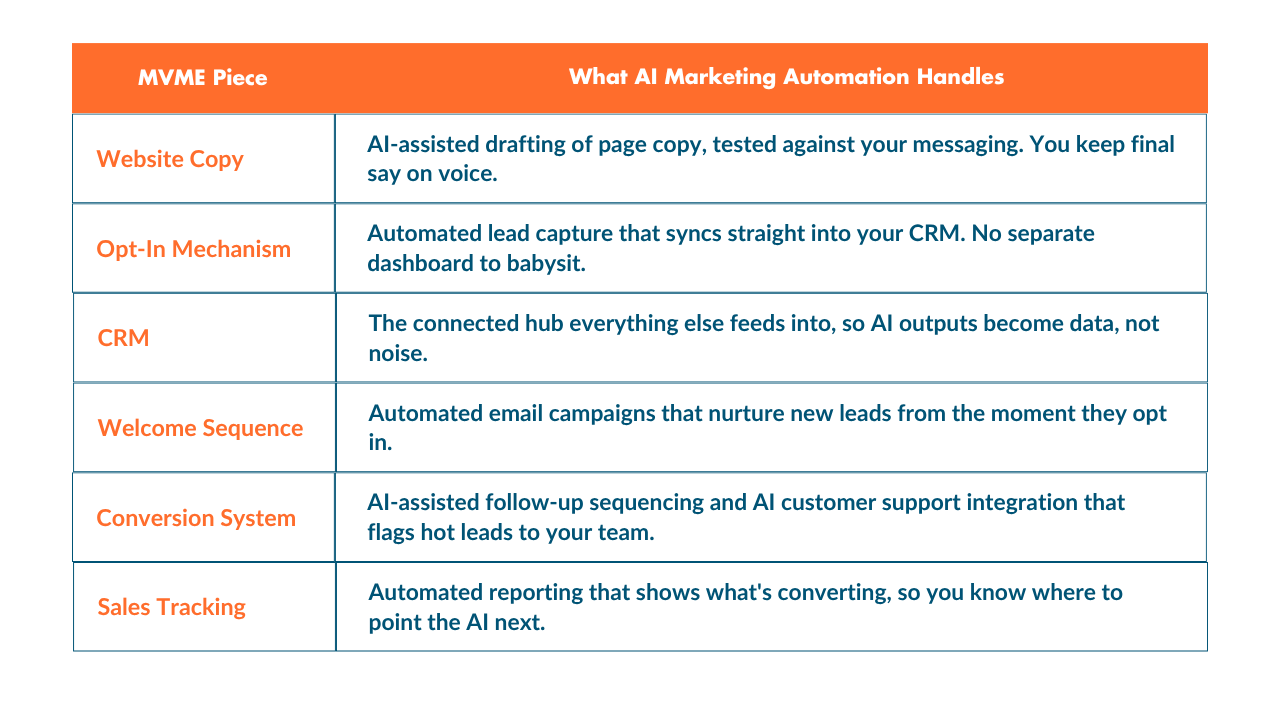
This is backed by the Lean Marketing's library of custom AI GPTs and 300+ channel-specific SOPs, which cut execution time on these tasks significantly. The AI is the engine that runs the strategy faster, in tools your team already understands.
Who is AI Marketing Support for?
AI Marketing Support is built for small and medium business owners and marketing managers who:
- Already know (or are building) their marketing system and want AI to handle the repetitive execution.
- Want their team, not an agency, not a vendor, to be the ones running the system day to day.
- Are tired of paying for AI marketing tools that sit half-used because nobody mapped them to a plan.
- Want to move from operator to owner, where marketing runs without everything passing through the founder.
Who Is AI Marketing Support NOT For?
This isn't the right fit if:
- You want fully hands-off marketing. If you want someone else to run your marketing indefinitely without your involvement, that's a done-for-you agency, and you'd be renting, not owning.
- You don't have a marketing system yet (and aren't building one). AI amplifies whatever it's pointed at. Without a system, it amplifies chaos. Build the foundation, starting with your message and offer, then add AI.
- You need leads by next week. AI marketing support starts with message, conversion, and nurture, not traffic. If you need emergency volume, that's a different timeline.
- You're not willing to use a CRM. The MVME runs on a CRM as its hub. Without one, AI outputs have nowhere to connect.
Frequently Asked Questions
What is AI marketing support for small businesses?
AI marketing support combines AI marketing automation tools (for tasks like automated email campaigns, lead capture, and AI customer support integration) with a coach's guidance on which of those tools to use first, based on a proven marketing system. It's the strategy layer that tells the AI what to do.
Does AI marketing automation replace the need for a marketing team?
No. AI marketing automation handles repetitive execution: drafting, sending, sorting, responding. But someone still needs to decide what the system should be doing and review what the AI produces. AI marketing support is designed to make a small team's existing efforts go further, not to remove the team.
How is done-with-you AI marketing different from a done-for-you AI agency?
A done-for-you AI agency runs your marketing automation inside their own accounts and tools. When you stop paying, the automation typically stops too. Done-with-you AI marketing support installs the same AI marketing tools inside your CRM and systems, with a coach's guidance on setup, so your team owns and runs it going forward.
What's included in AI marketing automation support for small businesses?
A complete AI marketing support system covers the full customer journey: website copy, lead capture (opt-in), a connected CRM, an automated welcome/nurture sequence, a conversion follow-up system with AI customer support integration, and sales tracking, with AI tools mapped to each piece and SOPs showing your team how to run them.
How long does it take to set up AI marketing support?
The core pieces (message and offer, one automated sequence, one lead capture flow, AI-assisted follow-up) can be live in weeks, not months. The key is installation order: message first, then conversion and nurture, then lead capture, then traffic. Each phase produces a measurable result, not just a deliverable.
Can I add AI marketing support to my existing system?
Yes, and that's the intended use case. AI marketing support maps to your existing CRM, website, and email platform. You don't rebuild from scratch; you automate the pieces that are already in place, starting with the one that handles the most volume (usually follow-up or welcome sequences).
How much does AI marketing support cost compared to an agency?
Most done-with-you AI marketing support is structured as a defined investment, often less than six months of a typical agency retainer, with the system continuing to run afterward at no additional cost. An agency retainer typically runs $5,000-$15,000+ per month indefinitely, and you don't own the result when you stop paying.
What's the difference between AI marketing support and just buying AI tools?
AI tools handle tasks: generating copy, sending emails, scoring leads. AI marketing support tells you which tasks to automate first, connects them to a system, and installs them in your own tools with a coach's guidance. Tools without a system automate whatever's easiest. Support ensures the AI is pointed at the bottleneck that's actually costing you money.
Ready to Put This to Work?
You've got the strategy. Now see what it looks like installed, with AI handling the grind and your team in control of every piece.
The 1-Page Marketing Plan vs. a Traditional Marketing Plan
A 40-page marketing plan sits in a drawer. The 1-Page Marketing Plan is built to actually get used. Here's what small businesses need instead.
Ask most small business owners if they have a marketing plan and you'll get one of two answers.
The first: "We had one. I think it's in a folder somewhere."
The second: "We've never really formalized it. We just do what seems to be working."
Both answers point to the same underlying problem: the traditional marketing plan doesn't fit how small businesses actually operate.
The 1-Page Marketing Plan was built to fix that.
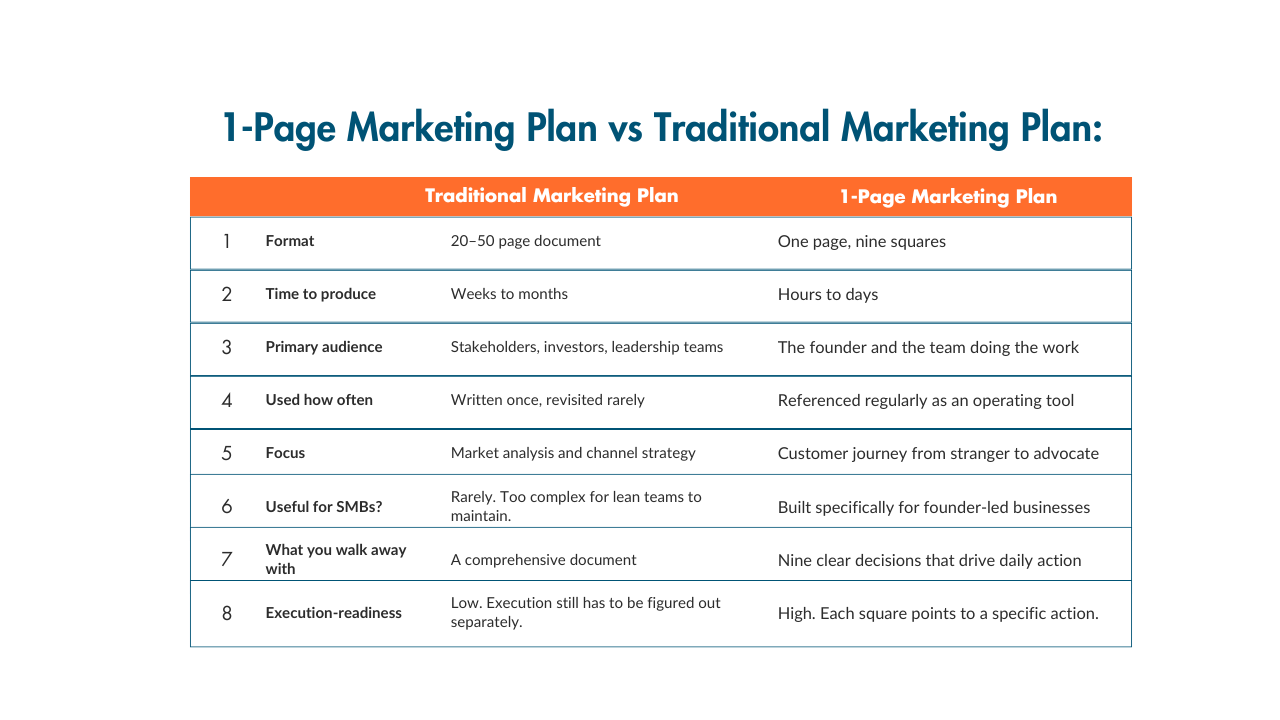
Quick Answer: A traditional marketing plan is a long-form strategy document, often 20–50 pages, covering market analysis, competitive positioning, channel strategies, and campaign timelines. Most small businesses write one, file it, and never look at it again. The 1-Page Marketing Plan (1PMP) maps the entire customer journey on a single page, focused on three stages: before the customer knows you, during the sales process, and after they become a customer. For small businesses, the 1PMP isn't a smaller version of the same document. It's a different category entirely: an operating tool, not a planning exercise.
What Is a Traditional Marketing Plan?
A traditional marketing plan is a comprehensive strategy document, typically produced by a consultant, agency, or internal marketing team, that outlines a company's marketing objectives, target market analysis, competitive positioning, channel strategies, budget allocation, and campaign calendar.
In its full form, a traditional marketing plan might run 30–60 pages. It covers the SWOT analysis. The buyer personas. The messaging matrix. The channel mix. The KPIs. The quarterly roadmap.
For large enterprises with dedicated marketing departments and long planning cycles, this format makes sense. Strategy can be separated from execution because different teams handle each. For a small or medium business, it almost never works as intended. The plan takes weeks to produce. By the time it's done, the business has already moved. And even when it's accurate, a 40-page document isn't something a small team opens every week to stay aligned.
The plan sits in a drawer. The team does whatever feels urgent. Nothing connects.
What Is the 1-Page Marketing Plan?
The 1-Page Marketing Plan, developed in my book of the same name, maps the entire customer journey on a single page, organized around three stages and nine squares.
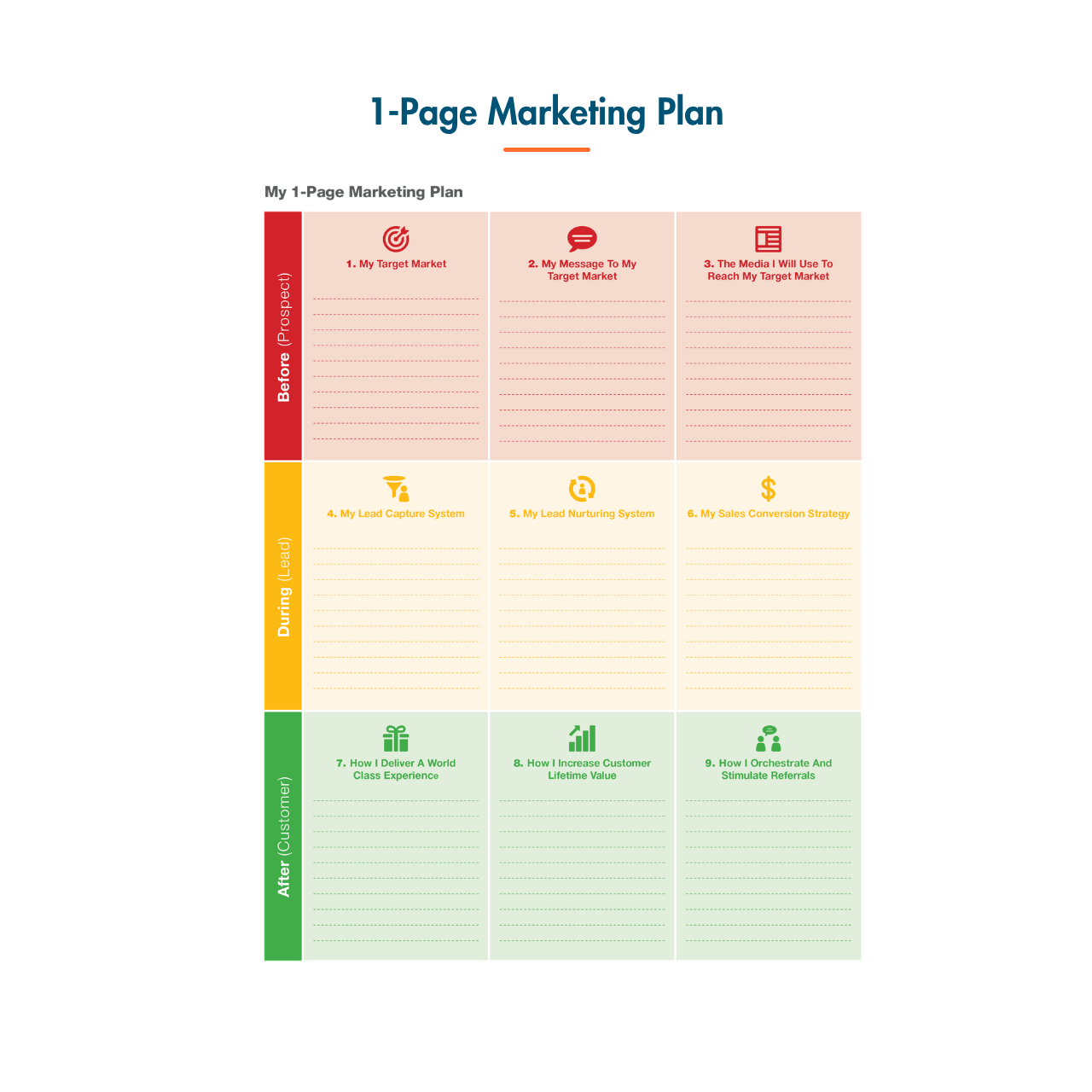
The three stages:
- Before: How you reach people who don't know you yet, and what happens when they do
- During: How you convert leads into paying customers
- After: How you deliver an experience that turns customers into repeat buyers and referrers
Each stage has three squares, one for each key decision a business needs to make. Nine answers on one page, something a small team can actually put to work.
The goal is clarity. A plan that fits on one page is one people actually use.
Why do traditional marketing plans fail small businesses?
The problem isn't that traditional marketing plans are wrong. They're built for a context that most small businesses don't have: large teams, long time horizons, and the separation of strategy from execution.
In a small business, the person who writes the plan is usually also the person executing it. That person doesn't need a 40-page document. They need nine clear answers to nine clear questions, in a format they can carry into next week's work.
Here's what goes wrong with the traditional approach:
- It takes too long to build. By the time a traditional plan is finished, the business context has already shifted. The market moved. The budget changed. A competitor launched something new.
- Nobody reads it after it's written. A 40-page document isn't a daily operating tool. It's a deliverable. It gets filed.
- It focuses on the wrong level. Traditional plans spend significant space on market analysis and competitive positioning, which matters, but most SMB marketing failures aren't strategy failures. They're execution failures. The message is unclear. The follow-up is broken. Nobody's tracking what's converting.
- It separates strategy from the customer journey. A traditional plan typically maps channels and campaigns, not the experience a customer actually has from first contact to repeat purchase. The 1PMP maps the journey. Channels and campaigns become secondary decisions inside that framework.
How does the 1-Page Marketing Plan change the conversation?
When a founder fills out the 1-Page Marketing Plan, they're answering questions most businesses never make explicit:
- Who exactly is my target market, described so specifically I could find them in a room?
- What is my message to that market, and does it sound different from what every other business in my category is saying?
- What is my offer, and is it clear enough that a stranger would immediately understand what they get and why it's worth paying for?
- How do I convert someone who's shown interest into a paying customer, without it depending on the founder personally closing every deal?
- What happens after someone buys? Do they become a repeat buyer? Do they refer others? Or does the relationship just stop?
These are business questions dressed up as marketing ones. The 1PMP is the tool that forces a small business to answer them, clearly, in a format that fits on a desk instead of a filing cabinet.
How does the 1PMP become the foundation for a marketing system?
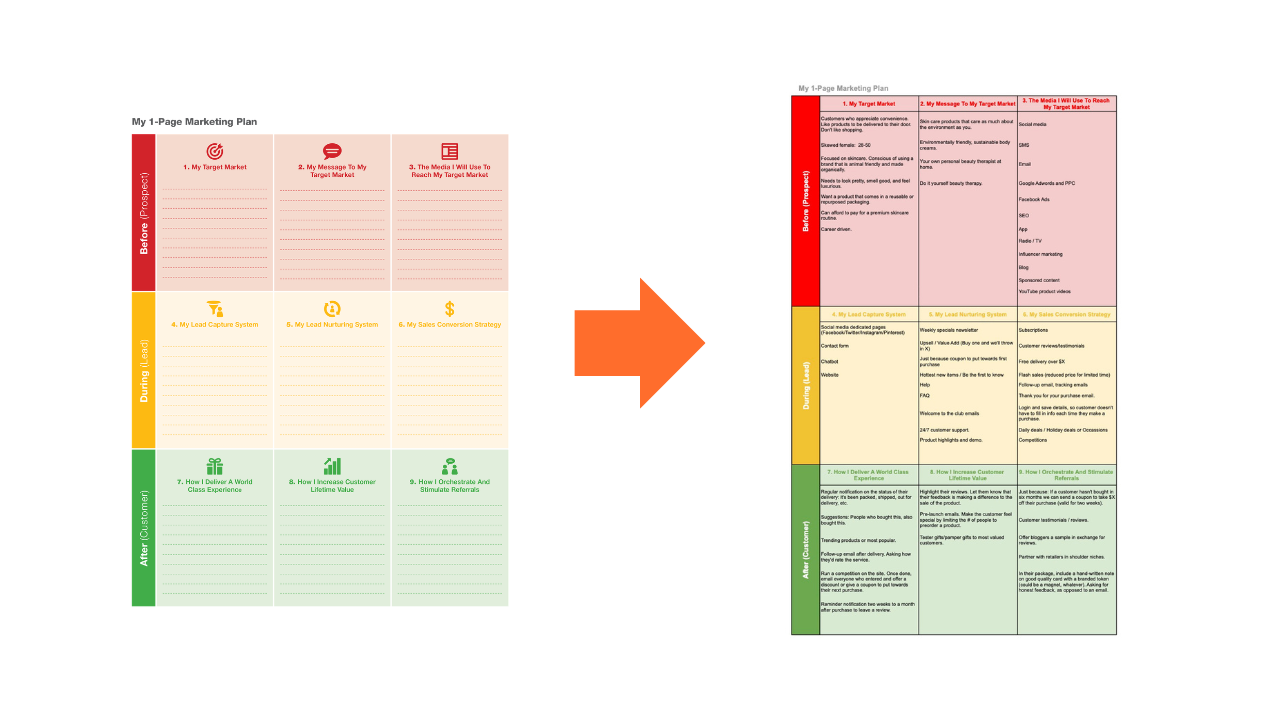
A 1-Page Marketing Plan is where the work starts, not where it ends.
The nine squares give you the strategy.
The Minimum Viable Marketing Engine (MVME) is how that strategy becomes a working piece of infrastructure: website copy, a CRM, a conversion system, a welcome sequence, an opt-in mechanism, and sales tracking, installed in your tools, in the right order.
Lean Marketing takes that map and builds the system that actually runs on it.
Who Is the 1-Page Marketing Plan For?
- Founder-led businesses that have never written a formal marketing plan, or wrote one that ended up in a drawer
- Small businesses with lean teams where the same people write strategy and execute it
- Business owners who know what they're supposed to be doing in marketing but can't get the pieces aligned in practice
- Any business at the stage where clarity is more valuable than comprehensiveness
Who Is the 1-Page Marketing Plan NOT For?
- Enterprise businesses with full marketing departments and long planning cycles. At that scale, a traditional plan's comprehensiveness is a feature, not a bug.
- Businesses that need a formal investor or board-facing strategy document. The 1-Page Marketing Plan is an operating tool, not a stakeholder presentation.
- Founders looking for a shortcut around doing the thinking. The 1-Page Marketing Plan is one page because the answers are hard to write, not because the process is fast.
What are the alternatives to the 1-Page Marketing Plan?
Full Traditional Marketing Plan: A comprehensive strategy document covering market analysis, competitive positioning, channel strategy, and campaign calendars. Appropriate for enterprise businesses with dedicated marketing teams. For most SMBs, the upkeep cost (time, revision, team alignment) exceeds the value.
Business Model Canvas: A one-page framework for mapping business model elements, including customer segments, value propositions, revenue streams, and key activities. Broader than the 1-Page Marketing Plan (covers the whole business, not just marketing) and less focused on the customer journey from stranger to advocate.
OKRs (Objectives and Key Results): A goal-setting framework widely used in tech companies. Useful for keeping teams aligned on outcomes. This differs from a marketing plan in that it doesn't address the message, offer, or the customer journey specifically.
Channel-by-Channel Planning: Planning each marketing channel separately (social media plan, email plan, content plan) without an overarching customer journey framework. Common in SMBs. The gap: each channel can look active while the overall marketing still doesn't convert, because the channels aren't connected to a unified message and journey.
Frequently Asked Questions
What is the 1-Page Marketing Plan?
The 1-Page Marketing Plan is a one-page framework that maps the entire customer journey across nine squares, organized into three stages: before (reaching prospects), during (converting leads), and after (turning customers into advocates). It's designed to be a daily operating tool for small and medium businesses, not a comprehensive strategy document.
Why is the 1-Page Marketing Plan better for small businesses than a traditional plan?
A traditional plan's comprehensiveness is designed for enterprise businesses with separate strategy and execution teams. Small businesses need a framework that the same people who write it can also use every week. The 1-Page Marketign Plan fits in a day's work to produce and on a single page to maintain. That's not simplicity for simplicity's sake. It's the format that founders and small teams actually use.
Does the 1-Page Marketing Plan replace a full marketing strategy?
For most small businesses, yes. The 1-Page Marketing Plan addresses the questions that actually drive marketing results: who you're targeting, what your message and offer are, how you convert leads, and what happens after someone buys. A 40-page traditional plan covers more ground but typically produces less clarity and less action.
How long does it take to complete a 1-Page Marketing Plan?
It takes about an hour to fill out the template. The thinking behind it, particularly the message, target market, and offer, can take days to get right. That's intentional. The one-page format forces you to choose what actually matters instead of documenting everything that might matter.
What's the difference between the 1-Page Marketing Plan and Lean Marketing?
The 1-Page Marketing Plan maps your marketing strategy across the customer journey. Lean Marketing is how that strategy becomes a working piece of infrastructure in your business by installing the system that runs it. Most founders start with the 1-Page Marketing Plan and then use the Lean Marketing team to install the Minimum Viable Marketing Engine as the implementation framework.
Can I use the 1-Page Marketing Plan with an existing marketing agency?
Yes. The 1-Page Marketing Plan is a strategy tool, not a service. You can complete it yourself, share it with any agency or vendor you work with, and use it as the brief that governs their work. Agencies that don't ask for something like this before launching campaigns are working from their own assumptions about your market and message, which often produces work that's well-executed but misaligned.
Is the 1-Page Marketing Plan the same as the 1-Page Marketing Plan book?
The template is the core tool inside Allan Dib's book The 1-Page Marketing Plan. The book explains the thinking behind each of the nine squares in detail, including why most businesses get their message wrong, how to define a target market narrowly enough to be useful, and what a real conversion system looks like. The template is the tool, the book is the manual for using it.
What comes after the 1-Page Marketing Plan?
Installation. Once your nine squares are clear, the next step is building the six pieces that turn your 1-Page Marketing Plan into a working system: website copy built on your message, a CRM as the hub, a conversion system, a welcome sequence, an opt-in mechanism, and sales tracking. That's the Minimum Viable Marketing Engine, installed in the right order starting with message and offer.
Ready to Turn Your Marketing Strategy Into a System That Actually Runs?
The 1-Page Marketing Plan gives you the strategy. We install the system that runs it, in your tools, with your team, in the right order.
Your first step is to fill out The 1-Page Marketing Plan with your business details. You can download it for free on our homepage.
.png)
Lean Marketing Accelerator for Six-Figure Growth
We help 6-figure founders get out of the weeds and scale to $1M by guiding them to build a business system they own. We get you from chaos to predictable, then stay with you as you grow.
Quick Answer: The Lean Marketing Accelerator is an ongoing coaching partnership for founder-led businesses earning $60K–$360K a year. A dedicated Coach guides you through building the Minimum Viable Marketing Engine (MVME): six core pieces installed in your own tools, in a specific order, starting with your message and offer, then conversion, then traffic. You own the system. It's not a course, not an agency, and not a mastermind. It's the path from operator to owner.
What Is the Lean Marketing Accelerator?
The Accelerator is Lean Marketing's core offering for 6-figure founders ready to scale. It's not a course you finish and shelve. It's not an agency retainer that quietly becomes a hostage situation. It's an ongoing partnership: we guide you through building your Minimum Viable Marketing Engine(MVME), train your team (or help you hire one), and get you to $1M+.
You stay in the driver's seat. We're the GPS.
If your revenue has been stuck at the same number for the second year running, the problem usually isn't effort. You're already working flat out. The real issue is that every lead, sale, and follow-up still runs through you personally, and your marketing channels are scattered across whatever felt urgent last month. The Accelerator fixes both, in that order.
Why Do Most Marketing Systems Fail?
Most six-figure businesses don't have a traffic problem. They have a leaky bucket and a founder stuck in the middle of it.
Leads come in, a few convert, most don't, and nobody can say exactly why. So the instinct is to pour in more: more ads, more content, more channels. More water into a bucket that's still leaking.
Here's what's actually going wrong:
- Weak message and offer: If your pitch sounds like everyone else's in your industry, you're competing on price before traffic even matters. This is supposed to come first, and most founders skip it.
- They start with traffic: Every marketing channel sells traffic (ads, SEO, social). So that's where most founders start. But traffic into a broken funnel just makes the leak more expensive.
- No CRM: Leads come in through five different channels and land in five different places. Nothing's connected, and opportunities fall through the cracks because nobody can see them.
- No nurture sequence: A lead raises their hand, and then... nothing. No automated follow-up. No trust-building. Just silence until a salesperson gets around to it.
- No tracking: Without sales tracking, you can't tell what's working. So you keep doing everything, instead of doubling down on the one thing that converts.
- Agency dependency: The agency runs it in their tools, on their terms. Stop paying, and the system stops. You never had a marketing system. You had a subscription.
The Accelerator addresses each of these in sequence: message and offer first, then conversion, then nurture, then lead capture, then traffic. Find the leak. Build the system. Turn it on. Remove the next constraint.
How the Accelerator Works
The Accelerator is built around three Force Multipliers, the things that multiply your marketing's effectiveness rather than just supporting it: Tools (your CRM, AI, automation), Assets (your website, your flagship offer), and Processes (the people, systems, and workflows that run it all).
In practice, that means installing your MVME, the six pieces every growing business needs, in this order:
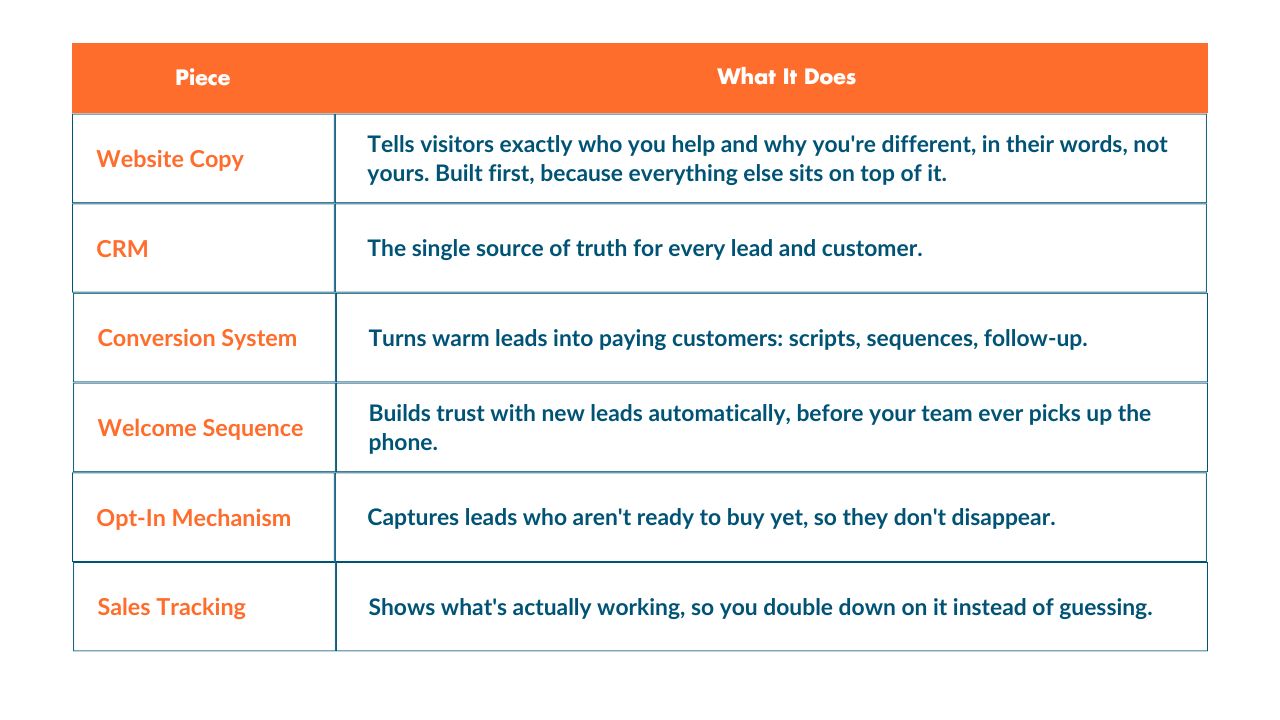
Your Coach guides you through each piece with clear Action Items between sessions and Strategic Alignment Calls to keep the whole system pointed at one goal: getting you to $1M+. We're in the trenches with you, reviewing pages, editing sequences, and troubleshooting the parts that aren't converting yet.
Who Is the Lean Marketing Accelerator For?
The Accelerator is built for founder-led businesses generating roughly $60K–$360K a year, with a clear path toward $1M+.
It works best for:
- Professional services businesses (agencies, consultants, legal, accounting, and similar) where the founder is still the main driver of new business.
- Trades and e-commerce businesses are ready to move from inconsistent sales to a repeatable system.
- Founders who've been burned before, by an agency that took the money and left a logo, or by a DIY stack of tools nobody on the team really uses.
- Owners who are stuck on execution, not strategy. You've read the books. You know what you should be doing. You just can't get the system off the whiteboard and into your business.
- Founders are ready to move from operator to owner, where the business runs without everything depending on them personally.
Who Is the Accelerator NOT For?
The Accelerator asks something of you. It's not a hands-off service, and it's not a quick fix. This is not a good fit if:
- You want a fully hands-off agency. The Accelerator is done-with-you. Your team builds the system with guidance. If you want someone else to run your marketing indefinitely, that's a done-for-you agency model.
- You don't want to be involved. The founder needs to be in the room, at least at the start. This system gets built around your specific business, not a generic template.
- You need leads tomorrow. The Accelerator fixes the foundation first: message and offer, then conversion, nurture, then traffic. If you need emergency lead flow this week, that's a different problem with a different solution.
- You aren't willing to use a CRM. The MVME runs on a CRM as its hub. No CRM, no system. If you're not ready for that, the rest won't hold together.
- You don't have product-market fit yet, or no proof that people want what you sell. The Accelerator installs a system around an offer that already works. It doesn't manufacture demand for one that doesn't.
The Accelerator isn't the only way to solve the marketing problem. Here are the most common alternatives and where each one fits:
Hiring a Marketing Agency (Done-For-You)
An agency builds and runs your marketing for you: campaigns, content, ads, sometimes the full funnel. Fast to start. The tradeoff: you're renting, not owning. The system lives in their tools, runs on their schedule, and stops when you stop paying. Works if you have the budget and don't need to own the capability long-term.
Fractional CMO
A part-time marketing executive who sets strategy and manages your team or vendors. Strong on strategy, light on execution. Works well if you already have people who can execute but need someone experienced to direct them. The gap: a fractional CMO tells you what to build but doesn't usually build it alongside you.
Marketing Consultant
A consultant audits your marketing, delivers a plan, and leaves. Similar to a fractional CMO but typically shorter engagements and less ongoing involvement. You get a roadmap, but execution and implementation are on you.
Mastermind Group
A peer group of business owners sharing strategies, often facilitated by a coach. Strong for accountability and perspective. The gap: a mastermind gives you ideas and motivation but doesn't install a system in your business. You still have to figure out the "how" and the "in what order" yourself.
Internal Marketing Hire
Hiring a full-time marketer or marketing manager. If you find the right person, they can own the system day-to-day. The risk: most small businesses hire a generalist who's good at one channel but can't build the whole system from scratch. Without a framework, the hire ends up doing random acts of marketing too, just on payroll.
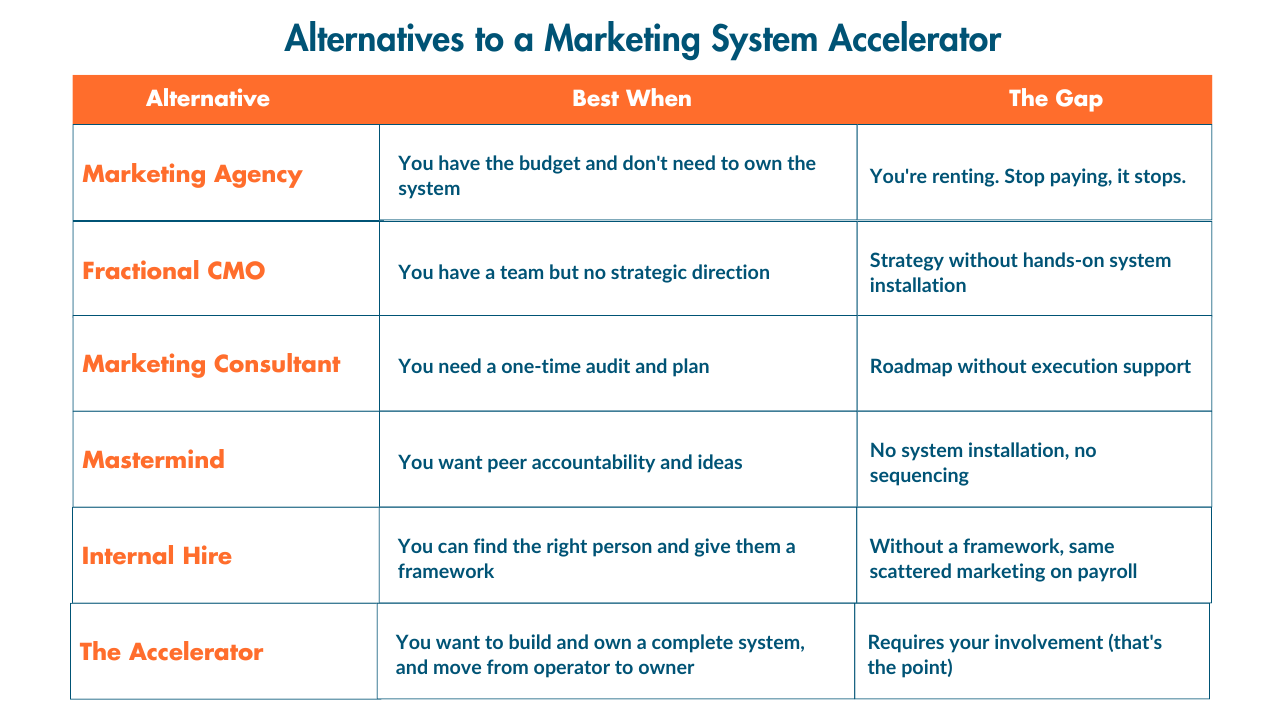
The Accelerator vs. Other Growth Accelerators
A lot of "accelerator" and "growth program" offers promise to take you from six figures to seven. Here's how to tell them apart before you buy:
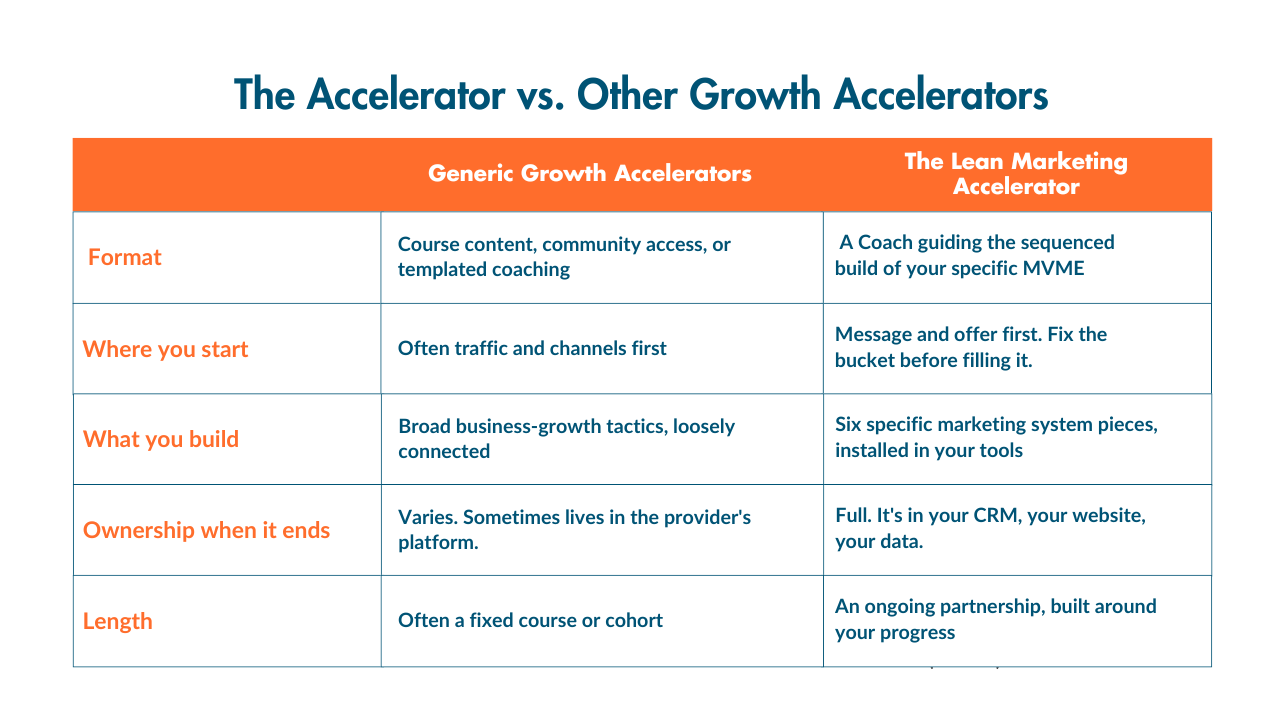
Frequently Asked Questions
What is the best marketing system accelerator for small businesses?
The right accelerator depends on what you're missing. Many growth accelerators focus on broad tactics (ads, content, funnels) without addressing whether your message and offer are right, or whether your existing funnel converts. The Lean Marketing Accelerator is built specifically around the Minimum Viable Marketing Engine: it fixes message and offer first, then conversion and nurture, then sequences traffic and channel growth on top of a foundation that already works, with a Coach guiding the build in your own tools.
What is the Lean Marketing Accelerator?
The Accelerator is Lean Marketing's ongoing partnership for 6-figure founders. Based on Allan Dib's 1-Page Marketing Plan, it guides you through installing your MVME, training your team (or helping you hire), and scaling toward $1M+, with you owning the entire system at every step. It's the practical path from operator to owner.
Who is the Accelerator for?
Founder-led businesses, typically generating $60K–$360K a year, in any industry (professional services, trades, e-commerce, etc.) where the business owner is the key decision-maker. It's built for founders who are stuck on execution, not strategy, and who want to own their marketing system rather than rent it from an agency.
How is the Accelerator different from a course or program?
A course teaches you a framework and leaves you to apply it alone. A program usually has a fixed end date. The Accelerator is neither. It's an ongoing partnership where a Coach works alongside you, with Action Items and Strategic Alignment Calls keeping the build on track until your system is fully installed and your team can run it.
What's included in the Accelerator?
Guided installation of all six MVME pieces (website copy, opt-in mechanism, CRM, welcome sequence, conversion system, and sales tracking), built in your own tools in the right order, starting with message and offer. You get a dedicated Coach, regular Strategic Alignment Calls, clear Action Items between sessions, and hands-on support reviewing pages and sequences as you build.
Should I hire an agency or use a marketing system accelerator?
An agency gets you to "launched" fast, but you're renting the result. The system lives in their tools, the strategy may be templated across dozens of clients, and if you cancel, you start over. A marketing system accelerator takes longer upfront because you're building it yourself (with guidance), but you walk away owning every piece. If you've already been burned by an agency that delivered a logo and a trickle of low-quality leads, the accelerator model exists to solve that exact problem.
What is the difference between a marketing accelerator and a mastermind?
A mastermind is a peer group: founders sharing ideas, holding each other accountable, and brainstorming together. That's valuable for perspective and motivation, but it doesn't build your marketing system for you. Nobody in the room is fixing your message, installing your CRM, or diagnosing why your conversion rate dropped. A marketing system accelerator pairs you with a Coach who does exactly that, in your tools, in a specific order.
How much does a marketing system cost to build?
It depends on the model. A done-for-you agency typically runs $5,000–$15,000+ per month on an indefinite retainer, and you don't own the result. A do-it-with-you accelerator is structured as a defined investment, often less than six months of an agency retainer, with the system continuing to run afterward at no additional cost. The DIY path is cheapest in dollars but most expensive in time and missed revenue from building the wrong things in the wrong order.
Why do most marketing systems fail?
Six reasons, in order of frequency: skipping the message and offer, starting with traffic before fixing conversion, running without a CRM so leads fall through the cracks, skipping the nurture sequence so warm leads go cold, not tracking what's working so every decision is a guess, and depending on an agency that owns the system instead of you. The Accelerator is sequenced to address each of these, starting with the most common failure point first.
How long does it take to see results from the Accelerator?
Most of the six core MVME pieces can be installed in weeks, not months, if you follow the sequence. The first phase (fixing message, offer, and conversion, and adding sales tracking) often surfaces 20–30% more revenue from the leads you already have, before spending a dollar on new traffic. Full system installation depends on the complexity of your business and how fast your team moves, but the order is designed so every phase produces a measurable result, not just a deliverable.
Ready to Build the System That Gets You to $1M+?
You don't need another course. You need a Coach, a sequence, and a system you actually own. From operator to owner.
.png)
Top AI Marketing Systems With Guided Support in 2026
AI tools are everywhere now. Here's why most small businesses still can't get traction with them, and the 5 systems that pair AI with real guidance.
Every small business owner now has access to the same AI marketing tools that used to require a full marketing department. ChatGPT writes your email sequences. AI tools draft your ad copy, summarize your customer feedback, and answer support tickets while you sleep.
So why are most small businesses still stuck?
Because a tool isn't a system. AI marketing automation without a sequence is just a faster way to do random acts of marketing. You can generate fifty pieces of content in an afternoon and still have no idea which piece of your funnel is actually leaking.
The businesses pulling ahead in 2026 aren't the ones with the most AI tools. They're the ones who paired AI marketing tools with a coach who tells them what to automate, in what order, and why. That's "done-with-you" marketing, and here's our skimmable breakdown of the top options for small and medium businesses.
Quick Answer: The top AI marketing systems with guided support in 2026 are: Lean Marketing Academy (AI mapped to a full marketing system with coaching), DigitalMarketer's AI-Powered Marketer Accelerator (training + community), Predictable Revenue (AI-augmented outbound for B2B), standalone AI marketing agents and customer service software (powerful but self-managed), and Knowledge Broker Blueprint/Mastermind.com (a different category: knowledge business, not marketing system). The key differentiator is whether the AI comes with a sequence or just a tool stack.
Why does AI need guidance to work?
Marketing system software has gotten radically cheaper and more capable. The bottleneck isn't access to AI marketing tools anymore. It's knowing what to point them at.
Hand a SMB owner a powerful AI marketing automation platform with no guidance, and here's what usually happens: they automate the easiest thing first (usually social posts), not the thing that's actually losing them money (usually a weak message or broken follow-up). The AI works perfectly. It's just automating the wrong step.
Done-with-you marketing systems solve this by pairing the software with a sequence: message and offer first, then conversion and nurture, then lead capture, then traffic. Use AI to speed up each piece once it's in the right order.
What should you look for before choosing an AI marketing system?
- Does it teach you to run the AI, or run it for you? Some "AI marketing systems" are really agencies with an AI label. You want one that transfers the skill to your team.
- Is there a sequence, or just a tool stack? A pile of AI marketing tools without an installation order is just a more expensive pile.
- Does it cover the full customer journey, including AI customer support integration for post-sale follow-up, or just the top-of-funnel content?
- What's the actual support model? Live coaching, a community forum, or just documentation?
- Is it built for your size of business? Enterprise AI sales stacks and SMB marketing systems solve different problems.
At a Glance:
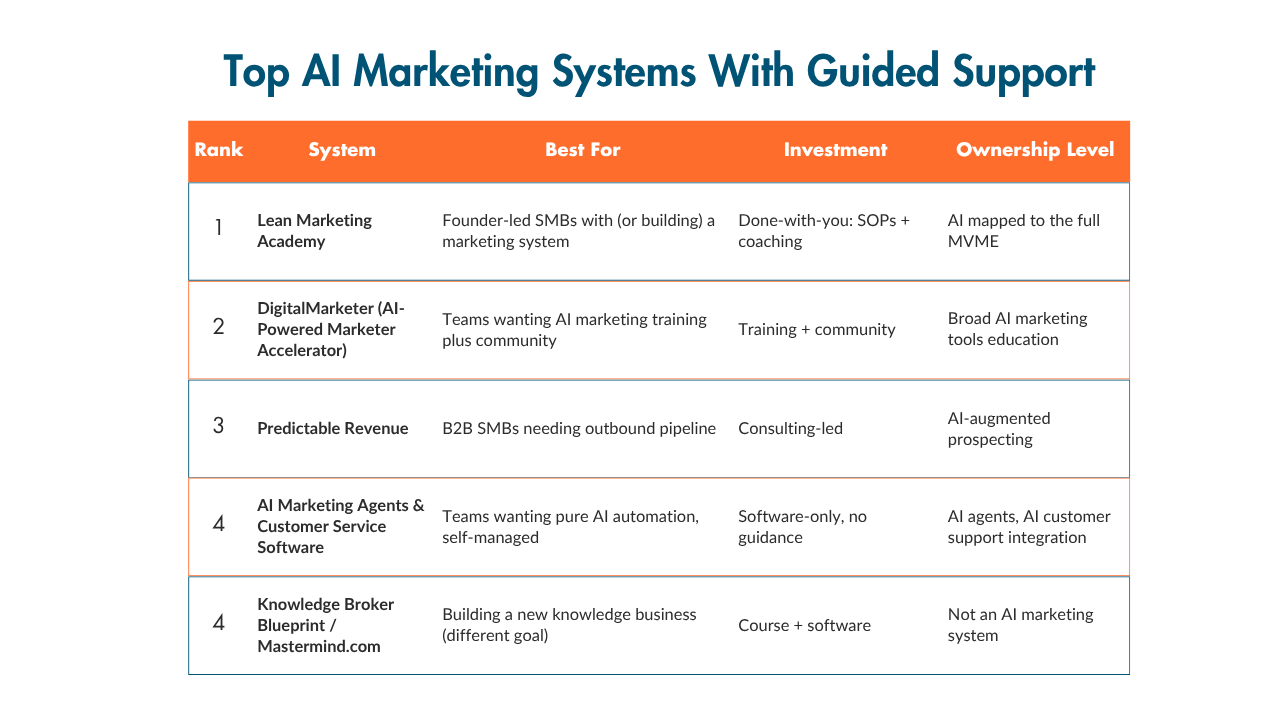
1. Lean Marketing Academy
Best for: Founder-led SMBs that already have (or are building) the Minimum Viable Marketing Engine and want AI to handle the execution grind, without losing the underlying strategy.
How it works: The Lean Marketing Academy pairs the 1-Page Marketing Plan course and 300+ channel-specific SOPs with a library of AI GPTs built specifically for each piece of the marketing system: refining your message and offer, writing welcome sequences, drafting conversion follow-ups, and automating routine customer communication. The AI plugs into a sequence you already understand, which cuts execution time without making your marketing a black box.
Strengths:
- AI tools are mapped directly to the MVME (website copy, opt-in, CRM, welcome sequence, conversion, tracking), so you always know what each automation is for.
- SOPs mean your team can run the AI tools, not just the founder.
- One-time access model, not an indefinite retainer.
Watch for: This works best if you've already got (or are building) the underlying system. It's an accelerator for a sequence, not a replacement for having one.
2. Digital Marketer: AI-Powered Marketer Accelerator
Best for: Marketing managers and small teams who want structured AI marketing training plus an ongoing community of practitioners.
How it works: DigitalMarketer's AI-Powered Marketer Accelerator delivers practical AI marketing playbooks through live Zoom training, with replay access through DigitalMarketer Academy and a network of certified partners for additional support.
Strengths:
- Strong on AI marketing tools education. Useful if your team needs to get fluent fast.
- Community access means ongoing answers, not a one-and-done course.
- Certified partner network available if you want extra hands-on help.
Watch for: It's a training and community model, broad across all marketing disciplines, not a packaged "install this system in your business" sequence. You'll need to do more of the sequencing yourself.
3. Predictable Revenue (Aaron Ross)
Best for: B2B SMBs whose biggest bottleneck is outbound lead generation and pipeline, not marketing as a whole.
How it works: Originally the outbound sales system Aaron Ross built at Salesforce, Predictable Revenue has evolved for 2026 to lean heavily on AI-augmented prospecting: AI agents that research prospects using intent signals, personalize outreach at scale, and score accounts dynamically, implemented with consulting support.
Strengths:
- Deep specialization in outbound sales. If cold outreach and pipeline are your specific gap, this is built for exactly that.
- AI-augmented approach reflects current 2026 outbound tactics, not a decade-old playbook with "AI" bolted on.
Watch for: This is a sales pipeline system, not a marketing system. It doesn't cover your website, opt-ins, or nurture sequences. If your gap is conversion or nurture rather than outbound volume, this solves a different problem.
4. AI Marketing Agents & AI Customer Service Software
Best for: Teams that want pure AI automation (AI agents handling outreach and content, and AI-powered customer service) without an ongoing guidance relationship.
How it works: A growing category of tools puts AI agents to work on specific jobs: handling follow-up and outreach, generating content, and triaging or resolving customer service conversations. Some are sold as standalone software you configure yourself; others get bundled by "AI marketing automation agencies" as a managed service on top.
Strengths:
- No ongoing dependency on a coach or consultant. Once configured, AI agents run continuously.
- AI customer support integration here is often the strongest in its category, since it's the product's core focus rather than an add-on.
- A strong complement to a done-with-you system once your sequence is established. AI agents can execute the parts you've already defined.
Watch for: Same "tool vs. system" gap as any self-serve AI marketing tools. AI agents are very good at running a process. They're not good at telling you which process to run, or whether your message is even right in the first place. Buy this without a sequence already in place, and you'll automate confidently in the wrong direction. If it's sold to you as a managed "AI marketing automation agency" service, the usual done-for-you ownership tradeoffs apply: confirm what happens to your data and workflows if you cancel.
5. Knowledge Broker Blueprint / Mastermind.com
Best for: People who want to build a brand-new revenue stream by packaging their own knowledge into a course or mastermind, not SMBs trying to automate marketing for an existing business.
How it works: KBB is a course (created by Tony Robbins, Dean Graziosi, and Russell Brunson) that teaches you how to turn expertise into a paid mastermind or community, paired with MindMint software to run it.
Strengths:
- If your actual goal is launching a knowledge business, MindMint handles the operational software side.
Watch for: This is a different category entirely. It's not an AI marketing automation system for running an existing SMB's marketing. It's a blueprint for building a new knowledge-product business. If that's not your goal, this won't solve the problem you came here with.
How to Choose
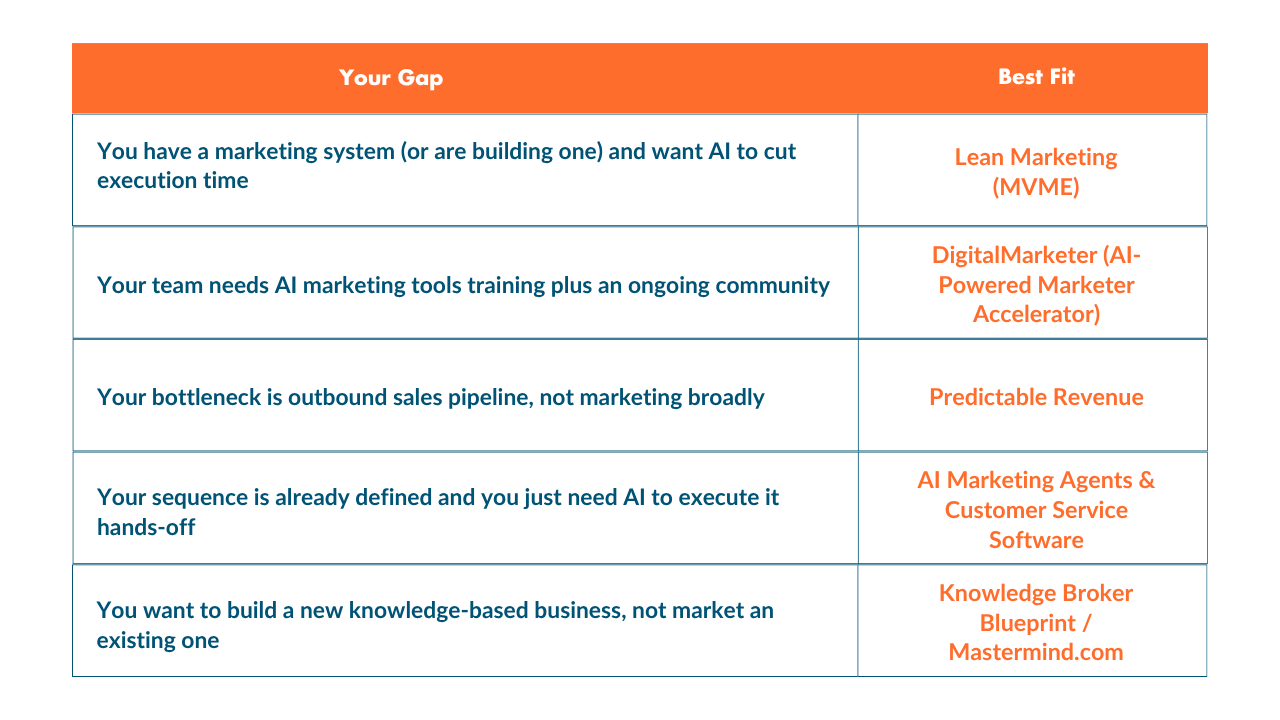
Who Is an AI Marketing System With Guided Support For?
This category works best for:
- SMB owners who already have a marketing system (or are building one) and want AI to handle the repetitive execution, not replace the strategy.
- Small teams where one or two people handle marketing and need AI to multiply their output without adding headcount.
- Founders who've tried AI tools on their own and ended up with a pile of generated content that doesn't connect to any system or sequence.
- Businesses ready to use a CRM as the hub, because AI marketing automation without a connected CRM is just faster noise.
Who Is an AI Marketing System With Guided Support NOT For?
This isn't the right fit if:
- You don't have a marketing system yet. AI amplifies whatever you point it at. If there's no sequence, it amplifies chaos. Build the system first (or build it alongside the AI with the right coach).
- You want AI to replace your entire marketing team. AI handles execution: drafting, sending, sorting, responding. Someone still needs to decide what the system should do and review what the AI produces.
- You're looking for a fully done-for-you service. Guided support means you're involved. If you want someone else to run AI marketing for you indefinitely, that's an AI agency, with the usual ownership tradeoffs.
- Your business changes direction every quarter. AI marketing systems compound over time. Constant pivots mean constant rebuilding.
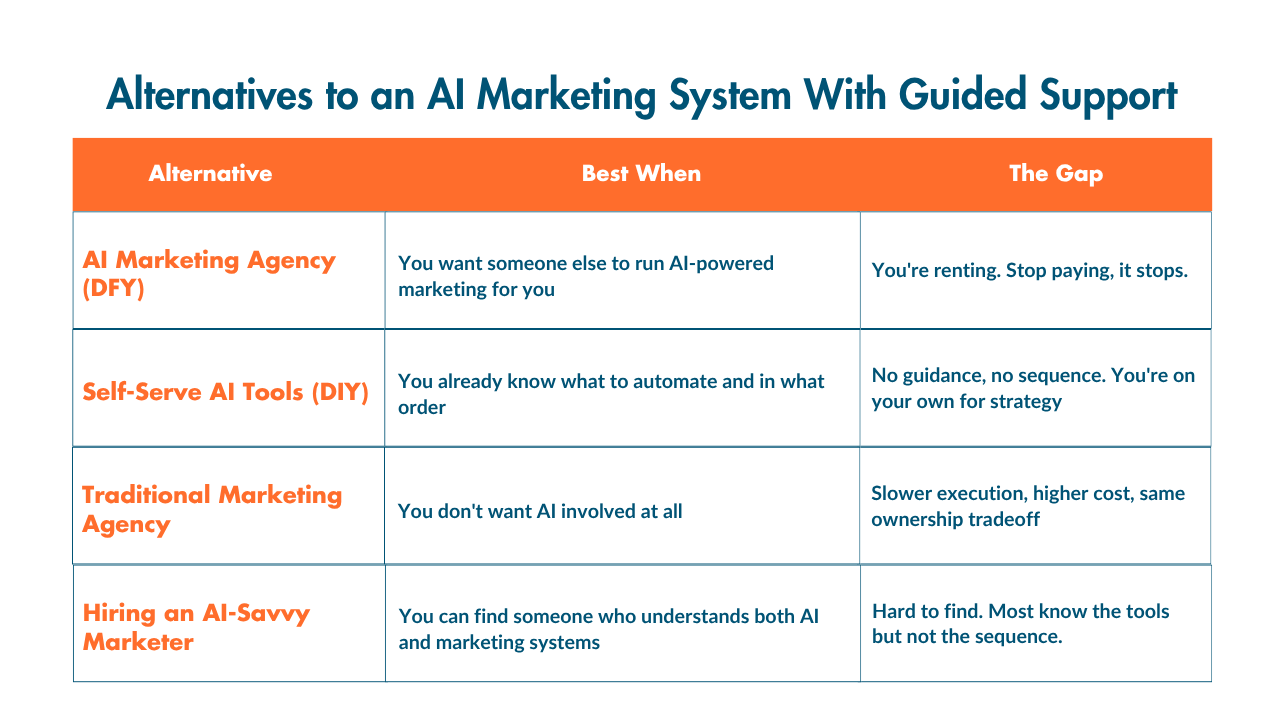
Frequently Asked Questions
What is AI marketing automation?
AI marketing automation uses AI tools to handle repetitive marketing tasks (writing email sequences, personalizing follow-ups, summarizing customer feedback, even handling first-line customer support) within a defined marketing system. The "automation" part is the AI; the "system" part is the sequence that tells the AI what to do and when.
What's the difference between AI marketing tools and an AI marketing system?
AI marketing tools are software. They generate content, automate emails, or integrate AI customer support into your CRM. An AI marketing system is the strategy and sequence that determines which tools get used, in what order, and for what purpose. Tools without a system tend to automate whatever's easiest, not what's most needed.
Is done-with-you marketing better than fully automated AI marketing?
For most SMBs, yes. Fully automated AI marketing tools are powerful but assume you already know what to build. Done-with-you marketing pairs the AI tools with a coach's guidance on sequencing (fixing your message and conversion before adding traffic, for example) so the automation amplifies a system that actually works, instead of speeding up guesswork.
How do I add AI to my existing marketing system without starting over?
Start with the piece of your system that already has the most volume (usually customer follow-up or welcome sequences) and automate that piece first using AI marketing tools mapped to your existing process. Avoid tools that require you to rebuild your CRM or website from scratch; a done-with-you system should slot AI into what you already have, not replace it.
What are AI marketing agents, and do I need one?
AI marketing agents are AI-driven tools that handle specific marketing or sales tasks on their own: outreach, follow-up, content generation, or customer service responses, running continuously without being prompted each time. They're a powerful addition to a marketing system, but they work best automating a step you've already identified as your bottleneck. Used without a sequence behind them, an AI agent just executes random acts of marketing faster.
Should I use AI marketing tools without a guide or coach?
You can, if you already know what to automate and in what order. Most SMBs don't. The risk of going solo with AI marketing tools is the same as the DIY risk without AI: you'll automate whatever's easiest (usually content creation), not whatever's actually costing you money (usually a weak message or broken follow-up). A coach points the AI at the right bottleneck first.
How do I choose between AI marketing training and an AI marketing system?
Training (like DigitalMarketer's Accelerator) teaches your team how to use AI marketing tools across a range of disciplines. A system (like Lean Marketing Academy) gives you a specific sequence: which tool handles which piece, in what order, mapped to your marketing funnel. If your team needs broad AI fluency, go with training. If you need AI plugged into a working system this quarter, go with a system.
Can I add AI to my marketing system later, or do I need to start with it?
You can add it later, and for most businesses, that's the smarter move. Build the system first (message and offer, then conversion and nurture), then layer AI on top to speed up execution. AI tools work best when they're automating a process that already works, not when they're trying to create a process from scratch.
.png)
Best Do-It-With-You Marketing Systems for SMBs in 2026
A ranked, honest breakdown of the best do-it-with-you marketing systems for small businesses in 2026, and what to look for before you pick one.
Most "marketing systems" fall into one of two camps. There's the book you read once, nod along to, and never implement. And there's the agency retainer you pay forever, that quietly becomes a hostage situation.
Neither one leaves you with a system you actually run. Worse, neither one gets you out of the business. Every lead, every follow-up, every decision still runs through the founder.
A third category has been quietly growing: do-it-with-you (DWY) marketing systems. These give you a proven framework, a coach to install it, and (critically) you build it inside your own tools, with your own team. When the engagement ends, the system doesn't end with it.
Here's our honest, ranked breakdown of the best do-it-with-you marketing systems for small and medium businesses in 2026, plus exactly what to look for before you pick one.
Quick Answer: The best do-it-with-you marketing systems for SMBs combine a proven framework with a coach who walks you through installation, in your own CRM, website, and tools. Top options in 2026: Lean Marketing (MVME) for a complete sequenced system you own, Duct Tape Marketing for a long-established framework with local consultant support, StoryBrand for messaging-specific fixes, and self-serve platforms like HubSpot or ActiveCampaign if you already have strategy and just need tooling.
At a Glance: Best Do-It-With-You Marketing Systems for SMBs

What "Do-It-With-You" Actually Means
Before the rankings, a quick gut check, because the term gets used loosely.
- Do-it-yourself (DIY): You build everything (strategy, copy, automation, tracking) on your own, usually stitched together from courses, templates, and a self-serve marketing automation tool. Cheapest option. Highest risk of building the wrong thing well.
- Done-for-you (DFY): An agency builds and runs it for you, in their systems. Fastest to "launch." Highest risk of owning nothing when the contract ends.
- Do-it-with-you (DWY): A coach or framework gives you the exact steps, in the right order, while you build it in your own CRM and tools. Slower than DFY upfront. The only model where you walk away owning the system.
If you've been burned by a $100K agency retainer that delivered a logo and a trickle of bad leads, or you've tried to DIY a self-serve marketing system off YouTube and ended up with twelve half-finished tools, DWY is the model built for you.
How We Evaluated These
A "system" is only as good as what's left when the engagement ends. We ranked each option against five questions:
- Do you own it when it's done? Or does it live in someone else's account?
- Does it install in your tools (your CRM, your website, your email platform), or theirs?
- Is it a full system or one piece of one? Messaging alone isn't a marketing system. Neither is a CRM with no strategy behind it.
- What's the cost structure? One-time investment with optional ongoing support, or an indefinite retainer?
- How fast can you get the core pieces running, in the right order? Message and offer first, then conversion and nurture, then traffic. Or year-long "roadmaps" that never finish?
The Ranked List
1. Lean Marketing (The Minimum Viable Marketing Engine)
Best for: Founder-led service businesses (roughly $60K–$10M in revenue) who want to build an in-house marketing system they fully own, and move from operator to owner instead of staying the bottleneck.
How it works: Built on Allan Dib's 1-Page Marketing Plan methodology, Lean Marketing's Minimum Viable Marketing Engine (MVME) installs six core pieces (website copy, opt-in mechanism, CRM, welcome sequence, conversion system, and sales tracking) in a specific order. Message and offer first, then conversion and nurture, then traffic last. A coach guides you through each phase while your team builds it directly in your own tools.
Strengths:
- True ownership: everything lives in your CRM, your website, your data. Not a vendor's dashboard.
- Sequencing matters here. Most systems start with traffic; this one deliberately doesn't, which avoids the most common (and most expensive) small business marketing mistake.
- Backed by 1M+ readers of the underlying framework and a track record across professional services, trades, and e-commerce.
Watch for: This is a hands-on model. If you're hoping to hand off marketing entirely and never think about it again, the upfront involvement required (yours and your team's) is higher than a pure DFY retainer. That's also exactly why you own the result.
Investment: Structured as a one-time program with optional ongoing coaching. Not an indefinite retainer.
2. Duct Tape Marketing
Best for: Small businesses that want a long-standing, proven framework and the option to work with a local certified consultant.
How it works: Created by John Jantsch over 20+ years, Duct Tape Marketing is built around a 7-step framework and the "Marketing Hourglass" (Know, Like, Trust, Try, Buy, Repeat, Refer). It covers strategy, content publishing, web presence, and lead generation, with a network of certified consultants who can deliver the system locally.
Strengths:
- One of the most established small business marketing frameworks around, with a strong emphasis on simplicity and consistency over chasing trends.
- 2026 guidance leans into practical, current tactics: local SEO, Google Business Profile as a content channel, authentic behind-the-scenes content.
- The certified consultant network means you're not stuck figuring out the framework alone.
Watch for: Because delivery often runs through a network of independent certified consultants, the depth of "do-it-with-you" guidance can vary by who you work with. Some engagements lean closer to done-for-you depending on the consultant and package.
Investment: Framework and resources are accessible at low cost; working with a certified consultant adds fees that vary by location and scope.
3. StoryBrand (Business Made Simple)
Best for: Businesses whose core problem is messaging, where your website and pitch sound like everyone else's and you're stuck competing on price.
How it works: Donald Miller's StoryBrand framework (the "BrandScript") gives you a clear, story-based messaging structure, delivered through a large network of certified StoryBrand Guides who work with you to rewrite your website and core marketing messaging.
Strengths:
- The strongest option for one specific, painful problem: unclear messaging.
- Large, accessible network of certified guides at a range of price points.
- The framework itself is simple enough that motivated teams can apply it without a guide.
Watch for: StoryBrand is a messaging framework, not a full marketing system. It doesn't address your CRM, lead capture, nurture sequences, or sales tracking. You'll need to pair it with something else to cover the rest of the MVME. That said, since messaging comes first in any proper sequence, fixing it well here is a legitimate starting point before adding the rest.
Investment: The framework itself is inexpensive to learn; working with a certified Guide adds cost depending on the package.
4. Self-Serve Marketing Automation Platforms (e.g., HubSpot, ActiveCampaign)
Best for: Teams that already have marketing strategy figured out and just need the tooling to execute it. The do-it-yourself marketing system route.
How it works: These platforms give you the CRM, email automation, landing pages, and sales tracking (the pipes) and leave the strategy, sequencing, and installation order entirely up to you.
Strengths:
- Powerful, mature tooling. If you know exactly what you're building, these platforms can run it well.
- Lower cost if you're not paying for guidance you don't need.
- Marketing automation that scales with you.
Watch for: This is the purest DIY option on the list, and it shows. A self-serve marketing system gives you tools, not a sequence. Plenty of small businesses buy the platform, skip the messaging work, build half the pieces, and end up with an expensive CRM that nobody really uses.
Investment: Monthly or annual subscription that scales with contacts and users. Ranges from budget-friendly to significant at scale.
How to Choose
Match the system to the gap you actually have, not the one you assume you have:

For most founder-led service businesses stuck at a revenue plateau, the honest answer is usually some combination: a messaging fix, a sequenced system, and tools that support it, installed in the right order, by you, with a coach who isn't trying to keep you dependent.
Who Is a Do-It-With-You Marketing System For?
DWY marketing systems work best for:
- Founder-led service businesses ($60K–$10M) where the owner is still driving growth and wants to build a marketing capability in-house.
- Businesses that have been burned by an agency. Paid for months (or years) of retainer, and walked away owning nothing when the contract ended.
- DIY founders who are stuck. They've tried building a marketing system from courses, YouTube, and templates, but ended up with a Frankenstein of half-finished tools and no clear sequence.
- Owners ready to invest time, not just money. You (or your team) will be doing the building. The coach shows you what to build and in what order.
- Founders who want to move from operator to owner, where the business runs without everything depending on them personally.
Who Is a Do-It-With-You Marketing System NOT For?
DWY isn't the right model for every business. It's not a good fit if:
- You want fully hands-off marketing. DWY requires your involvement. That's the whole point. If you want someone else to handle it indefinitely, you want a done-for-you agency.
- You need emergency lead volume this week. DWY starts with message and offer, then conversion and nurture, not traffic. If you need leads by Friday, that's a different problem.
- You don't have (or won't hire) anyone to run the system day-to-day. A DWY system gets built by your team. If there's no team and no plan to build one, the system won't sustain itself.
- Your business model changes every few months. A marketing system is an asset that compounds over time. If you pivot constantly, you'll keep rebuilding instead of compounding.
Alternatives to a Do-It-With-You Marketing System
If DWY isn't the right fit, here are the alternatives worth considering:

Frequently Asked Questions
How do do-it-with-you marketing systems work?
A do-it-with-you marketing system pairs a proven framework with a coach who walks you through installing it step by step, in the right order: message and offer first, then conversion and nurture, then traffic. Unlike a done-for-you agency, the system gets built directly in your own CRM, website, and tools, so when the engagement ends, the system keeps running because you (and your team) built it and understand it.
Which do-it-with-you marketing system is best for small businesses?
It depends on the gap. For founder-led service businesses that want to own a complete, sequenced marketing system in-house, Lean Marketing's Minimum Viable Marketing Engine is built specifically for that. For businesses that want a long-established framework with optional local consultant support, Duct Tape Marketing is a strong, proven option. If the core issue is messaging rather than the full system, StoryBrand fills that gap well.
Is a do-it-with-you marketing system better than a do-it-yourself one?
For most small businesses, yes, but it depends on what you're missing. A self-serve marketing automation platform gives you tools without sequencing, which works if you already know what to build and in what order. A do-it-with-you system gives you both the framework and the sequence, which is where most DIY attempts actually fail.
How much does a do-it-with-you marketing system cost compared to an agency?
Pricing varies, but most do-it-with-you marketing systems are structured as a coaching or guided-installation investment rather than an ongoing retainer. Often less than six months of a typical agency retainer for the full installation, with the system continuing to run afterward at no additional cost.
What's the difference between a do-it-with-you marketing system and a fractional CMO?
A fractional CMO sets strategy and manages your team or vendors. They tell you what to build. A do-it-with-you marketing system goes further: a coach walks you through building the system piece by piece, in your tools, in a specific sequence. The fractional CMO directs. The DWY system installs.
How long does it take to install a do-it-with-you marketing system?
Most of the core pieces can be installed in weeks, not months, if you follow the right sequence. The bottleneck is almost never time. It's order. Businesses that try to build everything at once (or start with traffic before fixing their message) often take a year and end up with less than businesses that follow a sequenced approach in a single quarter.
Can I switch from an agency to a do-it-with-you system?
Yes, and many founders do, usually after an agency engagement that cost more than expected and left them owning nothing. The transition means rebuilding the system in your own tools (CRM, website, email platform) with a coach. It takes more effort upfront than continuing with the agency, but you walk away with a system that doesn't disappear when you stop writing checks.
Why do most DIY marketing systems fail?
Three reasons: no clear message, no framework, and no sequence. Most founders who try to build a marketing system themselves skip straight to tactics (a website, some ads, a CRM) without fixing their messaging first, then skip the pieces that aren't exciting (tracking, nurture), and end up with a stack of disconnected tools that nobody maintains. A do-it-with-you system solves all three. You get the framework, the right order, and a coach who holds you to it.