
If you want proof that positioning matters, look at Ferrari.
A Ferrari serves the same functional purpose as every car on the market: to get you from point A to point B.
A Corolla could get you there just as efficiently. Probably more reliably. Definitely cheaper to maintain.
So why do people gladly spend 10x more for the luxury sports car?
Because Ferrari's positioning strategy makes the product make sense to their target customers. Their brand positioning is so clear that price becomes irrelevant.
And that's your exact challenge in business.
You need a positioning strategy that makes your value so clear that price becomes a non-issue. You need customers to believe—not just trust, but genuinely believe—that what you offer is the obvious choice.
I sat down with Simon Bowen, creator of The Genius Model and founder of The Models Method, to break down exactly how businesses can build this kind of positioning. Simon works with leaders in over 30 countries to simplify how they think, how they position their products and services, and how they influence decisions inside the business and in the market.
What we discussed will change how you think about positioning strategy, clarity, and why some businesses win while others struggle to justify their prices. You can watch the full video here.
Most businesses don't have a strategy problem. They have a thinking problem that undermines their positioning.
Too much complexity. Too many ideas. Not enough clarity in how they position their product or service.
Simon put it perfectly:
"The number one issue companies have in the marketplace is getting the market to understand the unique value or genius they bring in a way that has the customer almost disregarding the price."
We pick up commoditized marketing language—"world-class," "industry-leading," "innovative solutions"—thinking it strengthens our positioning. Or we overcomplicate our explanations, believing complexity signals intelligence and improves our market positioning.
But customers aren't looking for the most complex solution. They're looking for the most common-sense solution.
The one that makes sense to them in their context. That's what effective positioning delivers.

Simon breaks down problems into three levels. Understanding these layers is critical to creating a positioning strategy that actually resonates with customers.
This is what people tell you directly.
"I need to increase my sales."
"I need more leads."
"I need better conversion rates."
Solving known problems is pure labor. There's no strategic positioning value in it. You're just executing a task.
This is the problem people know but won't admit.
The known problem might be "I need more sales." The hidden problem could be "I'm really bad at selling, but I'm not going to come to you and say that."
This is where most consultants and agencies add value—by diagnosing what people won't say out loud. Your positioning needs to speak to this hidden layer.
This is the problem people don't even know exists. And this is where breakthrough positioning happens.
Most business owners think their selling problem is tactical—they need better scripts, more follow-ups, stronger closes. That's the known problem.
But there's a deeper issue they haven't identified: they've been taught an outdated method of selling that's actively working against them.
Simon calls it "industrial-age selling"—the old-school approach built on scarcity, urgency, and manipulation. Creating artificial deadlines. Pressuring people into decisions. Making them feel like they'll miss out if they don't buy now.
That approach doesn't work in a sophisticated market. Customers see through it. They resent it.
The unknown problem is that the entire framework they're using to sell is broken—but they don't realize it because everyone around them is using the same broken framework.
When you can identify and solve that unknown problem—when you can say, "What if I could give you a completely different way to sell that doesn't require manipulation at all?"—that's when transformation happens.
You're not just solving their immediate issue. You're fundamentally changing how they think about the problem itself.
That's unbeatable positioning.
When your positioning addresses all three levels, you position yourself as the only logical choice.

This might be the most important positioning insight from the entire conversation.
Simon said something that flipped conventional wisdom on its head:
"The currency of the purchase is not trust, it's belief. And that's counter to everything everyone's been talking about."
Think about it.
You can trust someone completely—think they're honest, reliable, a great person—and still not believe they can solve your problem.
Most businesses spend all their energy on brand positioning around trust. They build culture. They create consistency. They establish character.
And those things matter for positioning. But they're not enough.
Trust says: "I can rely on them to deliver a quality product or service."
Belief says: "I believe their product or service will actually solve my problem in a way that makes common sense."
Your value proposition must create belief, not just trust. Belief is what drives the purchase. And effective positioning creates that belief.
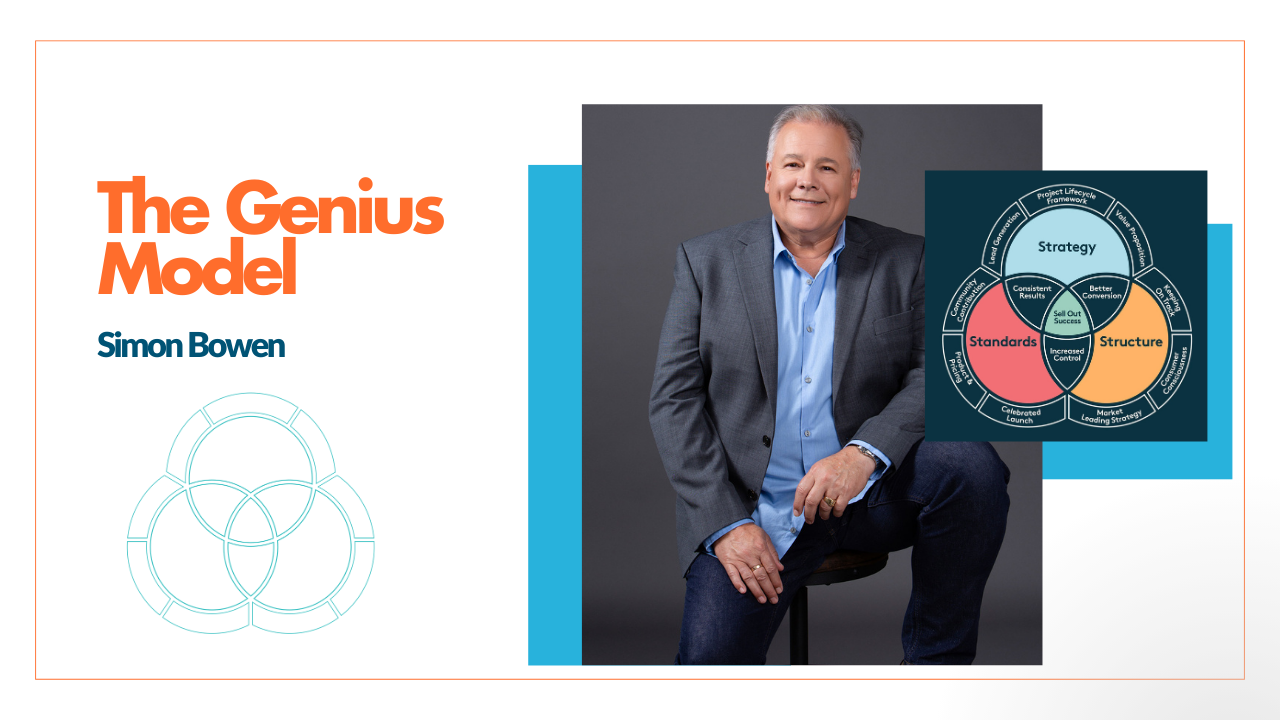
Simon developed The Genius Model to help companies answer one critical positioning question:
"Why do you deserve more sales compared to anyone else in the marketplace?"
Most businesses answer with some version of "We're the best."
Okay. Prove it through your positioning.
Grab a piece of paper. Draw the model that shows me you're better than everybody else.
And that's where most businesses freeze.
They haven't articulated their positioning. They can't visualize it. They can't communicate it clearly.
If you can't draw your positioning, you can't communicate it. And if you can't communicate your positioning, customers won't believe it.
The Genius Model helps businesses capture their unique value—their organizational genius—in a positioning framework that's visual, structured, and impossible to ignore.
When you can say, "This is how clever we are as a company," and show it through a simple positioning model, prospects think: "Why isn't every other company doing that?"
That's when belief happens. That's when your positioning wins.
A strong positioning statement backed by a visual framework becomes your most powerful sales tool.
Simon's entire career is built on turning complex ideas into simple, powerful visual models that strengthen positioning.
His process for creating positioning frameworks starts with geometry.
"I spend a fair bit of time thinking about what's the geometry that would tell this story. Is it a Venn diagram? Is it a spiral? Is it a 2x2 matrix? Is it a triangle? Is it an iceberg?"
The structure tells the positioning story.
For example, when explaining the three levels of problems, an iceberg is the perfect visual for positioning. The known problem sits above the waterline. The hidden problem is just below the surface. And the unknown problem—real transformation—is deep underwater where most people never look.
Geometry isn't just about aesthetics. It's about creating a structural story that guides understanding and reinforces your positioning.
When customers see a well-designed positioning framework, they don't just understand your value—they internalize it. It becomes hard to deny. It becomes the management tool they use to think about their business.
Your positioning framework becomes the lens through which customers evaluate every other option. And when that happens, you've won.
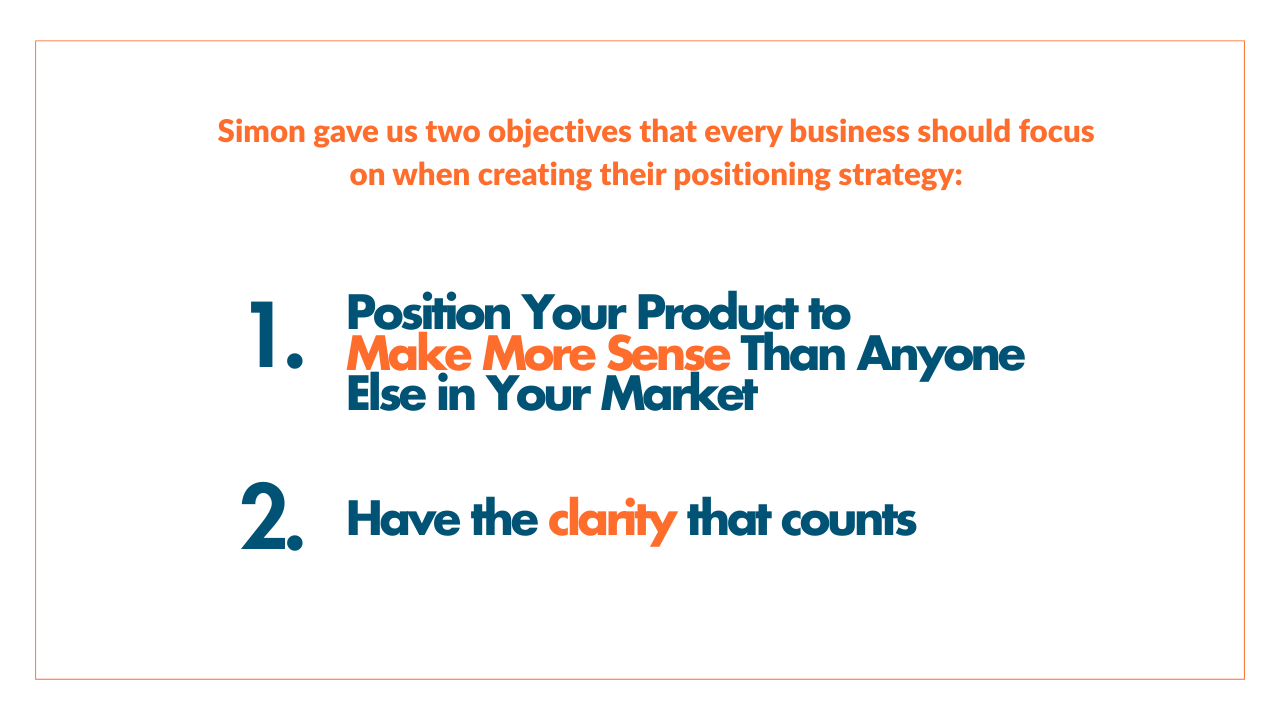
Simon gave us two objectives that every business should focus on when creating their positioning strategy:
"When a customer meets you and you make more sense than anyone else they've spoken to in your market, where does that position you?"
At the top.
Everyone's trying to differentiate, position, and stand out. But most businesses overcomplicate their positioning strategy.
Just position to make more sense than everybody else in the market.
You do that by drawing structured, organized frameworks of thinking that clarify your positioning.
"Having clarity is not the most important thing. Having the clarity that counts is the most important thing."
You can have clarity across five or six different things in your positioning. But if you have absolute clarity around that one thing that matters more than anything else, customers pay for that.
They pay for the person who makes more sense than everybody else and has the positioning clarity that really counts.
This is how you position yourself as the obvious choice. Not through complexity, but through absolute clarity on what matters most.
There are two objectives that every business should focus on when creating their positioning strategy:
"When a customer meets you and you make more sense than anyone else they've spoken to in your market, where does that position you?"
At the top.
Everyone's trying to differentiate, position, and stand out. But most businesses overcomplicate their positioning strategy.
Just position to make more sense than everybody else in the market.
You do that by drawing structured, organized frameworks of thinking that clarify your positioning.
"Having clarity is not the most important thing. Having the clarity that counts is the most important thing."
You can have clarity across five or six different things in your positioning. But if you have absolute clarity around that one thing that matters more than anything else, customers pay for that.
They pay for the person who makes more sense than everybody else and has the positioning clarity that really counts.
This is how you position yourself as the obvious choice. Not through complexity, but through absolute clarity on what matters most.
Common sense—and therefore effective positioning—is contextual.
For some customers, a simple car is the right positioning. For others, it's a million-dollar car.
What makes sense to one customer might not make sense to another. Your job isn't to convince everyone. It's to position your product or service so clearly to the people for whom it does make sense that they see no other option.
This is absolute positioning: knowing exactly who you're positioned for and making your value undeniable to them.
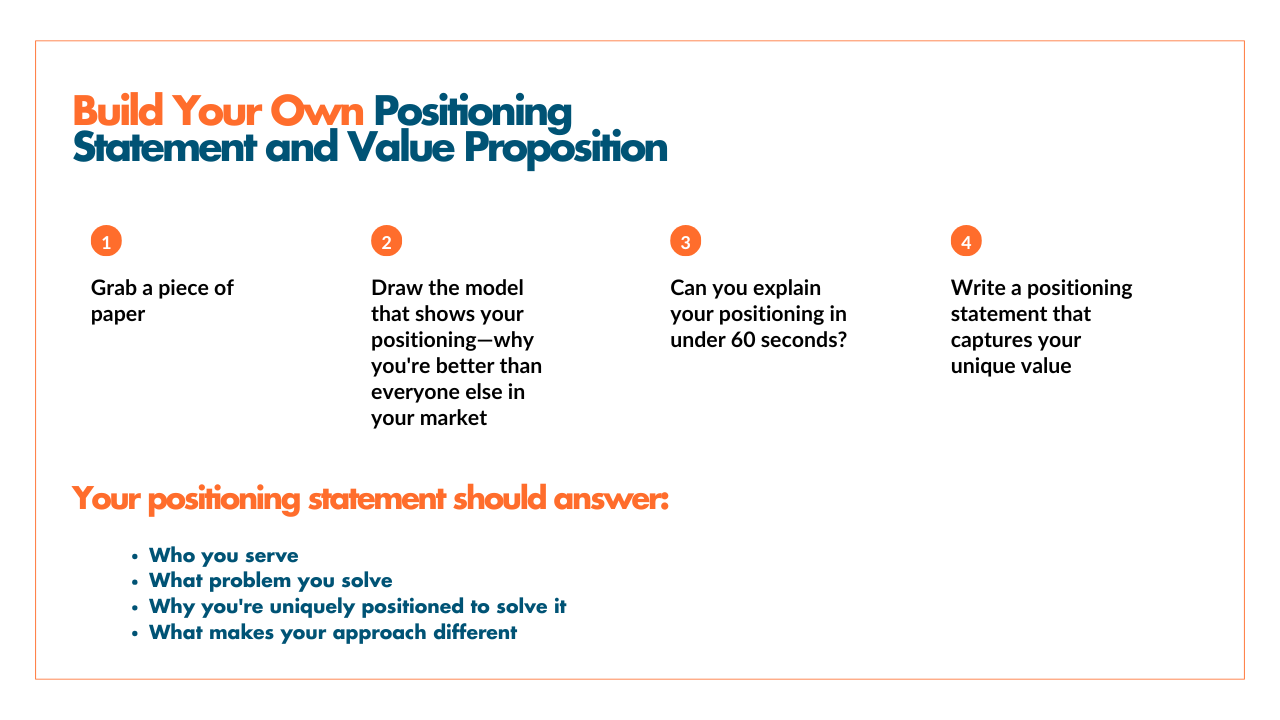
Take 10 minutes and try this positioning exercise:
Your positioning statement should answer:
Because when your positioning makes more sense than anyone else, price stops being the main objection.
And that's when everything changes.
You'll get new articles delivered straight to your inbox, plus special subscriber-only content such as podcasts, videos and live training events.

Download your personalized marketing strategy worksheet here. Inside, you'll go through the same steps we use with clients to identify your ideal customer, refine your positioning message, and build a marketing strategy that makes sense—to you and your market.
Get free weekly emails that make you smarter at marketing and help you grow your business