
Your marketing messaging probably isn't "bad" because you're not smart.
It's bad because you're too close to your business.
You know what you mean… but your buyer doesn't. And if your buyer doesn't understand your messaging in 3 seconds, they do what all rational humans do: they bounce, ghost, or ask for a discount.
This post will show you exactly how to diagnose what's broken in your marketing messaging and fix it with a simple framework we use with growth-stage founders who want predictable leads… without becoming full-time marketers.
Bad marketing messaging isn't an aesthetic problem. It's a profit problem.
If your messaging sounds like everyone else, prospects compare you like everyone else… by price. And when your message is vague, it also attracts the "wrong" people: low-budget buyers, mismatched industries, and the ones who want a unicorn solution with zero effort.
Confused people don't click. Confused people don't book. Confused people don't buy.
So you end up with:
When messaging is unclear, founders do the predictable thing: they try to "fix it" with more tactics.
More ads. More content. More funnels. More tools that don't talk to each other.
That's how you get random acts of marketing… and a calendar full of busy work that doesn't pay you back.
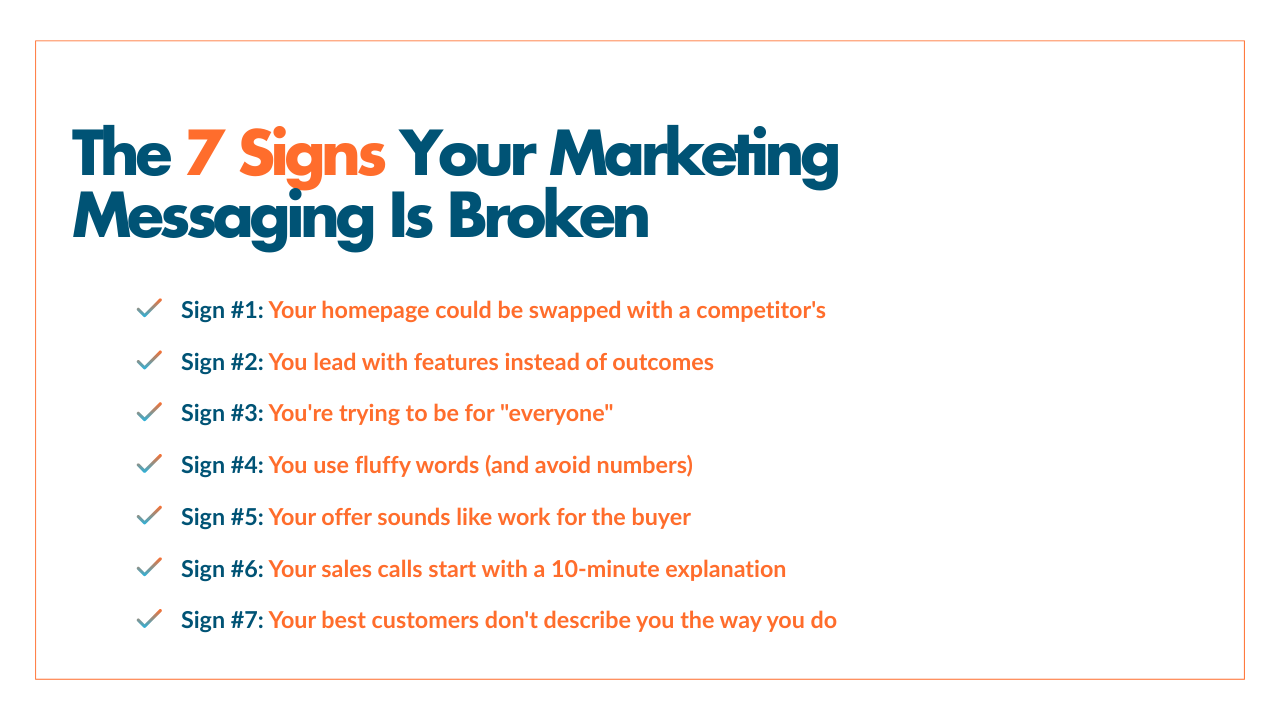
Here's a quick gut-check. If you recognize yourself in two or more of these, your messaging is the bottleneck.
If your hero section says some version of "We help businesses grow with innovative solutions"… you're not marketing. You're wallpaper.
"Weekly calls." "Dashboards." "AI tools." Cool… but buyers pay for outcomes.
Features support the promise. They're not the promise.
When you say you serve "small businesses" or "founders," you're basically telling the market you don't know who you're best for. Specific wins. General loses.
Words like "transform," "elevate," and "unlock" aren't automatically bad… but they're usually used to avoid being concrete.
Clarity loves numbers:
If your messaging implies the prospect has to become a marketing expert to succeed, they won't start.
They want a GPS… not a textbook.
If you regularly say, "So basically what we do is…" and watch eyes glaze over, your marketing messaging isn't doing its job. Your job is to pre-sell. The call is for fit and details, not basic comprehension.
This one stings because it's common.
You describe your service one way. Your best clients describe the value a totally different way… usually simpler, more emotional, and more specific.
Guess whose language converts?
Bad marketing messaging is usually a sequencing problem.
Founders write like this: "We provide done-with-you marketing consulting and automation."
Buyers think like this: "I need leads I can predict… without hiring an agency I don't trust."
Inside-out messaging makes you sound like a vendor. Outside-in messaging makes you sound like the obvious choice.
When you don't know what to say, you subconsciously borrow what everyone else is saying.
That's how entire industries end up using the same five phrases until nobody believes any of them.
We'll say it bluntly: if you don't nail message and offer first, everything downstream gets expensive.
Fix the bucket before you fill it.
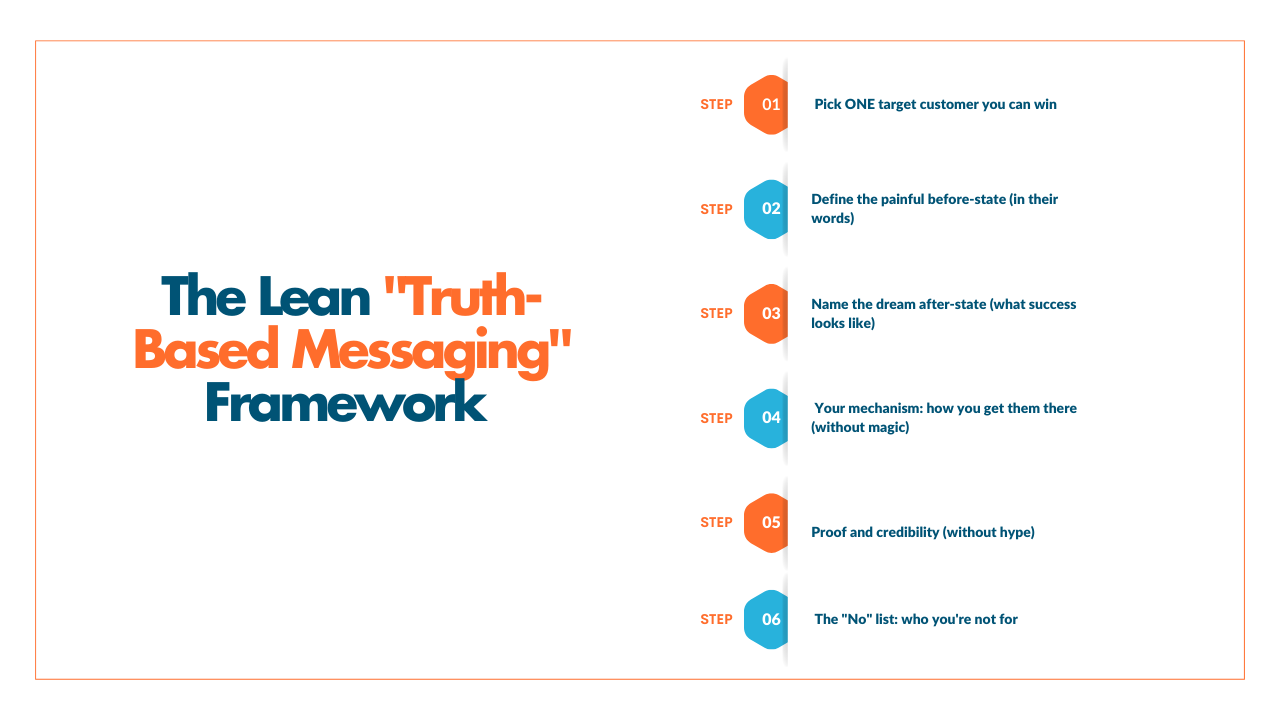
This is the exact order we use to turn messaging into a money multiplier because it forces clarity and removes BS. It also gives you brand messaging your teams can actually execute across pages, emails, and ads.
You don't need a million leads. You need the right leads.
Pick a winnable segment you already have proof with. Examples:
Being specific isn't limiting. It's positioning.
This is where most marketing messaging dies. Founders describe the pain like a consultant, not like a human.
Use real language:
Be concrete. Paint a simple picture:
Your "mechanism" is your method. Not your buzzwords.
Example mechanism language:
Credibility is not chest-thumping. It's specificity.
This is where your message gets sharp.
You should clearly say "no" to at least a few groups, like:
Don't overthink this. You're going for clear, not clever.
Headline: We help [specific customer] get [specific outcome] without [big objection].
Subhead: Using [your mechanism], we build a marketing system you actually own… so you can [business benefit] and stop [painful behavior].
Example: We help founder-led professional services firms get predictable leads without relying on sketchy agencies. Using a hands-on marketing operating system, we build the system inside your tools so your team owns it.
For [ICP] who want [desired outcome], we [do what you do] so you [get measurable result].
Next step: Book a [call/workshop] to map your top bottleneck and the next step.
What you'll leave with: a clear execution plan, the metrics to watch, and what to fix first (so you stop guessing).
You don't need a 40-page brand strategy deck. To craft magnetic messaging, you need language your market already uses.
Get on three quick calls with your best-fit clients and ask:
Create a simple document called Voice of Customer. Every time you hear a great phrase, paste it in.
Small hinges swing big doors. A handful of exact phrases can increase conversions more than a full redesign.
Messaging should earn the right to be "built." Test it first.
Show your homepage hero to someone who doesn't know what you do. Give them three seconds. Then ask:
If they can't answer, your message is too abstract.
Send your new positioning line to a good client and ask: "Would you forward this to a friend who needs what we do?"
If the answer is "ehhh," it's not clear enough.
Great messaging handles objections before the sales call.
You're looking for fewer "wait, what do you do?" moments and more "that's exactly what I need."
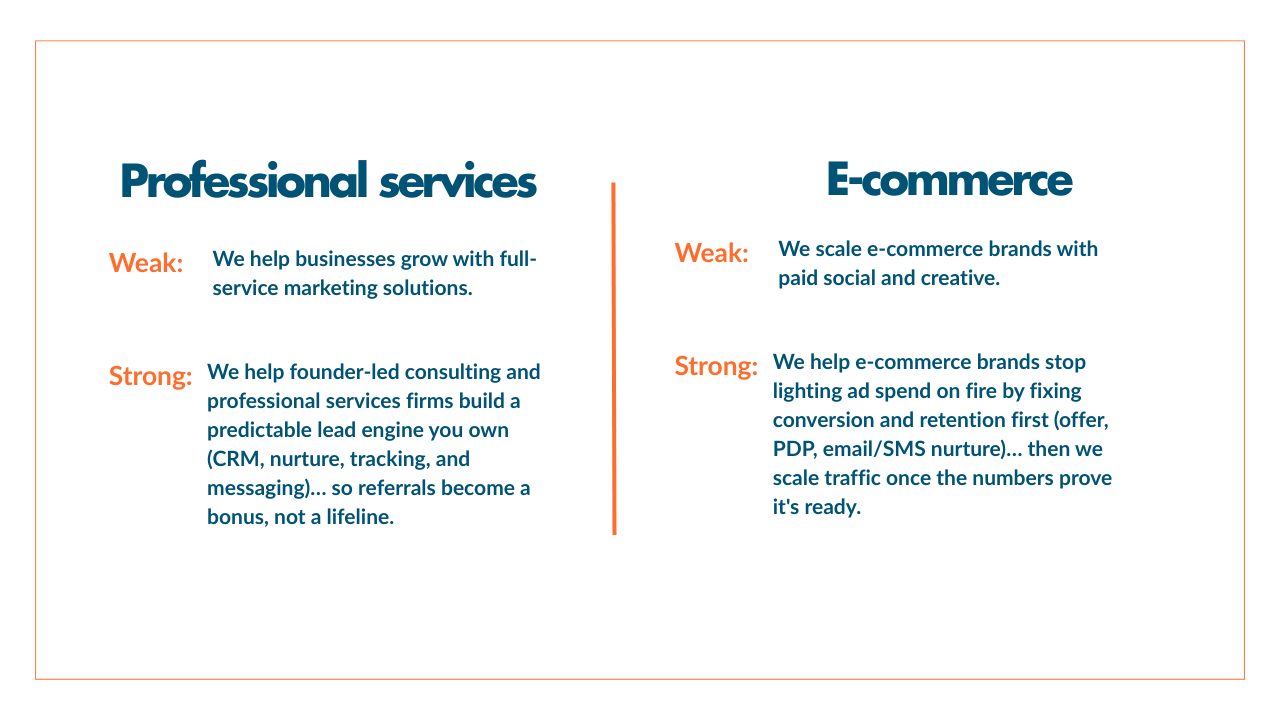
These are simplified examples, but they'll show you the shift.
Weak: We help businesses grow with full-service marketing solutions.
Strong: We help founder-led consulting and professional services firms build a predictable lead engine you own (CRM, nurture, tracking, and messaging)… so referrals become a bonus, not a lifeline.
Weak: We scale e-commerce brands with paid social and creative.
Strong: We help e-commerce brands stop lighting ad spend on fire by fixing conversion and retention first (offer, PDP, email/SMS nurture)… then we scale traffic once the numbers prove it's ready.
Your marketing messaging has one job: make the right buyer feel understood and move them to the next step.
If you want help installing this end-to-end (message → conversion → nurture → traffic) inside your tools so you actually own the system, that's what we do.
Positioning is your strategic "place" in the market (who you're for, what you're best at, why you win). Brand messaging is how you express that positioning on your website, ads, emails, and sales calls.
You can improve clarity in a day. Serious improvements in marketing messaging usually happen over 2–4 weeks as you gather customer language, update core pages, and test on real calls.
Not to get started. You need customer truth and a clear messaging framework. A good copywriter becomes leverage after the strategy is clear.
AI can help you draft variations and tighten wording. But it can't replace customer truth. Garbage in, garbage out. Use AI to move faster… not to guess faster.
You'll get new articles delivered straight to your inbox, plus special subscriber-only content such as podcasts, videos and live training events.

You'll learn our proven framework for writing great direct response copy, delivered straight to your inbox.
Get free weekly emails that make you smarter at marketing and help you grow your business