
AI will follow wherever you point it. The question is whether you're pointing it in the right direction.
Small business owners now have access to AI marketing tools that would have required a full department a few years ago. ChatGPT writes email sequences in minutes. AI tools draft ad copy, score leads, summarize customer feedback, and handle first-line support around the clock.
So why are most small businesses still stuck in the same place they were before AI got good?
Because a tool isn't a system. And AI without a system doesn't solve the marketing problem. It just executes it faster.
Quick Answer: AI marketing tools are software, ChatGPT, automation platforms, AI customer service agents, that handle specific marketing tasks: writing, sending, sorting, responding.
An AI marketing system is the strategy and sequence that tells those tools what to do, in what order, and why. Tools without a system automate whatever's easiest. A system ensures the AI is pointed at the actual bottleneck, usually starting with message and offer, then conversion and nurture, then traffic last. For most small businesses, adding AI tools without a system first produces faster random acts of marketing, not better results.
AI marketing tools are software products that use artificial intelligence to handle marketing tasks that previously required human time and skill. They fall into a few broad categories:
Each of these tools is genuinely capable. The problem is that none of these tools know anything about your business strategy. They'll automate whatever you point them at, including the wrong thing.
An AI marketing system is the combination of AI tools with a proven sequence that tells those tools what to do, in what order, and why.
The sequence is the key word. A system doesn't start by asking "which AI tool should I use?" It starts by asking "what's the actual problem, and where in the customer journey is it leaking?" Then it maps the right AI tool to the right piece, in the right order.
For most small businesses, that sequence looks like this:
This is the Minimum Viable Marketing Engine (MVME) with AI plugged into each piece, in the right order.
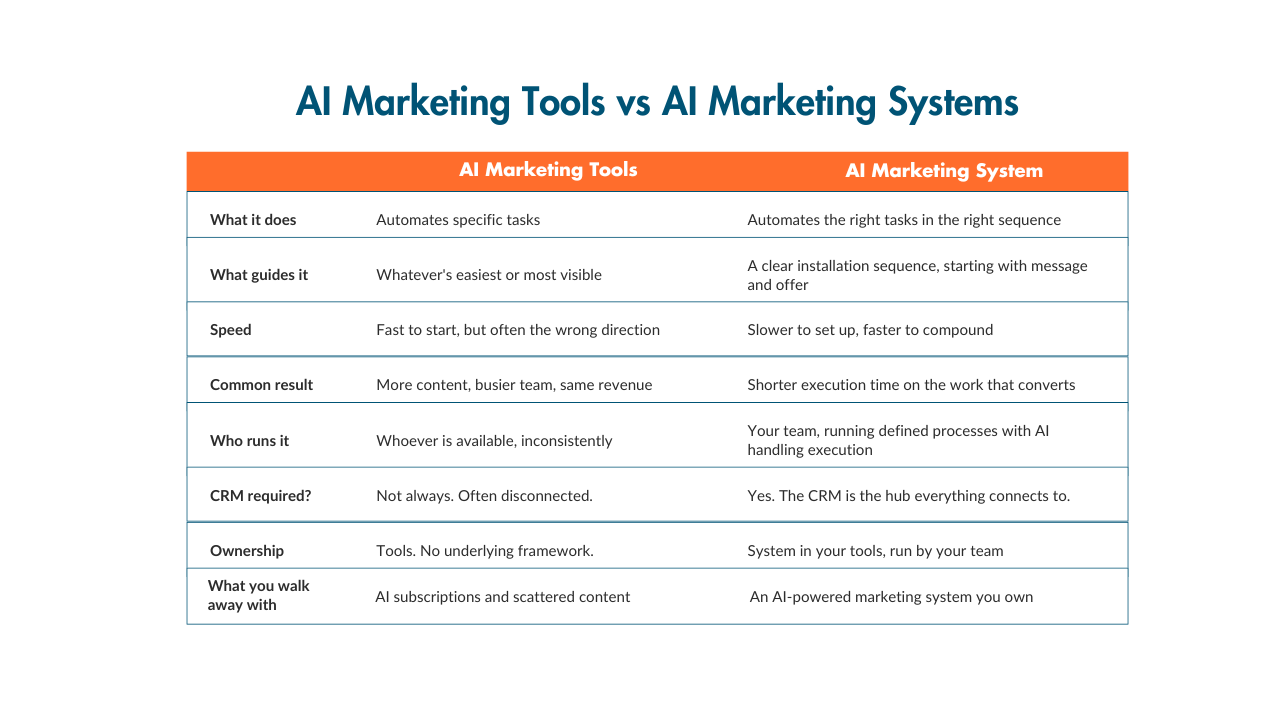
Here's what actually happens in most small businesses when they adopt AI marketing tools without a system in place:
They automate the easy thing first. Usually content. Social posts, blog drafts, email subject lines. These are visible, satisfying, and easy to hand to AI. They're also rarely the bottleneck. The conversion rate doesn't move because the bottleneck was never content volume. It was a weak message, a broken follow-up sequence, or leads falling out of a CRM nobody was maintaining.
They end up with faster noise. AI makes it possible to produce 10x as much content in the same amount of time. But 10x the content without any strategy doesn’t move the needle. Random acts of marketing, executed faster.
They can't tell what's working. Without sales tracking and a connected CRM, AI outputs become data that lives nowhere useful. Leads come in through five channels and land in five different places. The AI is running. The system isn't.
In short, the technology isn't the problem. The sequence is.
An AI marketing system starts with the question a tool can't answer: what's actually costing you money right now?
For most six-or seven-figure businesses, the answer is one of a small number of things:
An AI marketing system finds the leak first, then builds the fix, then applies AI to run that fix faster and more consistently. The AI doesn't set the sequence. The system does. AI is the engine. The system is the road map.
Lean Marketing's approach maps specific AI tools to each piece of the Minimum Viable Marketing Engine:
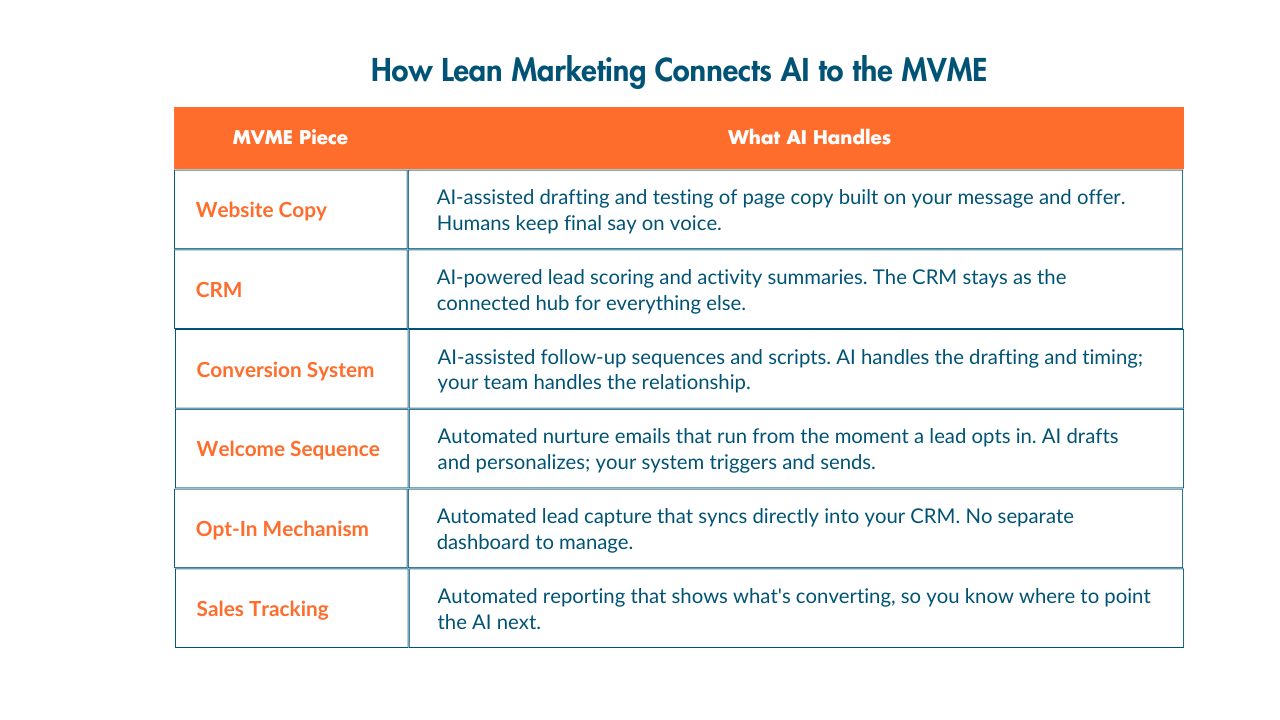
This is backed by a library of custom AI GPTs and 300+ channel-specific SOPs, which cut execution time on these tasks by roughly 70%. The AI handles the execution grind. The system handles the sequence. Your team stays in control of the decisions that matter.
AI marketing tools are software that automate specific tasks: writing copy, sending emails, scoring leads, and handling customer inquiries. An AI marketing system is the sequence that tells those tools what to do, in what order, mapped to a proven marketing framework. Tools without a system automate whatever's easiest. A system ensures the AI is pointed at the actual bottleneck.
No. AI can execute a strategy faster. It can't create one. An AI marketing tool given a blank prompt will produce generic output that sounds like every other business in your category. A marketing system, starting with a clear message and offer, gives AI the strategic direction it needs to produce output that's specific, differentiated, and actually converts.
You get faster random acts of marketing. AI produces more content, more emails, more campaigns, but pointed in the same directions as before. The bottleneck wasn't content volume. It was a weak message, a broken follow-up, or a funnel that doesn't convert. More AI output into a broken funnel just makes the leak more expensive.
Start with the piece of your system that already has the most volume, usually follow-up sequences or welcome campaigns, and automate that first. The installation order should follow the system: message and offer first, then conversion and nurture, then lead capture, then traffic. AI tools work best when they're automating a process that already works, not when they're creating one from scratch.
Yes, if you want the tools to compound. Without a CRM, AI outputs (lead data, email responses, scoring signals) land in disconnected places and produce no cumulative value. The CRM is the hub that connects AI outputs to actual business data, so every automated action builds on a shared picture of the customer journey.
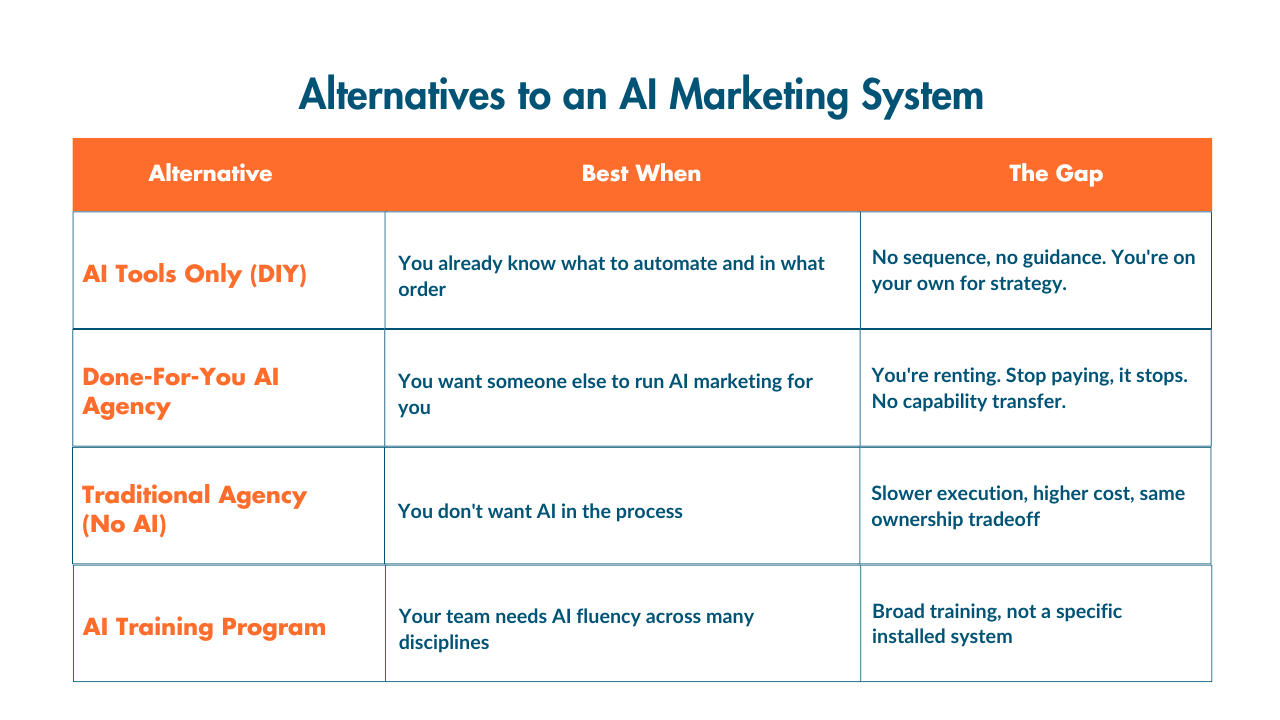
A done-with-you AI marketing system is typically structured as a defined investment for the build phase, often less than six months of a typical agency retainer. The system continues running afterward at no additional cost. A done-for-you AI agency runs on an indefinite retainer, usually $5,000–$15,000+ per month, and you don't own the system when the relationship ends.
The best AI marketing tools for a small business are the ones mapped to your specific marketing bottleneck, not the most popular ones. For most small businesses, the highest-impact applications of AI are in follow-up sequences (converting warm leads faster), welcome campaigns (building trust with new leads automatically), and sales tracking (surfacing what's actually converting so you stop guessing). Start there, then layer in content and traffic automation once conversion is working.
Yes, and that's typically the best approach. A connected AI marketing system slots into your existing CRM, website, and email platform. You automate the pieces already in place, starting with the one handling the most volume. The goal isn't to rebuild from scratch. It's to take what's working and make it run faster, with less manual effort from your team.
For most founder-led businesses, yes. A done-for-you AI agency runs your marketing automation inside their accounts and tools. When you stop paying, the automation usually stops too. Done-with-you AI marketing installs the same tools inside your own systems, with a coach's guidance, so your team owns and runs it going forward. The capability stays with you even if the coaching relationship ends.
The tools are ready. The question is whether you have a system to point them at. We map AI to every piece of your Minimum Viable Marketing Engine, in the right order, so the automation compounds on a foundation that actually converts.
You'll get new articles delivered straight to your inbox, plus special subscriber-only content such as podcasts, videos and live training events.

Get free weekly emails that make you smarter at marketing and help you grow your business