
Most founders don't have a marketing problem. They have a leaky bucket.
You turn on the tap (ads, referrals, cold outreach), water comes out, and somehow the bucket never fills. Leads trickle in, a few convert, most don't, and you can't say why. So you do what every guru tells you to do: pour in more water. More ads. More content. More hustle.
Pouring expensive bottled water into a leaky bucket doesn't fix the bucket. It just makes the leak more expensive.
Here's the bigger problem hiding under the marketing one: even if the bucket fills, everything still runs through you. Every lead, every follow-up, every decision waits on the founder. That's not a marketing system. That's a job you built for yourself.
A lean marketing system fixes the bucket first, then turns on the tap.
This guide walks you through exactly how to install one: what it is, how it's different from hiring an agency or duct-taping together a dozen apps, and the order to build it in so you don't waste a single dollar of marketing spend.
Quick Answer: A lean marketing system is six connected pieces, website copy, opt-in, CRM, welcome sequence, conversion system, and sales tracking, installed in a specific order: message first, then conversion, then traffic. Skip the order and every dollar spent upstream leaks through the gap. Install it right, and the business runs without depending on the founder for every lead and decision.
A lean marketing system is a connected set of tools, assets, and processes that turns strangers into customers and customers into repeat buyers, without depending on the founder's personal hustle to keep it running.
It's not a tactic. It's not "post more on Instagram" or "run more ads." It's the underlying machine that makes every tactic work harder. Most businesses skip straight to tactics because tactics feel like progress. But a tactic without a system is just a random act of marketing.
The lean approach flips the usual order. Instead of starting with traffic (the most expensive part), you start at the bottom of the funnel: conversion, nurture, and opt-in. Then you work your way up to traffic last.
You plug the leaks first.
This is the entry point to a bigger shift: from operator, where the business runs through you, to owner, where the business runs without you. The marketing system is the first piece of infrastructure that makes that shift possible
Before you install anything, you need to decide who's doing the installing. There are three models, and most founders pick the wrong one because nobody explains the tradeoffs.
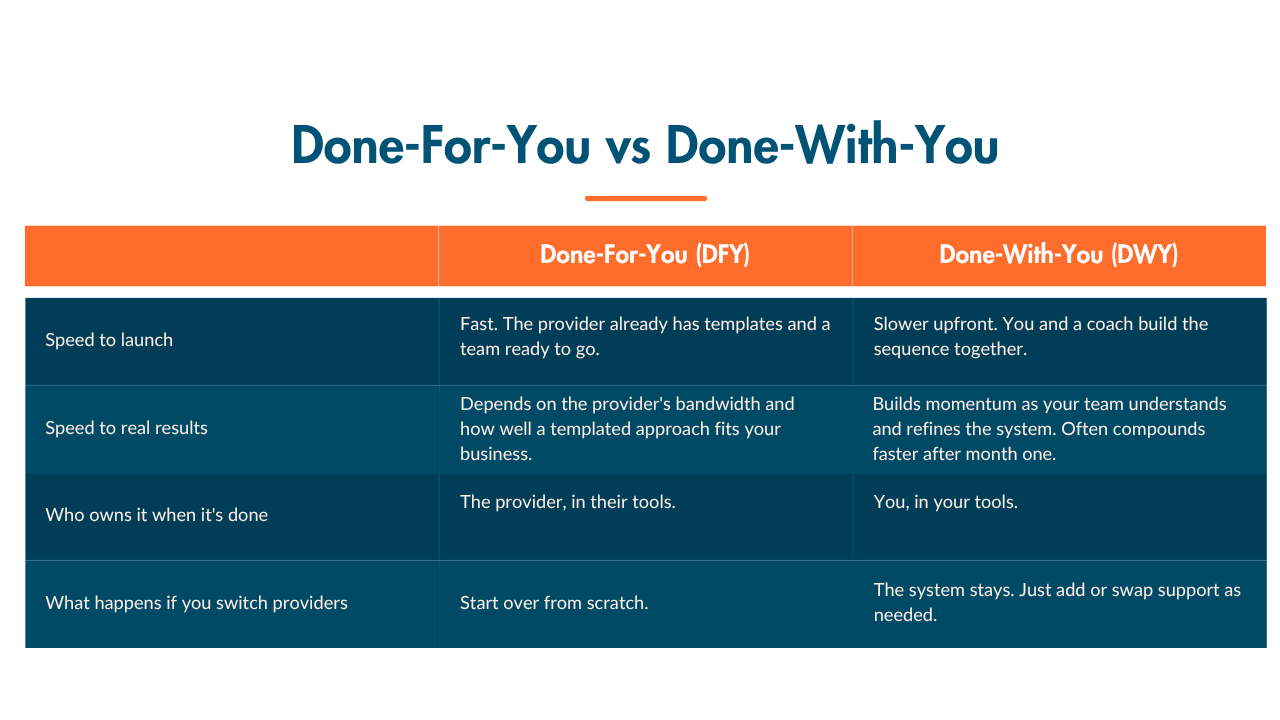
A do-it-yourself marketing system sounds appealing because it's cheap and you stay in control. The problem is most founders don't know what "good" looks like, so they end up with a Frankenstein of half-finished funnels, an email list nobody emails, and a CRM that's really just a spreadsheet with extra steps.
A done-for-you marketing system solves the knowledge gap but creates a dependency gap. We've talked to founders who paid an agency $100,000 over two years and walked away with nothing but a logo and a stack of low-quality leads. The agency owned the keys the whole time.
A do-it-with-you marketing system is the middle path. Think of it like a GPS for your marketing: you get exact turn-by-turn directions, but you're still driving. Your team, your tools, your data. When the trip's over, you keep the car.
If you're searching for "how to install a lean marketing system," you're really asking: how do I get the do-it-with-you outcome? Expert guidance, without the agency hostage situation.
"Done-for-you" gets used as a blanket promise. Hand us the problem, we'll handle it. In practice, it means something narrower and more specific: the work happens inside the provider's tools and accounts, using their templates and their team.
That's not automatically bad. It can mean fast turnaround and zero learning curve.
But "really" means a few things buyers often miss: your campaigns, your email sequences, and sometimes your customer data live in a system you don't control. The strategy behind the work may be a template applied across dozens of similar clients, not built around your specific bottleneck. And "done" rarely means "done forever." It means "done as long as the invoice clears."
None of that makes DFY the wrong choice. It makes it a rental, not a purchase. Know which one you're buying.
This is the comparison most founders actually need to make, and the honest answer is: it depends what you mean by "faster."
If you need something live by next week and have zero internal capacity, DFY wins on launch speed. Full stop. But "fast to launch" and "fast to results" aren't the same thing. A templated campaign that doesn't fit your specific conversion bottleneck can launch in days and still produce nothing for months.
A do-it-with-you system takes longer to get moving, but because it's built around your actual leak (not a generic template), it tends to compound faster once it's live, and it doesn't reset to zero if you change who's helping you.
A lean marketing system isn't 47 tools and a 12-month roadmap. It's six pieces, installed in the right order. Skip a piece, and every dollar you spend upstream leaks straight through the gap.
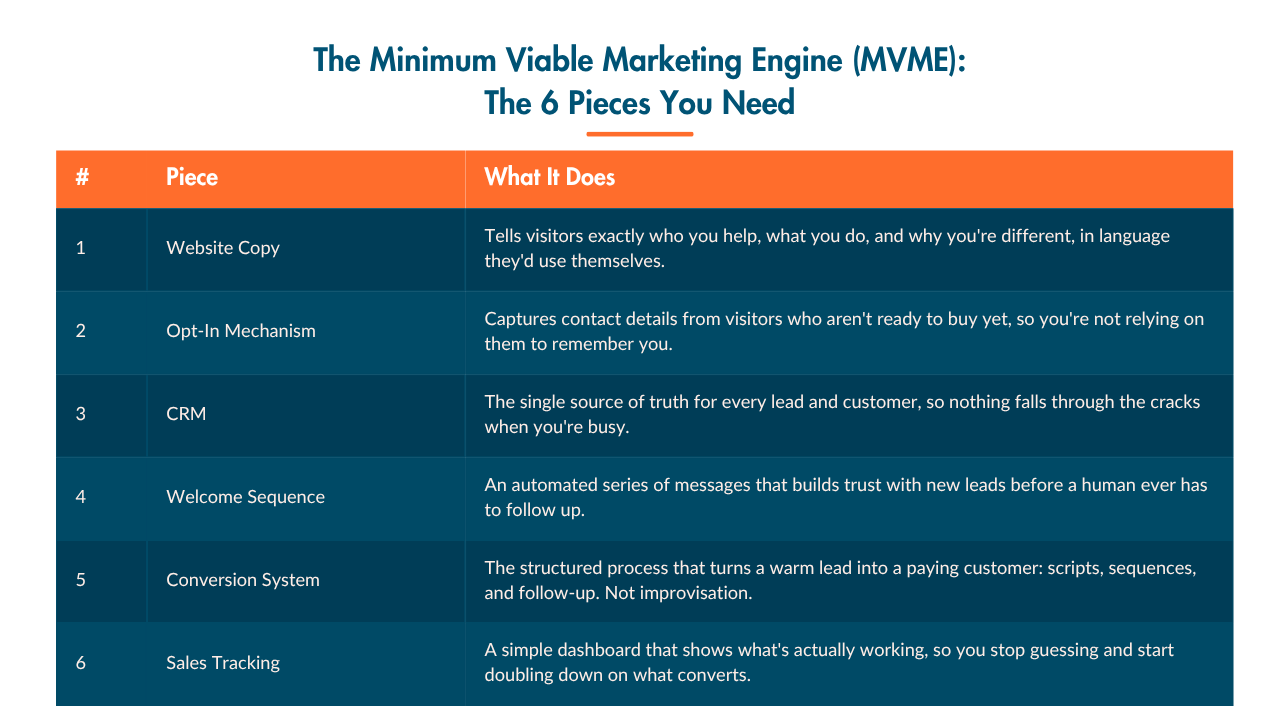
Notice what's not on this list: ads, social media, SEO, podcasts. Those are traffic tactics. They're important, but they're piece seven, eight, and nine. If you turn on traffic before these six pieces are in place, you're just pouring more water into the leaky bucket.
These six pieces are also your Force Multipliers: the Tools, Assets, and Processes that make everything else you do faster, cheaper, and more effective. Get them right, and every later investment in traffic, hiring, or new channels pays off harder.
Installation order matters more than installation speed. Here's the sequence that prevents waste: message and offer first, then conversion and nurture, then traffic.
Find the leak, build the system, turn it on, then remove the next constraint.
Before you touch a single tool, nail your Website Copy: who you help, what makes you different, and an offer that's easy to say yes to. Most businesses skip this and go straight to tactics. But if your message sounds like everyone else's, you're competing on price before you've even started, and every later phase gets built on a weak foundation.
Now install your Conversion System, your CRM, and Sales Tracking. Before you spend a single dollar attracting new people, make sure the people you already have are converting at the rate they should be. Most businesses find 20-30% more revenue here without spending anything on new traffic.
Install your Welcome Sequence next. This is the automated handshake that happens the moment someone raises their hand, before a salesperson ever picks up the phone. It builds trust on autopilot, so your team only talks to people who are already warmed up.
Now add your Opt-In Mechanism. With your message, conversion, and nurture already working, every new lead that opts in has somewhere productive to go. Add this step too early, and you're just collecting names that go nowhere.
Last comes traffic: ads, content, partnerships, referral campaigns, all feeding into the CRM you already built in Phase 2. By this point, your system already converts well. Traffic just adds fuel to a fire that's already burning, instead of fuel to a fire that hasn't been lit.
You don't need 47 tools. You need one tool per piece, set up correctly. At minimum:
Resist the urge to buy more software before you've installed the system. New tools don't fix a missing process. They just give you more tabs to leave open.
Starting with traffic. This is the single biggest mistake, and it's the one every marketing channel pushes you toward, because every channel sells traffic. Run ads to a leaky funnel, and you're just paying to find out how leaky it is.
Skipping the message and offer. Founders who jump straight to building a CRM or a funnel without nailing their message end up with a system that converts poorly no matter how well it's built. If your offer doesn't sound different from the next business in your industry, you're stuck competing on price, and no amount of automation fixes that.
Building it all yourself with no outside eyes. A do-it-yourself marketing system built in isolation tends to repeat the founder's blind spots. You don't know what you don't know. That's not a knock, it's just how blind spots work.
Hiring an agency to "take it off your plate." This feels like relief in month one and a hostage situation by month twelve. If the agency disappears, does your marketing disappear with it? If yes, you never had a system. You had a subscription.
Skipping sales tracking. Without it, you're flying blind. You'll feel busy, but you won't know if you're actually making progress or just generating activity. Guessing is expensive. Systems are cheaper.
Staying the bottleneck. Even a well-built system fails if every decision still runs through the founder. The point of installing a system is to get your hands on the controls, not stay buried in the engine.
A lean marketing system is built for founder-led businesses, typically professional services (agencies, consultants, legal, accounting), trades, or e-commerce, where the owner is still the main driver of growth and revenue sits between $60K and $10M.
It fits you if:
Not every business needs this approach. A lean marketing system is not a good fit if:
A lean marketing system isn't the only path. Here are the most common alternatives and where each one fits:
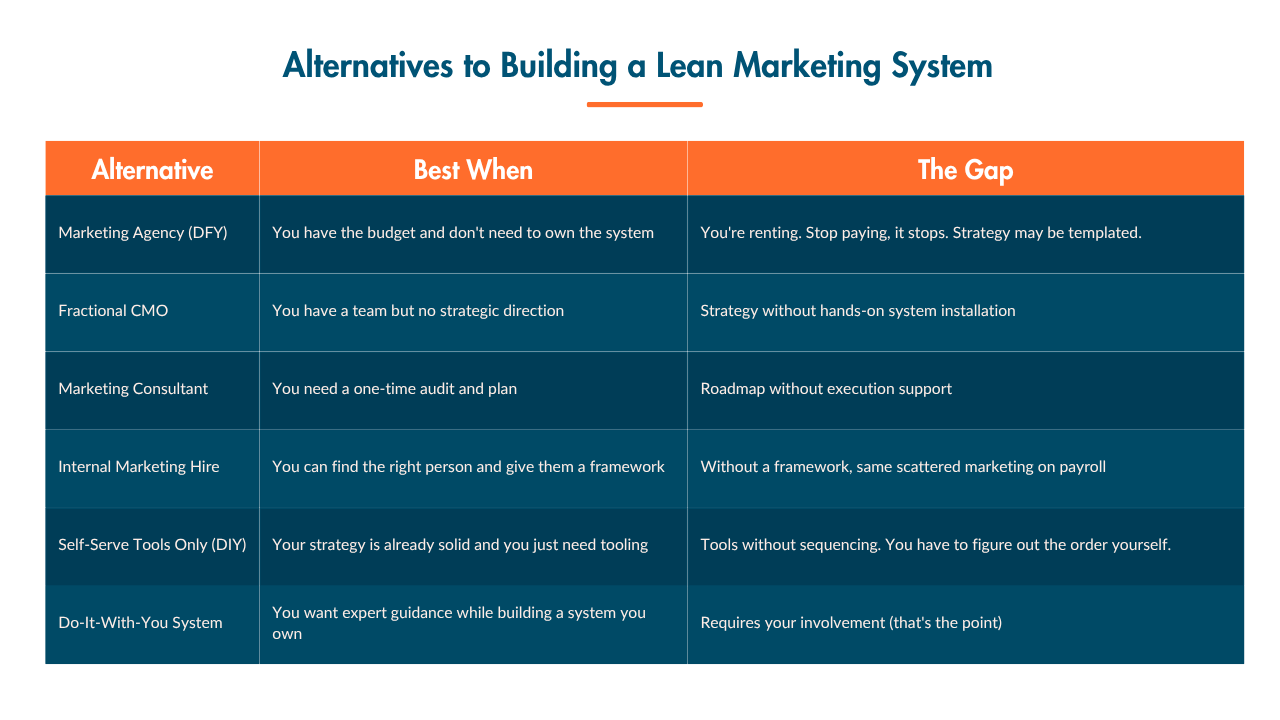
For most founder-led businesses stuck at a revenue plateau, the honest answer is: get the sequence right first, then choose the model (DFY, DWY, or DIY) that matches your capacity and timeline.
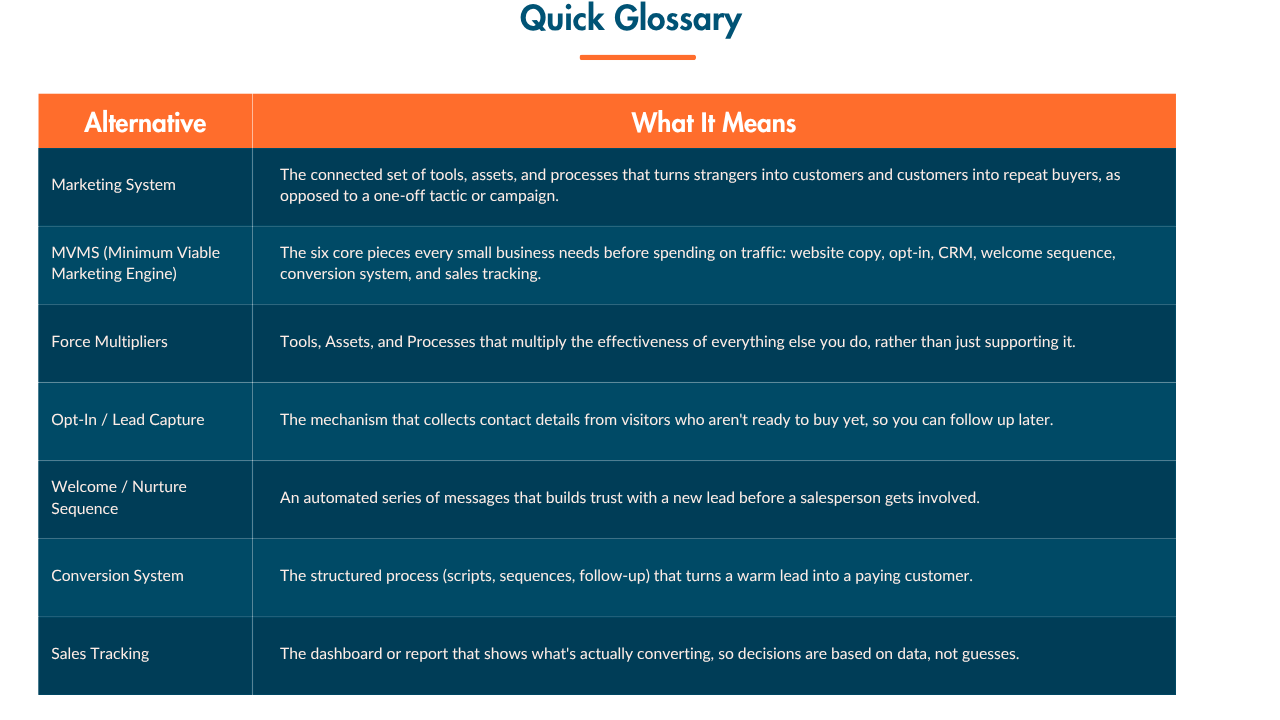
A do-it-yourself marketing system is a marketing setup (website, CRM, email automation, conversion process) that a business owner builds and manages without an agency. The advantage is full ownership and low cost. The risk is building without a proven framework, which often leads to a system that looks complete but has critical gaps.
A do-it-with-you marketing system is one where a coach gives you the exact framework, sequence, and action steps, while you and your team build it inside your own tools. You get expert direction without handing over ownership. It's the middle ground between paying an agency to do everything (and owning nothing) and figuring it out entirely alone.
An agency builds and runs your system using their tools and their processes. When the contract ends, you're often left with nothing. A do-it-with-you marketing system gets installed in your tools, your CRM, your data, from day one. You're not renting your marketing. You own it.
The best fit depends on revenue stage. Businesses earning $60K-$360K a year typically need the foundational six pieces (the MVME) installed correctly for the first time. Businesses past $360K usually already have pieces in place but need them connected, sequenced, and optimized, plus a system for training a team to run it without the founder.
Most of the six core pieces can be installed in weeks, not months, if you follow the right order. The bottleneck is rarely time. It's sequence. Businesses that try to do everything at once (or start with traffic) often take a year to get less than businesses that follow the message-first, conversion-second, traffic-last order in a single quarter.
It means the work (campaigns, copy, sequences) gets built and run inside the provider's tools and accounts, not yours. It's often fast to launch and requires little effort from you, but the strategy may be templated rather than built around your specific bottleneck, and access usually ends when you stop paying.
Done-for-you is faster to launch because a provider's team and templates are ready to go. But "launched" isn't the same as "working." A templated approach that doesn't target your actual bottleneck can sit live for months without moving revenue. Done-with-you takes longer to set up because it's built around your specific gaps, but tends to compound faster once live, and the system doesn't disappear if you change providers.
It depends on what you're optimizing for. An agency gets you to "launched" fast, but the system lives in their tools and stops when you stop paying. Building a marketing system yourself (or with a coach) takes longer upfront, but you own every piece (CRM data, email sequences, conversion processes) and it keeps running without the agency. If you've already spent $50K+ on an agency and can't point to a system you control, the answer is probably: build it yourself, with the right coach.
A marketing agency builds and runs campaigns in their own tools, on their own schedule. You're the client, not the operator. Lean Marketing is the opposite: we guide you through building the system inside your tools, your CRM, your data. When the engagement ends, the system doesn't end with it. Think of it as the difference between renting an apartment and building a house, with a contractor who shows you how every piece works so you can maintain it yourself.
It varies by model. A done-for-you agency typically runs $5,000-$15,000+ per month on an indefinite retainer. A do-it-with-you system is structured as a defined investment, often less than six months of an agency retainer, with the system continuing to run afterward at no additional cost. The pure DIY path is cheapest in dollars but most expensive in time and missed revenue from building the wrong things in the wrong order.
Fixing your marketing is one piece of a bigger shift. A lean marketing system is the foundation, since it stops every lead and follow-up from running exclusively through you. But operator to owner goes further: it means your team can run the system day to day, you can see what's working without digging for it, and the business keeps growing whether or not you're the one driving each deal personally.
It's the six pieces (website copy, opt-in, CRM, welcome sequence, conversion system, and sales tracking) installed in the right order, owned by you.
Do it yourself, and you risk missing pieces you didn't know you needed. Hand it to an agency, and you risk owning nothing when they're gone. Do it with the right coach, and you get both: the framework that works, and a system that's actually yours when it's done.
That's the whole point. Your team. Your tools. Your data. We're the GPS. You're driving.
Want that system built with someone next to you? Book a call and we'll look at your business, team, tools, and goals to see if the Lean Marketing Accelerator is a fit. If it is, you'll walk through all six pieces, in order, with a coach checking your work at each step. You keep the system when it's done.
You'll get new articles delivered straight to your inbox, plus special subscriber-only content such as podcasts, videos and live training events.

Get free weekly emails that make you smarter at marketing and help you grow your business