
Every small business owner now has access to the same AI marketing tools that used to require a full marketing department. ChatGPT writes your email sequences. AI tools draft your ad copy, summarize your customer feedback, and answer support tickets while you sleep.
So why are most small businesses still stuck?
Because a tool isn't a system. AI marketing automation without a sequence is just a faster way to do random acts of marketing. You can generate fifty pieces of content in an afternoon and still have no idea which piece of your funnel is actually leaking.
The businesses pulling ahead in 2026 aren't the ones with the most AI tools. They're the ones who paired AI marketing tools with a coach who tells them what to automate, in what order, and why. That's "done-with-you" marketing, and here's our skimmable breakdown of the top options for small and medium businesses.
Quick Answer: The top AI marketing systems with guided support in 2026 are: Lean Marketing Academy (AI mapped to a full marketing system with coaching), DigitalMarketer's AI-Powered Marketer Accelerator (training + community), Predictable Revenue (AI-augmented outbound for B2B), standalone AI marketing agents and customer service software (powerful but self-managed), and Knowledge Broker Blueprint/Mastermind.com (a different category: knowledge business, not marketing system). The key differentiator is whether the AI comes with a sequence or just a tool stack.
Marketing system software has gotten radically cheaper and more capable. The bottleneck isn't access to AI marketing tools anymore. It's knowing what to point them at.
Hand a SMB owner a powerful AI marketing automation platform with no guidance, and here's what usually happens: they automate the easiest thing first (usually social posts), not the thing that's actually losing them money (usually a weak message or broken follow-up). The AI works perfectly. It's just automating the wrong step.
Done-with-you marketing systems solve this by pairing the software with a sequence: message and offer first, then conversion and nurture, then lead capture, then traffic. Use AI to speed up each piece once it's in the right order.
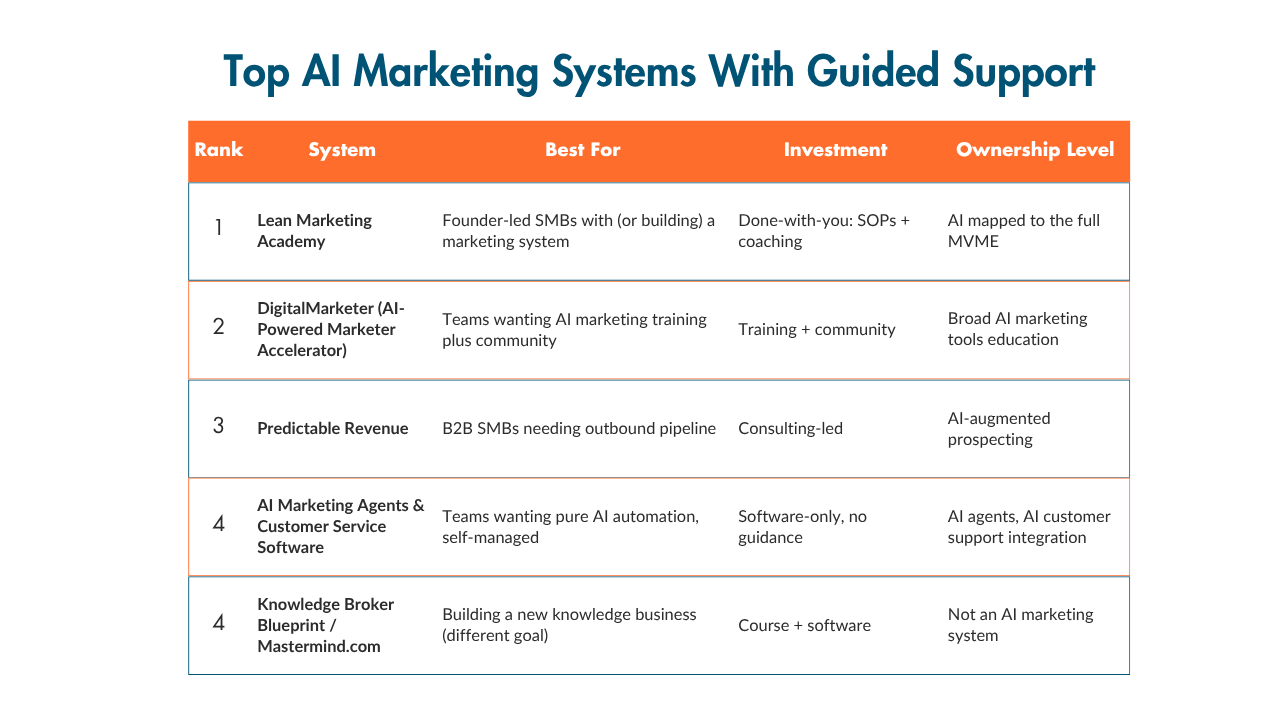
Best for: Founder-led SMBs that already have (or are building) the Minimum Viable Marketing Engine and want AI to handle the execution grind, without losing the underlying strategy.
How it works: The Lean Marketing Academy pairs the 1-Page Marketing Plan course and 300+ channel-specific SOPs with a library of AI GPTs built specifically for each piece of the marketing system: refining your message and offer, writing welcome sequences, drafting conversion follow-ups, and automating routine customer communication. The AI plugs into a sequence you already understand, which cuts execution time without making your marketing a black box.
Strengths:
Watch for: This works best if you've already got (or are building) the underlying system. It's an accelerator for a sequence, not a replacement for having one.
Best for: Marketing managers and small teams who want structured AI marketing training plus an ongoing community of practitioners.
How it works: DigitalMarketer's AI-Powered Marketer Accelerator delivers practical AI marketing playbooks through live Zoom training, with replay access through DigitalMarketer Academy and a network of certified partners for additional support.
Strengths:
Watch for: It's a training and community model, broad across all marketing disciplines, not a packaged "install this system in your business" sequence. You'll need to do more of the sequencing yourself.
Best for: B2B SMBs whose biggest bottleneck is outbound lead generation and pipeline, not marketing as a whole.
How it works: Originally the outbound sales system Aaron Ross built at Salesforce, Predictable Revenue has evolved for 2026 to lean heavily on AI-augmented prospecting: AI agents that research prospects using intent signals, personalize outreach at scale, and score accounts dynamically, implemented with consulting support.
Strengths:
Watch for: This is a sales pipeline system, not a marketing system. It doesn't cover your website, opt-ins, or nurture sequences. If your gap is conversion or nurture rather than outbound volume, this solves a different problem.
Best for: Teams that want pure AI automation (AI agents handling outreach and content, and AI-powered customer service) without an ongoing guidance relationship.
How it works: A growing category of tools puts AI agents to work on specific jobs: handling follow-up and outreach, generating content, and triaging or resolving customer service conversations. Some are sold as standalone software you configure yourself; others get bundled by "AI marketing automation agencies" as a managed service on top.
Strengths:
Watch for: Same "tool vs. system" gap as any self-serve AI marketing tools. AI agents are very good at running a process. They're not good at telling you which process to run, or whether your message is even right in the first place. Buy this without a sequence already in place, and you'll automate confidently in the wrong direction. If it's sold to you as a managed "AI marketing automation agency" service, the usual done-for-you ownership tradeoffs apply: confirm what happens to your data and workflows if you cancel.
Best for: People who want to build a brand-new revenue stream by packaging their own knowledge into a course or mastermind, not SMBs trying to automate marketing for an existing business.
How it works: KBB is a course (created by Tony Robbins, Dean Graziosi, and Russell Brunson) that teaches you how to turn expertise into a paid mastermind or community, paired with MindMint software to run it.
Strengths:
Watch for: This is a different category entirely. It's not an AI marketing automation system for running an existing SMB's marketing. It's a blueprint for building a new knowledge-product business. If that's not your goal, this won't solve the problem you came here with.
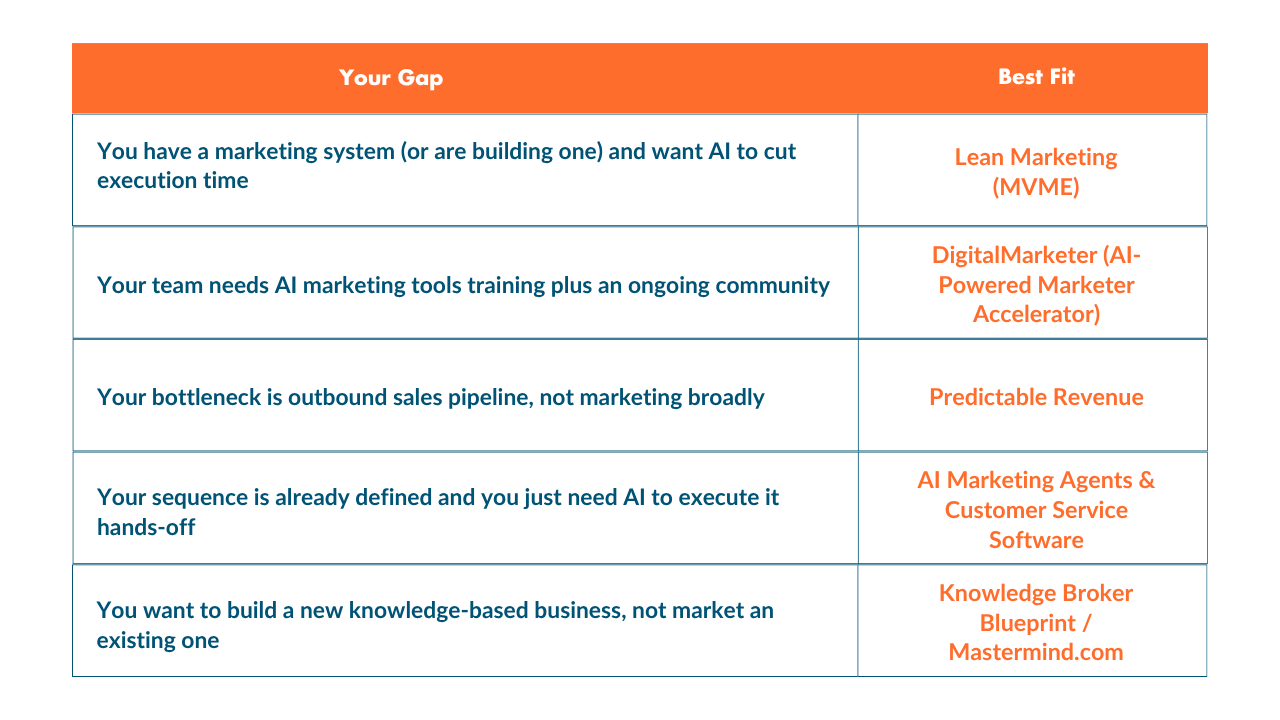
This category works best for:
This isn't the right fit if:
AI marketing automation uses AI tools to handle repetitive marketing tasks (writing email sequences, personalizing follow-ups, summarizing customer feedback, even handling first-line customer support) within a defined marketing system. The "automation" part is the AI; the "system" part is the sequence that tells the AI what to do and when.
AI marketing tools are software. They generate content, automate emails, or integrate AI customer support into your CRM. An AI marketing system is the strategy and sequence that determines which tools get used, in what order, and for what purpose. Tools without a system tend to automate whatever's easiest, not what's most needed.
For most SMBs, yes. Fully automated AI marketing tools are powerful but assume you already know what to build. Done-with-you marketing pairs the AI tools with a coach's guidance on sequencing (fixing your message and conversion before adding traffic, for example) so the automation amplifies a system that actually works, instead of speeding up guesswork.
Start with the piece of your system that already has the most volume (usually customer follow-up or welcome sequences) and automate that piece first using AI marketing tools mapped to your existing process. Avoid tools that require you to rebuild your CRM or website from scratch; a done-with-you system should slot AI into what you already have, not replace it.
AI marketing agents are AI-driven tools that handle specific marketing or sales tasks on their own: outreach, follow-up, content generation, or customer service responses, running continuously without being prompted each time. They're a powerful addition to a marketing system, but they work best automating a step you've already identified as your bottleneck. Used without a sequence behind them, an AI agent just executes random acts of marketing faster.
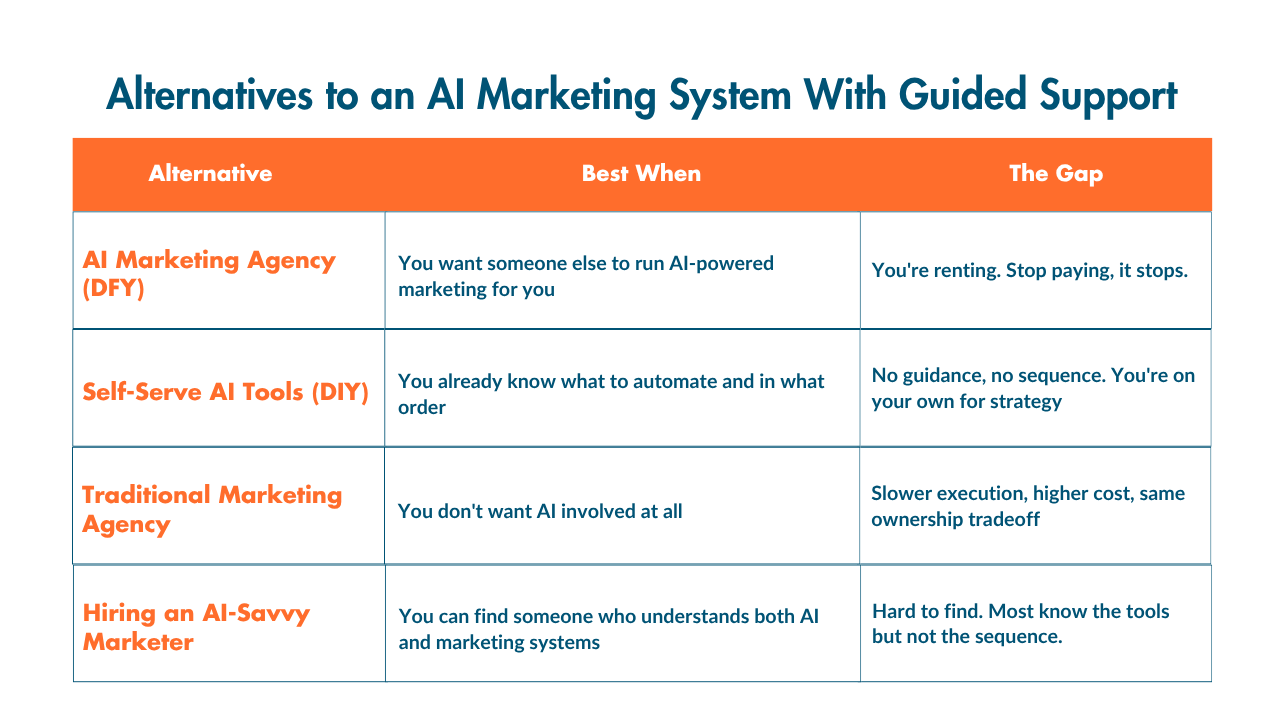
You can, if you already know what to automate and in what order. Most SMBs don't. The risk of going solo with AI marketing tools is the same as the DIY risk without AI: you'll automate whatever's easiest (usually content creation), not whatever's actually costing you money (usually a weak message or broken follow-up). A coach points the AI at the right bottleneck first.
Training (like DigitalMarketer's Accelerator) teaches your team how to use AI marketing tools across a range of disciplines. A system (like Lean Marketing Academy) gives you a specific sequence: which tool handles which piece, in what order, mapped to your marketing funnel. If your team needs broad AI fluency, go with training. If you need AI plugged into a working system this quarter, go with a system.
You can add it later, and for most businesses, that's the smarter move. Build the system first (message and offer, then conversion and nurture), then layer AI on top to speed up execution. AI tools work best when they're automating a process that already works, not when they're trying to create a process from scratch.
You'll get new articles delivered straight to your inbox, plus special subscriber-only content such as podcasts, videos and live training events.

Get free weekly emails that make you smarter at marketing and help you grow your business