
Quick Answer: Small business owners burn out from marketing because they're doing random acts of marketing with no system to sustain it. The typical pattern is this — they try a new tactic, it doesn't work fast enough, they abandon it and try something else, and the cycle repeats until they're exhausted. The fix isn't doing less marketing. It's building a system that runs without the founder at the center of every task.
Marketing is supposed to grow your business. For most small business owners, it does the opposite; it drains them.
Not because they're doing too much. Because they're doing the wrong kind.
I've spoken with hundreds of founder-led businesses over the years. The burnout story almost always follows the same pattern. They try a new channel, Instagram, Google Ads, a newsletter, and a referral program. It doesn't produce results in three months. They abandon it, feel guilty about abandoning it, and start something else. By the time they're talking to me, they've tried a dozen tactics, have nothing consistent running, and can't tell you whether any of it has ever worked.
This isn't a work ethic problem so much as a systems one.
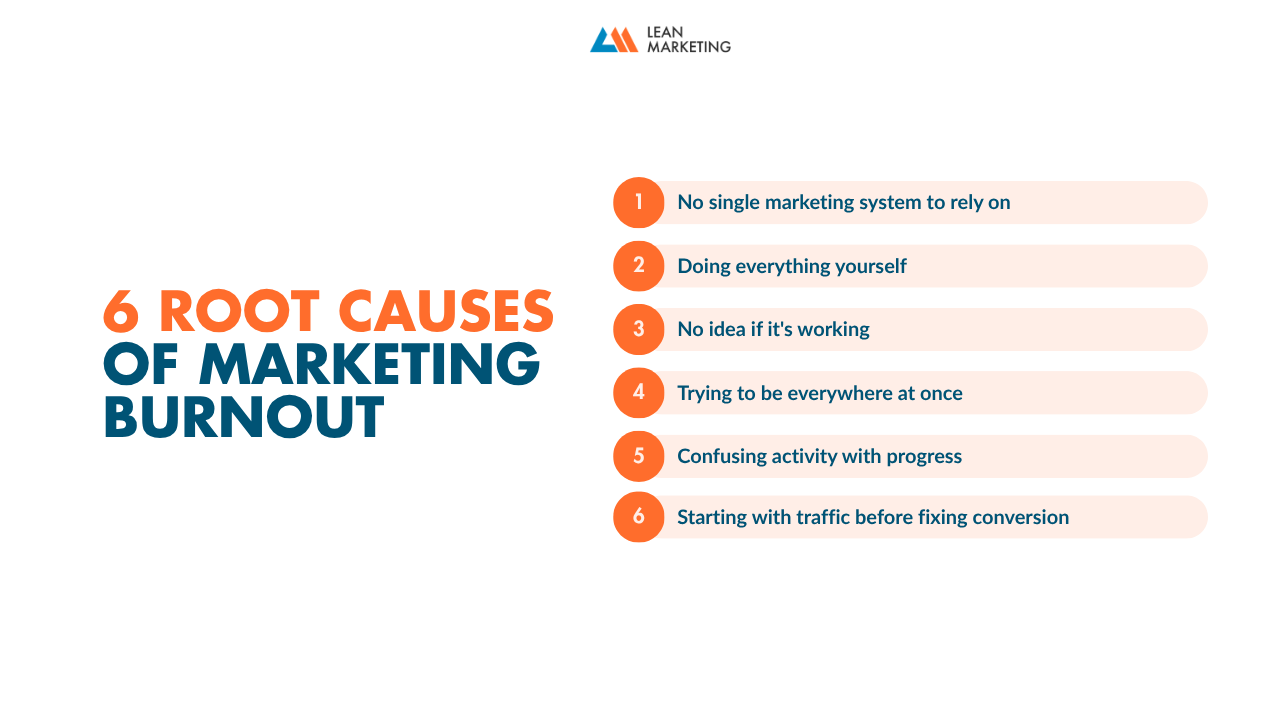
1. No single marketing system to rely on
The most common form of marketing burnout isn't caused by one specific activity. It's caused by having too many activities and no coherent system connecting them.
When everything is ad hoc, everything requires your thinking. Every piece of content is a decision. Every ad is a new experiment. Every email requires starting from scratch. There's no flywheel. Nothing compounds. You put in the same effort every week just to maintain the same output.
A marketing system changes this. When you have documented processes for how leads come in, how they're nurtured, and how they convert, the work becomes execution rather than reinvention. You stop making dozens of small marketing decisions and start running a machine.
A break won't fix that. A system that doesn't need you to think about it constantly will.
2. Doing everything yourself
Here's the thing about being the only one who does the marketing in your business: you're not being scrappy. You're creating a ceiling.
Every hour you spend writing a post, scheduling an email, or updating your website is an hour you're not doing the work only you can do: strategic decisions, relationships, delivery, and the things that actually differentiate your business in the market.
The argument against delegating usually comes down to one of two things. "No one else can do it the way I do," which is probably true, and probably a signal that you haven't documented how you do it. Or "I can't afford to hire someone," which is often a cost-of-hiring problem, not a money problem.
Getting faster at doing everything yourself isn't leverage; it's a faster treadmill.
3. No idea if it's working
This is the most exhausting part, and most business owners don't identify it as a cause of burnout. They think they're tired from the work, when really they're tired from not knowing if it's working.
When you don't know whether your marketing is working, you can't feel confident about stopping what isn't working. You can't feel confident scaling something that is. Every tactic becomes an open loop. Did the webinar work? Was the LinkedIn post worth the two hours it took to write? Did the email campaign move anyone closer to buying?
Without a scoreboard, you're flying blind and exhausted from constantly wondering.
Winning without knowing why is fine until it stops. The scoreboard isn't a reporting exercise. It's what makes the work feel purposeful rather than arbitrary.
4. Trying to be everywhere at once
Someone tells you LinkedIn is where your audience is. Someone else says it's email. Your competitor is crushing it on video. You've heard podcasting is having a moment.
So you try all of it. You're half-committed to five channels instead of fully committed to two. Results are mediocre everywhere. You assume the channels are wrong, so you try different ones. Still mediocre. You burn out.
The channels aren't the problem. The spread is.
One channel done well for twelve months beats five channels done badly at the same time. Everyone agrees with that in principle. Almost nobody does it in practice.
Pick one. Build it. Measure it. Move on only when it's working.
5. Confusing activity with progress
Posting every day feels like marketing. It isn't, unless the posts are connected to a clear goal and you're measuring whether they move people closer to buying.
Attending networking events feels like marketing. It isn't, unless you're converting conversations into something.
Sending newsletters feels like marketing. It isn't, unless someone's opening them, clicking, and eventually buying.
Activity without measurement is just motion. It's tiring because it doesn't compound, and there's always more you could post, more events you could attend, more things you could send.
Progress is measured by leads generated, leads converted, and revenue traced to your marketing activity. If you can't answer those three questions, you're busy, not growing.
6. Starting with traffic before fixing conversion
This is the single most expensive mistake I see founder-led businesses make. They spend money on ads before they've confirmed their website converts. They generate leads before they've built a nurture sequence. They pour traffic into a leaky bucket, wonder why it's not filling up, and spend more on traffic.
The right sequence is message and offer first, then conversion, then traffic. Traffic is the last thing you add, not the first.
Starting with traffic creates a particularly brutal form of burnout because it produces fast negative feedback. You spend money, you don't see results, you conclude either marketing doesn't work or you're not doing it right. Neither is true. You're just doing it in the wrong order.
A better content calendar won't fix this. Neither will a new tool, or a week off.
What fixes it is a marketing system that doesn't require you to reinvent everything each week.
Here's what that looks like in practice:
A clear target market with real criteria, not "small business owners," but the specific kind of business, at the specific stage, with the specific problem you solve best. When you know exactly who you're talking to, everything gets easier. Content is easier to write. Ads are easier to target. Conversations close faster.
A message that differentiates you without you having to explain it. When your positioning is sharp, you stop competing on price and start attracting people who already want what you specifically offer.
A marketing coordinator who owns execution, not a strategist, not an agency. One person inside your business who runs the machine. You set the direction; they execute.
When those things are in place, marketing stops being something you do on top of running your business. It becomes part of how the business runs.
The instinct, when marketing feels overwhelming, is to hand it off to someone else: an agency, a freelancer, a VA. And sometimes that helps in the short term.
But if you outsource without first having a system in place, you end up managing the outsourced relationship instead of your marketing, which is its own version of burnout.
The business owners I see recover most completely from marketing burnout are the ones who build the system first, then hire into it. Hire into a system and you get a contributor. Hire into chaos and you get more overhead.
The goal isn't to get marketing off your plate. It's to get marketing out of your head.
If you're burned out from marketing, here are the options available to you and what each one actually delivers:
Taking a break and restarting works temporarily. It doesn't change what you return to. You'll burn out again the same way within three to six months.
Hiring a marketing agency removes some of the execution burden, but you still need to brief them, review their work, and manage the relationship. It doesn't build anything inside your business. When the contract ends, you start from scratch.
Bringing in a fractional CMO gives you strategic direction without the full-time cost. It's useful if execution resources are already in place, but it doesn't solve the founder-doing-everything problem on its own.
Hiring a marketing coordinator gives you execution support, but without a system to run, they default to whoever's asking them for things. You still carry the strategy.
Building a marketing system with coaching support installs the strategy, the processes, and the coordinator capability together. It takes time investment upfront, but it creates a machine that runs without you at the center. This is what Lean Marketing is designed to do.
You're likely ready to fix marketing burnout if:
Is marketing burnout different from general business burnout?
Yes. General business burnout often comes from running the entire operation. Marketing burnout has a specific cause: doing marketing without a system, without knowing if it's working, and without being able to delegate it. The good news is it has a specific fix, which means it's solvable without changing everything about how you run your business.
How long does it take to recover from marketing burnout?
That depends on what you change. If you take a break and return to the same approach, burnout recurs quickly. If you use the break to install a system and hand off execution to someone else, most business owners feel significantly different within sixty to ninety days. The compounding from a real system takes longer, but the relief from not carrying it personally is almost immediate.
What are the signs that marketing is draining rather than growing the business?
You're doing more marketing activity than last year, but generating the same or fewer leads. Marketing is the first thing that gets dropped when the business gets busy. You feel guilty when you're not actively doing marketing tasks. You don't know which of your current activities is working. Any three of these are a clear signal.
Can I fix marketing burnout without hiring anyone?
Yes, in the short term. The most immediate relief often comes from stopping five things and doubling down on one. If you eliminate the channels that aren't generating leads and focus on the one that is, the cognitive load drops significantly. Long-term, someone besides you needs to own execution. But you can start recovering without hiring.
Is it normal for business owners to do their own marketing?
Very common in the early stages. The problem is that marketing is one of those functions that requires consistent execution over time to compound, and founders doing it alongside everything else almost always produce inconsistent output. The real question isn't whether it's normal. It's whether it's sustainable and produces results.
How much time should a business owner spend on marketing each week?
At the beginning, when you're building the system, probably 10 to 15 hours a week. Once the system is installed and running, your role shifts to weekly review and high-leverage content creation. Many founders I work with get two to three hours per week of genuine marketing oversight once the system is in place and a coordinator is handling execution.
What's the difference between being busy with marketing and actually doing marketing that works?
Busy with marketing means activity you can measure: posts published, emails sent, ads running. Marketing that works means outcomes you can measure: leads generated, conversion rates improving, revenue traced to specific activities. The distinction matters because it's entirely possible to stay busy with marketing and have nothing to show for it. If you can't connect your marketing activity to leads and revenue, you're busy, not productive.
Marketing burnout isn't inevitable. It's what happens when you run without a system. If marketing feels like a weight rather than an engine, the answer isn't to do more of the same or less of everything. It's building the thing that runs when you're not pushing it.
You'll get new articles delivered straight to your inbox, plus special subscriber-only content such as podcasts, videos and live training events.

Get free weekly emails that make you smarter at marketing and help you grow your business