
You started your business with energy and a clear vision. Now you're posting content at midnight, chasing every new tactic, and working longer hours for fewer results. Something has gone wrong, and it's not your effort.
Marketing burnout is one of the most common things I see in founder-led businesses. It almost always traces back to the same cause: no documented plan, too many channels, and no way to tell what's actually working.
This guide gives you seven steps to prevent marketing burnout by building practical systems that reduce overwhelm. You'll get clear on what matters, cut what drains you, and end up with a plan you can follow even on your busiest weeks.
Quick Answer: Marketing burnout usually comes from chasing too many channels without a clear plan. The fix is working from a written strategy that tells you exactly what to do each week. These seven steps show you how to build that rhythm so marketing runs on a system, not on willpower.

Marketing burnout rarely comes from doing too much. It comes from doing too much of the wrong things. Before you change anything, you need to diagnose why you're exhausted.
Ask yourself three questions.
Most business owners I work with discover the same pattern. They're chasing tactics without a strategy underneath. They're trying to be everywhere at once. And they can't tell what's working because they're not measuring anything meaningful.
Write down everything you did for marketing last month. Circle the activities that generated leads or sales. Be honest. If your circles are sparse, you've found your problem.

Trying to market to everyone guarantees burnout. When your message is broad, you need more content, more channels, and more effort just to get noticed. Narrowing your focus lets you do less and connect more.
Your target market isn't "small business owners" or "people who need my service." It's a specific person with specific problems in a specific situation. The tighter your definition, the easier your marketing becomes.
Here's what to pin down:
Start with your best existing customers.
Use their language, their frustrations, and their desires as the foundation for everything you create.
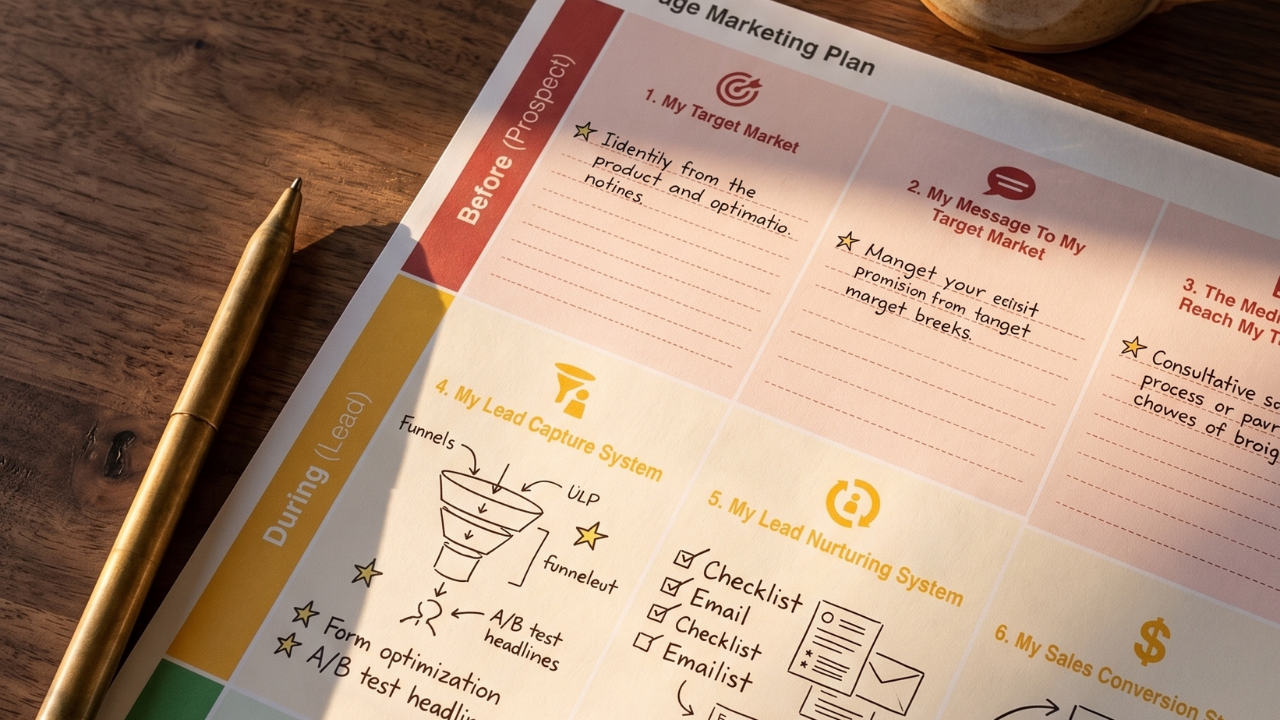
The fastest way to reduce marketing overwhelm is to get your entire strategy onto a single page. When you can see everything at once, you stop second-guessing what to do next.
The 1-Page Marketing Plan breaks your marketing into three phases:
Each phase has three steps. Nine total boxes. That's your entire marketing strategy.
This isn't about oversimplifying. It's about clarity. Complex plans get ignored. Simple plans get executed. When you know exactly who you're targeting, what message connects, and which channels to use, you stop wasting hours on activities that don't move the needle.
Block 30 minutes this week to draft your first version. It won't be perfect. It doesn't need to be. What matters is having something written down that you can refine as you learn what works.

If you're posting on five platforms, running ads, writing blogs, sending emails, and networking, you're heading for collapse.
Pick two channels. Just two. Master those before adding anything else.
How do you choose? Ask your customers where they found you. Look at where your competitors are getting traction. Consider which platforms suit how you communicate naturally. A local service business might focus on Google Business Profile and email. A B2B consultant might choose LinkedIn and a podcast.
The goal isn't to be everywhere. It's to be consistent somewhere. Two channels done well beats six channels done sporadically, every time. Your audience learns when to expect content from you. Algorithms reward accounts that show up regularly. And you stop feeling like you're drowning.
Give your two-channel approach 90 days before judging results. Quick changes based on short-term numbers are another path to burnout.
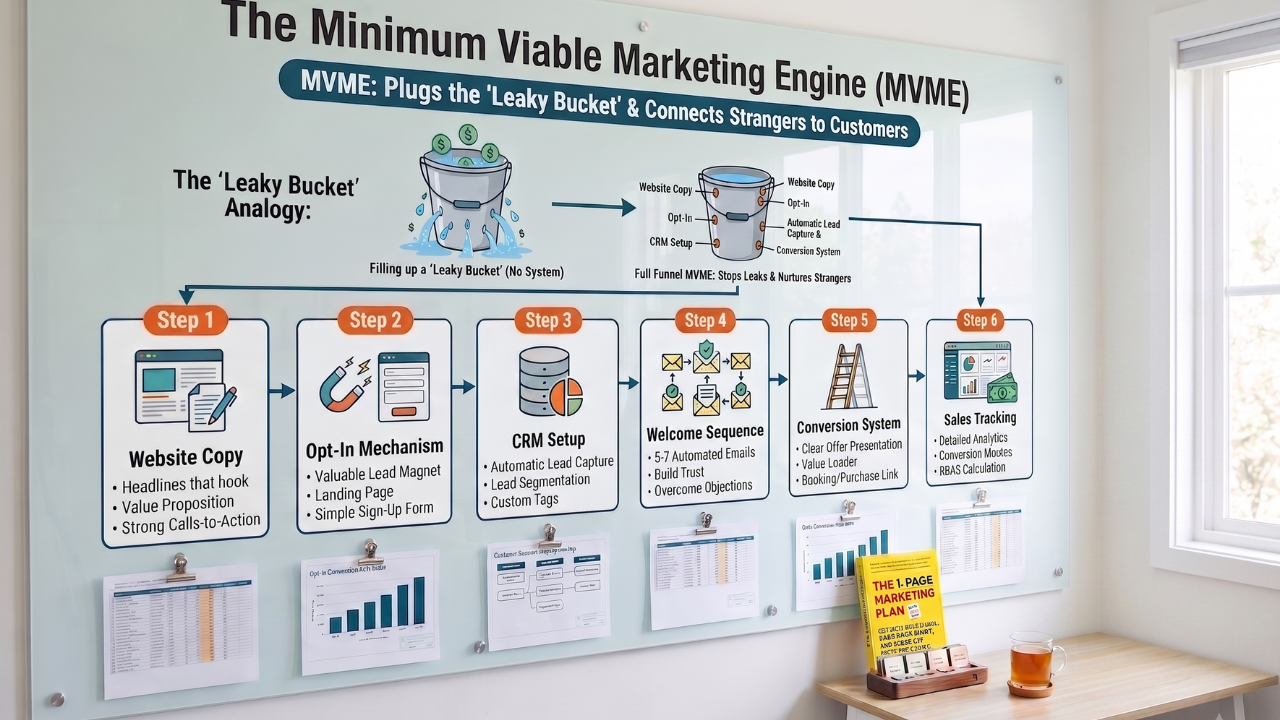
Every task you do more than twice should have a written process. Documented steps turn marketing from a creative challenge into a fill-in-the-blank exercise. They save hours every week and make it possible to hand work off later.
Start with your most common marketing activities.
Write each step out in simple bullet points.
Your written processes don't need to be elaborate. A checklist in a Google Doc works fine. The point is removing the mental load of figuring out what to do each time you sit down to work. When you have a process, you execute instead of deliberating.
Systems also protect your marketing when life gets chaotic. A sick week, a family emergency, or a busy season won't derail you because the playbook is already written.

Marketing burnout happens when there's no finish line. If every day feels like you're behind, you'll eventually stop trying. A weekly rhythm gives you structure and permission to rest.
A realistic schedule that works for most small business owners: one hour reviewing your numbers, 90 minutes improving one marketing asset, one hour creating content, two 30-minute blocks for distribution. That's roughly four hours of focused marketing time per week.
Notice what's not on the list: checking social media five times a day, responding to every comment immediately, or constantly tweaking ads. Those activities feel productive but rarely move your business forward.
Schedule your marketing time the same way you'd schedule a client meeting. Block it in your calendar. Protect it from interruptions. When the session ends, you're done for the day. That boundary is what keeps burnout from coming back.

The work that drains you most is often not the work that grows your business. Reporting, graphic design, scheduling posts, sending follow-up emails: these tasks pull you back into the details when you should be focused on decisions.
You don't need to hire full-time help to start. Two to five hours per week from a freelancer is enough. Outsource the repeatable tasks first: content repurposing, basic design, review requests, or data entry. Keep the high-judgment work for yourself.
If you’re looking for help with your next marketing hire, download our ultimate hiring toolkit with the exact process we’ve used for 1,000+ marketing hires.
Automation handles the rest. Email sequences can nurture leads between your check-ins. Scheduling tools can publish your content across platforms. A CRM can track your contacts without manual updates. The goal is removing friction from consistent execution.
If you've done something more than five times, it's a process. If it's a process, someone or something else can run it.
Running marketing as a founder means being five different things at once: creative, strategic, technical, analytical, and consistent. That combination would stretch a team. For a solo founder, it's a recipe for exhaustion.
The constant switching makes it worse. Writing content requires a different mental mode than analyzing ad performance or responding to comments. Moving between these tasks throughout the day fragments your attention and drains your energy faster than focused work would.
Add platform changes to the mix. Algorithms shift constantly. New features launch every few weeks. Staying current feels like a second job on top of running your actual business. And the penalty for inconsistency is steep: step away for a week and your reach drops.
The real cost is opportunity. Every hour spent on marketing is an hour not spent serving customers, improving your product, or resting. When marketing feels endless, something has to give.
Follower counts and likes feel good but rarely connect to revenue. Track numbers that show your marketing is generating business, not just attention.
Start with three.
Review these once a month. If lead volume is low, your visibility or message needs work. If conversion rate is weak, your follow-up or sales process needs attention. If acquisition cost is too high, you're using channels that aren't efficient for your business.
One number most business owners overlook is customer lifetime value. A customer who buys once is worth far less than one who returns and refers others. Build that number into your planning, and you'll make smarter decisions about where to put your energy.
This approach works for founders who:
Lean Marketing gives business owners a practical approach to simplify marketing, get clear, and grow without running on empty. The 1-Page Marketing Plan, trusted by over a million founder-led businesses, puts your entire strategy on one page so you always know what to focus on next.
Instead of chasing tactics and hoping something works, you build a systematic approach that produces consistent results. Lean Marketing's operating systems give you repeatable processes for every stage: targeting, messaging, lead capture, follow-up, conversion, and retention.
The whole approach is built on doing more with less. That means cutting what doesn't move the needle, focusing on activities that generate leads and sales, and creating systems that run without constant personal attention. When your marketing runs on a system, you can step back without everything falling apart.
If you're tired of chasing tactics that drain your energy without filling your pipeline, start with a plan. Download the free 1-Page Marketing Plan and start building a marketing system that supports your business instead of consuming it.
You're likely burned out if you're working longer hours but seeing fewer results, avoiding marketing tasks you used to enjoy, or feeling dread when you think about creating content. The first thing to check is whether you have a documented marketing plan. Without one, every decision becomes a source of stress.
Yes, but only by changing your approach. The fastest path is simplifying your strategy with a tool like the 1-Page Marketing Plan. Focus on two channels, create written processes for repeatable tasks, and set clear boundaries around your marketing time. You can do less and still grow.
Four to five focused hours per week is sustainable for most small business owners. The key is making those hours count by working from a written plan. Without one, you'll spend ten hours on activities that could be done in two with clear direction on what matters.
Trying to be on every platform and chasing every new tactic. This spreads your energy too thin and almost always produces inconsistent results. The opposite approach is to go deep on two channels and build consistency before adding more.
A written plan removes daily decision-making from your plate. You already know who you're targeting, what message to use, and which channels matter. The 1-Page Marketing Plan gives you that clarity in nine boxes. When you're not constantly figuring out what to do next, your energy goes further.
Busy feels productive even when it's overwhelming. Burnout feels pointless. If you're working hard on marketing but can't point to what it's actually producing, that's the clearest sign something needs to change. The fix isn't doing less. It's doing the right things in the right order with a plan that tells you both.
Cut to two channels and stop everything else. This single decision removes the majority of the mental load immediately. Then spend 30 minutes writing down your target market, your core message, and what you want people to do when they encounter your marketing. You now have the start of a plan.
If you're managing multiple marketing channels without clear processes, or you've been working harder without seeing more results, the 1-Page Marketing Plan is where it starts. Download it free and spend 30 minutes getting your strategy on one page.
You'll get new articles delivered straight to your inbox, plus special subscriber-only content such as podcasts, videos and live training events.

Just tell us where to send yours below. We respect your email inbox and will never spam.
Get free weekly emails that make you smarter at marketing and help you grow your business