
It's 9:40 on a Thursday night and you're still at the laptop. A lead from Tuesday never got a reply. A happy client is waiting on the referral intro you promised. The email your marketing person drafted has sat in your inbox for approval since Friday. And you still can't say whether last month's ads did anything.
You're the bottleneck for too many things, and you know it. Every step that turns a stranger into a customer runs through your memory and your inbox.
That's where founder load comes from. The fix is marketing systems that move people forward without you pushing them.
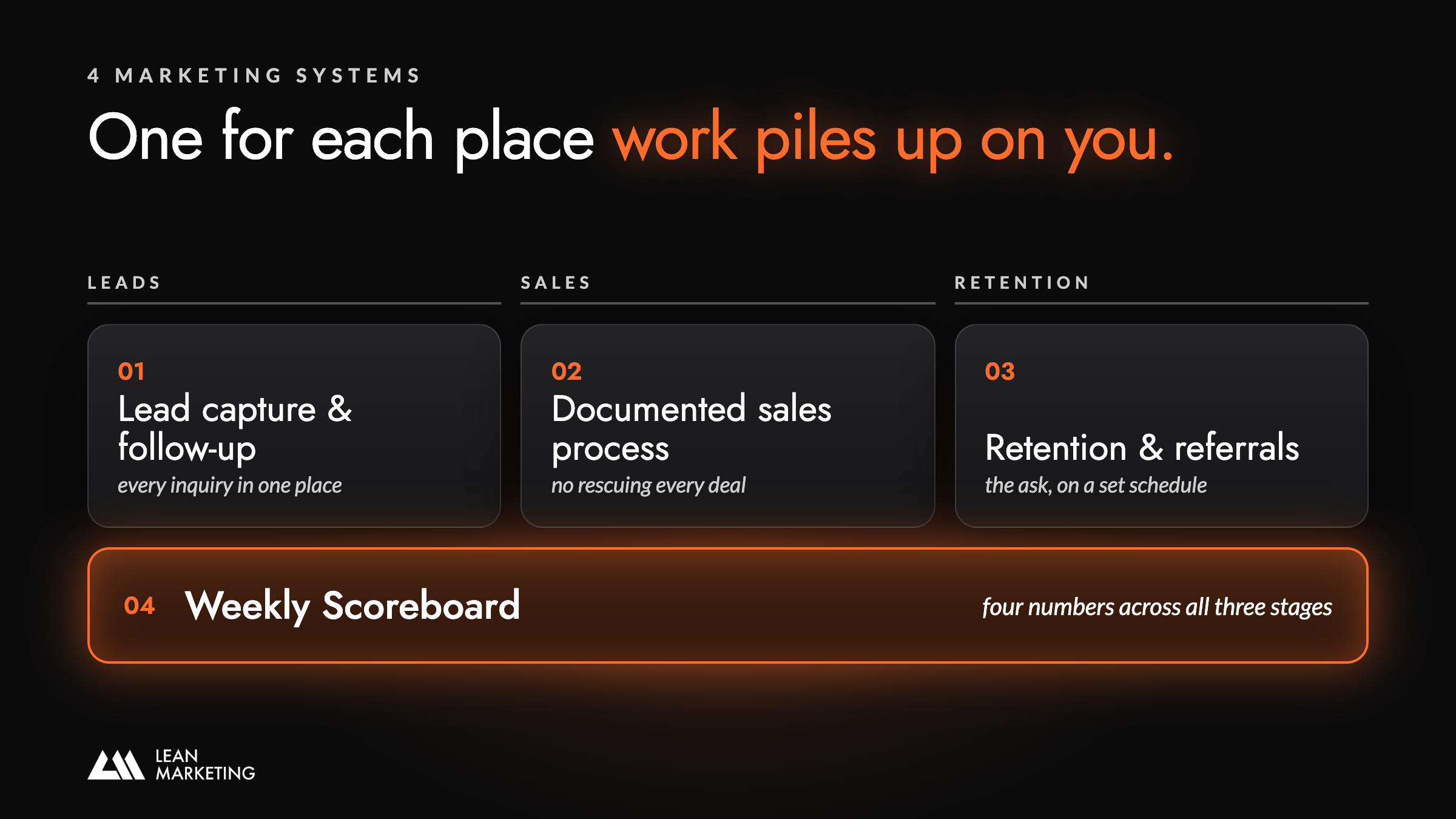
Quick Answer: The four marketing systems that ease founder load are lead capture and follow-up, a documented sales process, a retention and referral system, and a weekly Scoreboard. Each one moves customers or decisions forward without you personally remembering or chasing every step. Build them where growth is stuck first, and document each one before you automate it.
Quick guide: 4 marketing systems that ease founder load
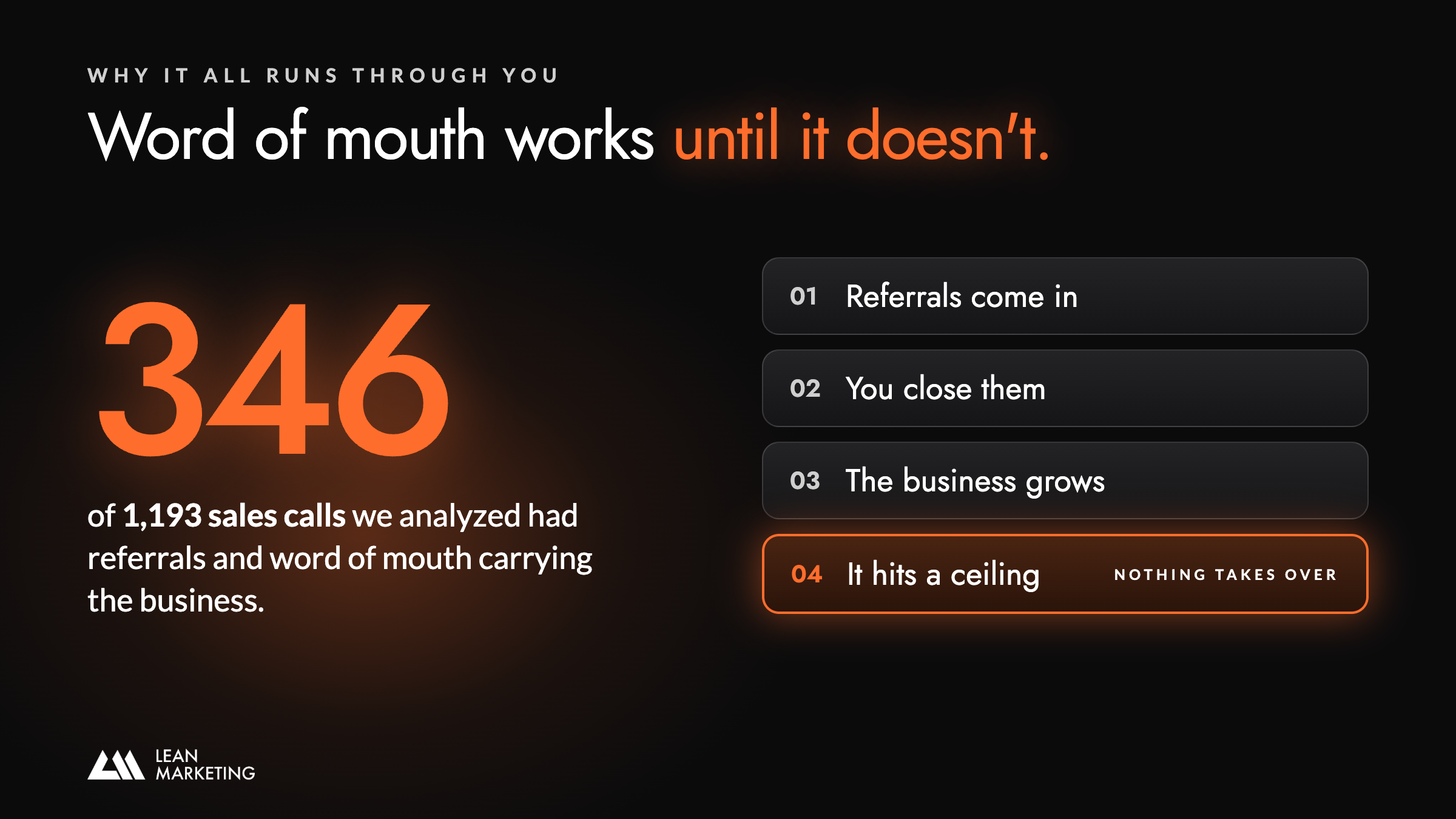
Because it started with you. Early on, you were the lead gen and the sales team, and that worked. Referrals came in, you closed them, the business grew.
Then it hits a ceiling. In 1,193 sales calls we analyzed, referrals and word of mouth were carrying the business in 346 of them. The pattern repeats: word of mouth works until it hits the limit, and nothing else is set up to take over.
The instinct is to work harder or buy another tool. Neither removes load. Faster manual work still depends on you, and a new AI tool often becomes one more thing to supervise.
Relief comes from marketing systems: connected processes that move people from one stage to the next whether or not you're watching.
If you're planning the move, here's how to replace your marketing agency step by step.
One for each place where work piles up on you.
This system puts every inquiry in one place and follows up automatically until the person is ready to talk. It replaces you trying to remember who reached out and when.
You need four pieces:
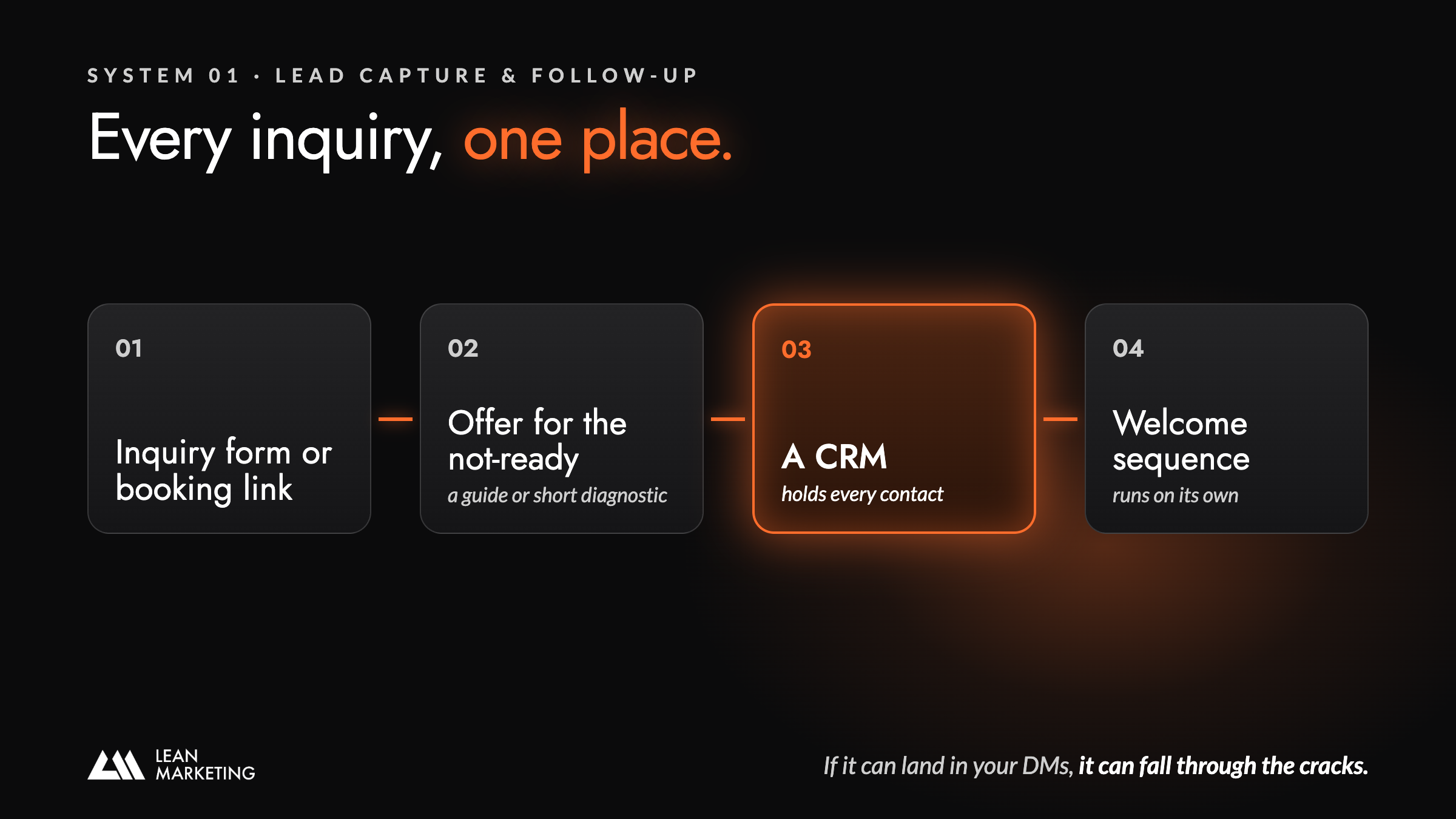
If a lead can land in your personal inbox or your DMs, it can fall through the cracks.
This week: list every way a lead can reach you and where each one ends up. Anything that doesn't reach the CRM is a leak.
A documented sales process moves a qualified lead to a yes or no without you rescuing the deal. It spells out who's a fit, how fast you respond, what happens after the first call, and when to follow up.
More leads won't fix a sales problem. If every deal depends on you taking the call, growth is capped at your calendar. Converting more of the leads you already have takes load off faster than chasing new ones.
This week: write down the steps of your last few closed deals, from first contact to signed. The steps they share are your first draft.
This system keeps customers buying and referring without anyone having to remember to ask. It covers four things:
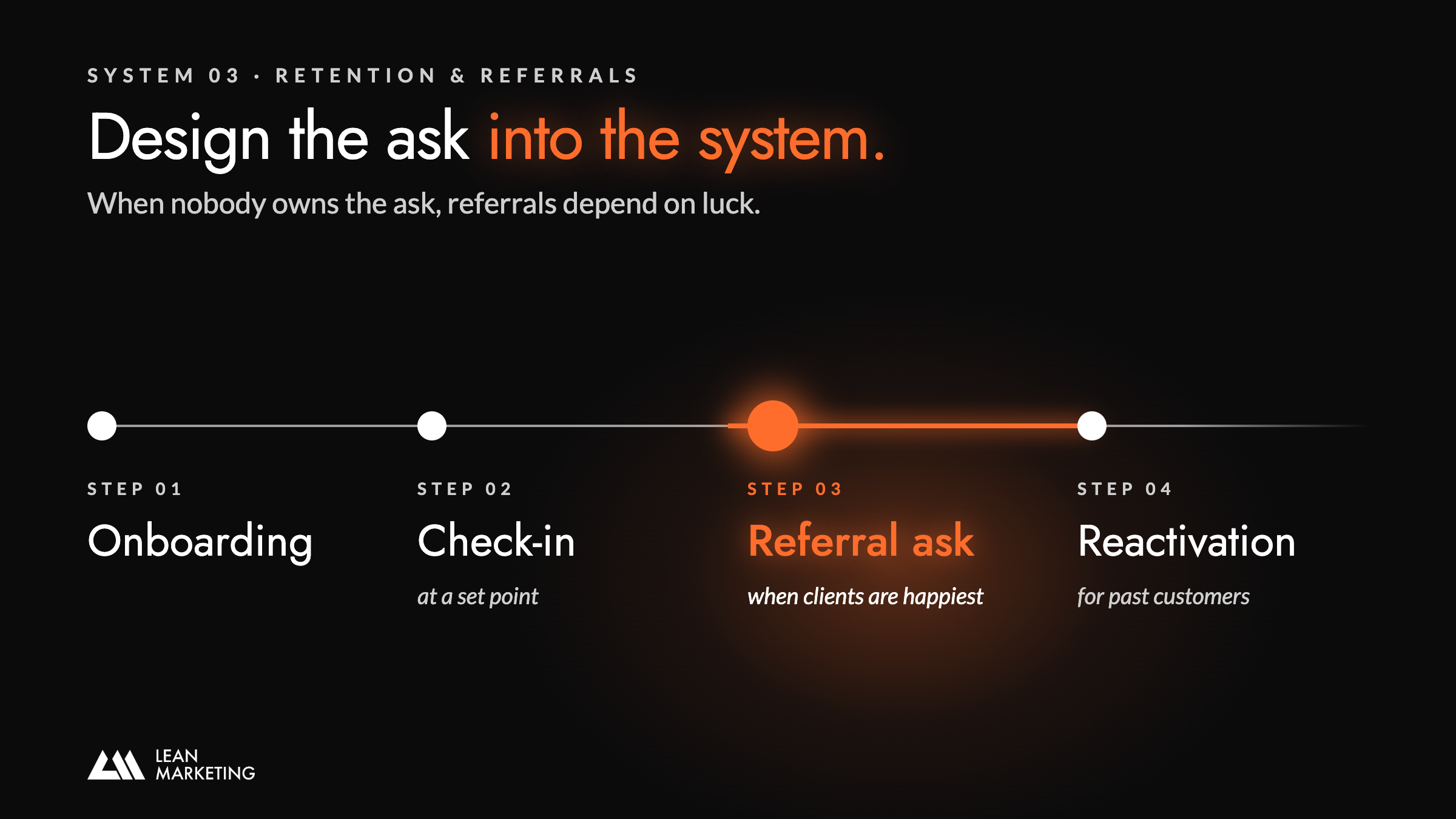
When nobody owns the ask, referrals depend on luck. Design the ask into the system and your best channel becomes predictable, and customers stay longer.
This week: pick the moment clients are most pleased with your work. Write the referral ask for that exact moment.
A Scoreboard is the short set of numbers that tells you whether you're winning and where the constraint is. It takes decisions out of your head and puts them where your team can see them.
Keep it to four numbers:
When everyone sees the same numbers, nobody has to ask you what to work on next. The Scoreboard is the referee. For more, see the marketing metrics that matter.
This week: put those four numbers in one sheet. Review them for 15 minutes every Monday.
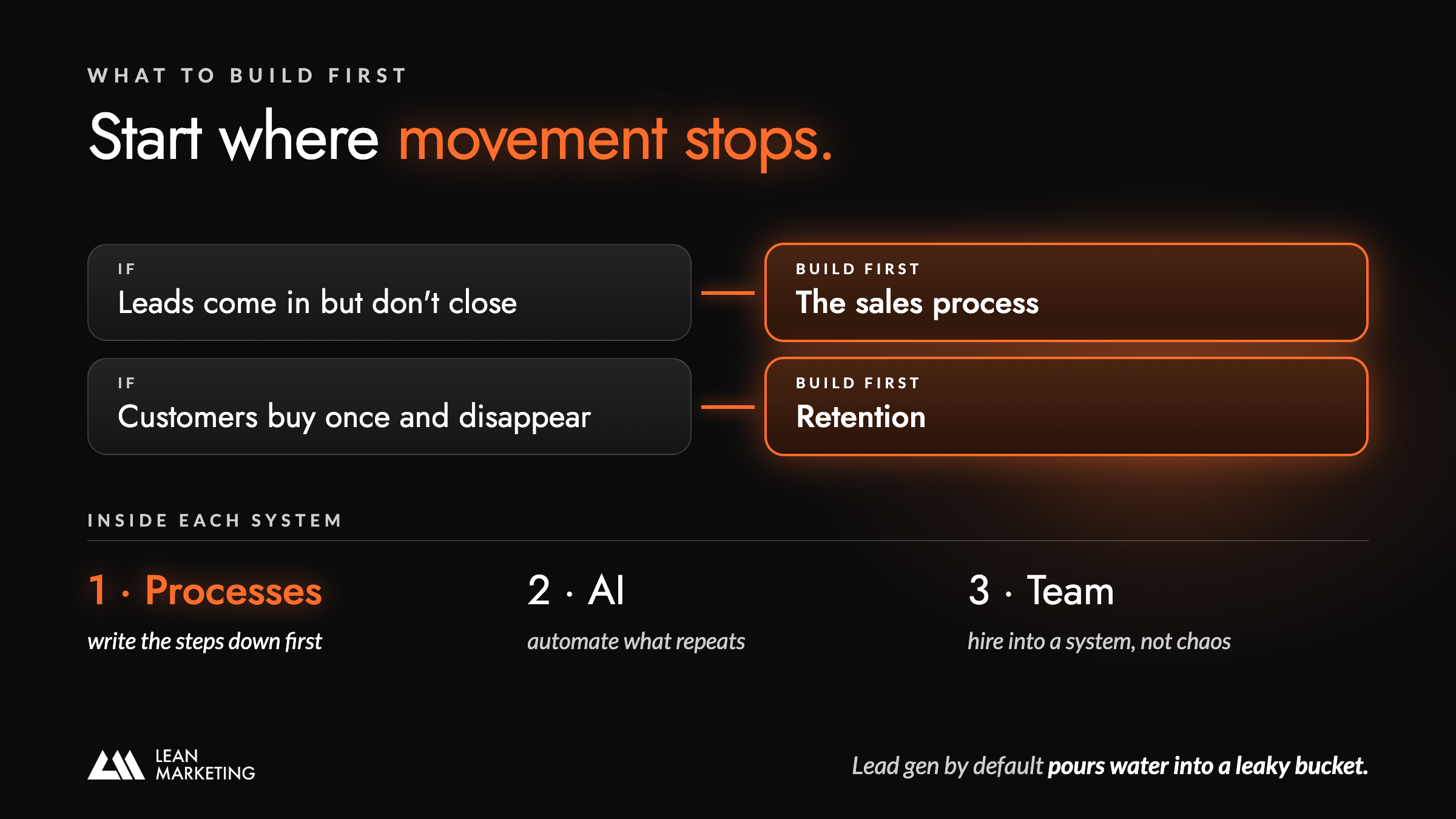
Start where movement stops. If leads come in but don't close, build the sales process first. If customers buy once and disappear, start with retention. Defaulting to lead generation pours more water into a leaky bucket.
Inside each system, follow the same order: Processes → AI → Team.
Doing it yourself is still quicker this week. It's slower every week after.
Joseph Ialacci put it this way: "I'm sure a lot of entrepreneurs are like me, who don't delegate and trust enough… I feel like I've gotten my life back."
Not sure it's time yet? Check these 9 signs you need an in-house marketing system.
Lean Marketing helps founder-led businesses install their first Marketing System in their own tools. A coach guides the build and your team does the work. We start where movement is breaking down across Leads → Sales → Retention, document it, automate what repeats, then help you hire into it.
The target is 1 Page, 1 Person, 1 Pulse: a working plan with a real mechanism at every stage, someone besides you who can run it, and a live Scoreboard. You own every piece, and your team runs it after we're done.
The four marketing systems that ease founder load most are lead capture and follow-up, a documented sales process, a retention and referral system, and a weekly Scoreboard. Together they move leads and customers forward without the founder personally remembering or chasing each step.
A marketing system is a connected set of processes that moves people from first contact to paying customer to repeat buyer without depending on the owner. At Lean Marketing, that means Leads → Sales → Retention, with each stage handing off to the next.
Automation helps with founder burnout management only after the process is clear. Automating a messy process creates new work, because someone still has to check and fix it. Document the steps first, automate what repeats, then review the results on your Scoreboard each week.
Marketing infrastructure is what your marketing runs on: your CRM, forms, email sequences, tracking, and documented steps. Good infrastructure lives in accounts you own, so your system and your data stay with you if a vendor or employee leaves.
Usually not. Build and document the core systems first, then hire someone to run them. A new hire who walks into clear processes and a live Scoreboard can contribute quickly. A new hire who walks into chaos usually needs you for every decision.
You can draft each system in a few weeks if you focus on one at a time. In Lean Marketing's Launch program, the full build takes four months, with your team building in your own tools alongside a coach.
If every lead and every referral still runs through you, start by finding where movement stops. Book a Marketing Clarity Call and complete the short MRO diagnostic. We'll review your numbers, show you where growth is likely leaking, and tell you which system to build first.
You'll get new articles delivered straight to your inbox, plus special subscriber-only content such as podcasts, videos and live training events.

Get free weekly emails that make you smarter at marketing and help you grow your business