You’ve proven the business works. Now you want to step back, and every program promises to set up your marketing. Each one sounds fine on the call.
None of them shows you what you’ll hold on the last day. Settle this first.
Quick Answer: Choose a guided marketing setup by defining done before you buy. Ask what you will hold at the end: tools in your own accounts, written processes, a trained person who runs them and a live Scoreboard. Then check who builds, who reviews your work and what happens after the last session.
What is a guided marketing setup?
A guided setup means you build the marketing system in your own tools while a coach plans it, reviews your work and fixes what breaks. It sits between doing everything alone and paying someone to run it for you.
You want out of the details. You don’t want to hire someone to do everything and keep paying them. A guided setup keeps you in control while the work moves off your plate.
How does a guided setup compare with the other ways to get set up?
Each route changes who builds the system and what you own afterward.
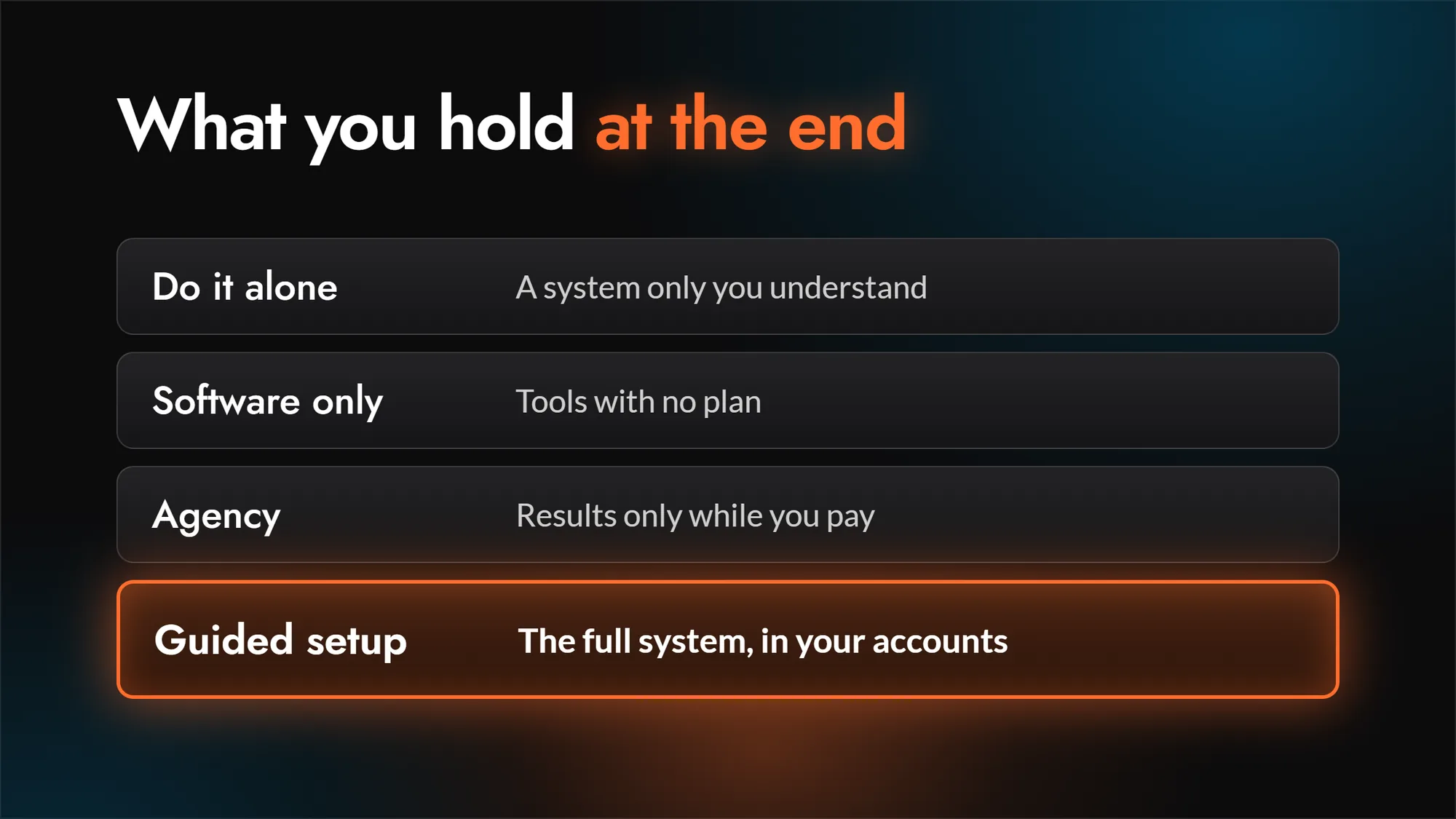
| Option | Who builds | What you hold at the end | What to watch |
|---|---|---|---|
| Do it alone | You | A system only you understand | Slow progress and no one to review your work |
| Software only | You, with help articles | Tools with no plan behind them | Features without a process to run them |
| Agency | The agency | Results while you pay, often little else | Logins and data held by someone else |
| Guided setup | Your team, with a coach | The full system in your accounts | Weekly time from you or one team member |
No route fits every business. The table shows why the end state matters more than the sales call.
What should you hold when the setup is done?
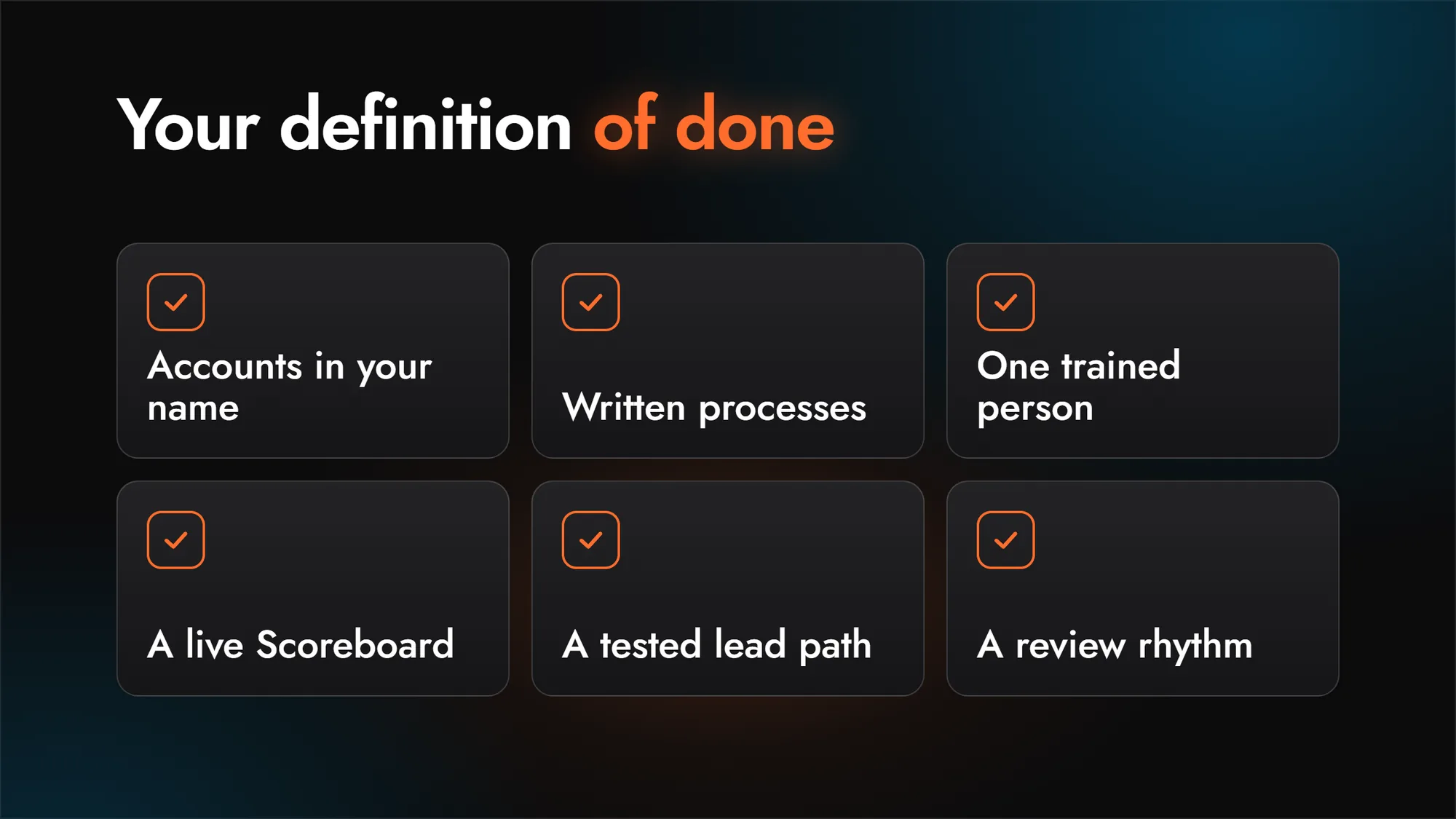
Write your own definition of done before you compare providers. Six items make a fair list:
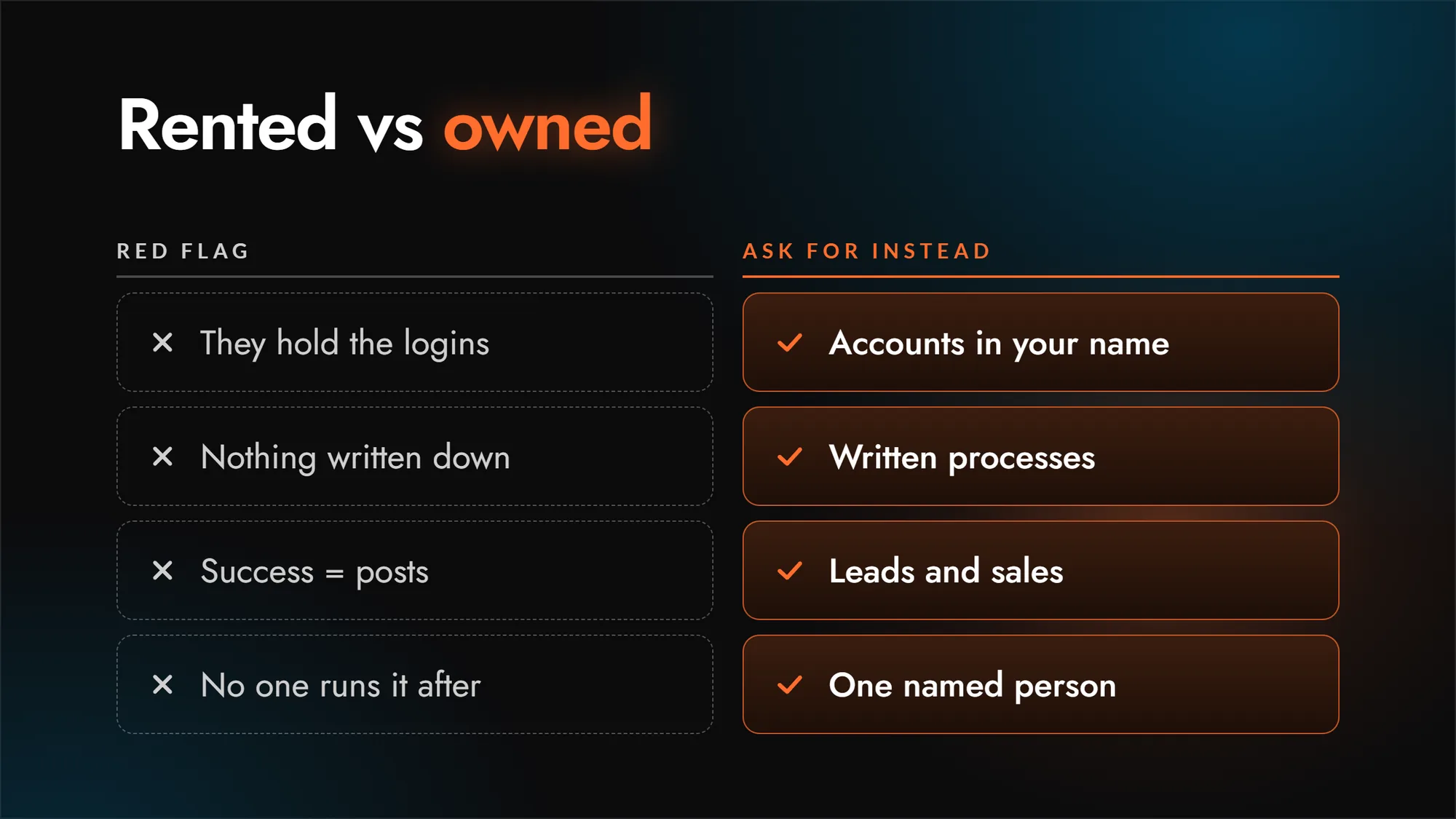
- Accounts in your name. Your CRM, domain, email platform and analytics all sit under your login.
- Written processes. Lead capture, follow-up and customer onboarding are documented so someone besides you reads them and runs them.
- One trained person. A named person runs the system week to week without needing your memory.
- A live Scoreboard. A few numbers, such as leads, sales, cost per customer and repeat buyers, update on a schedule.
- A tested path from lead to follow-up. You send in a real lead and watch it move through the system.
- A review rhythm. Weekly numbers and monthly decisions each have an owner.
Ask every provider to put these six in writing before you sign.
This week: write the six items on one page. Score your marketing today from zero to six. The gap is your setup list.
What questions should you ask before you choose?
Ask every option the same questions, then compare the answers side by side.
- Who builds the pages, emails and automations, you or them?
- Who reviews your work, and how fast do they respond?
- Which accounts hold everything, and whose name is on them?
- What does a typical week ask of you and your team?
- Which numbers prove the system works, and who reviews them?
- What happens after the last session?
- What does it cost, and what are the terms for leaving? Get the answer in writing.
Good answers are specific. A vague answer to any of them tells you something.
What red flags show a setup won’t last?
Watch for these:
- The provider holds the logins or the data.
- No one writes down a process. Everything stays in the provider’s head.
- Success is measured by activity, such as posts or impressions, not leads and sales.
- The provider names no one to run the system after launch.
- A date is promised for results.
- A tool or service is required for the setup to work and you don’t see why.
Any one flag is a reason to ask for a fix in writing before you decide.
How do you check fit with your own business?
Match the setup to your stage and your calendar.
If you haven’t sold your product yet, talk to customers first. A system needs something proven to carry. If you have sales but no time, the system matters now.
Someone on your team needs weekly hours for the build. Count those hours honestly. A CRM left unused costs more than the setup you skipped.
To compare providers by name, read the best do-it-with-you marketing systems. To check the support itself, use how to choose AI marketing support. To see the build step by step, read how to install a Lean Marketing System.
Who is this for?
- Owners who have proven the business works and want out of the details
- Founders comparing an agency, software and a guided build
- Teams with one person ready to run a documented system
Who is this not for?
- Businesses still testing whether anyone wants the product
- Owners who want someone else to run all their marketing
- Anyone unwilling to give the build weekly hours
How does Lean Marketing help you choose a guided setup?
We build on Operating Leverage: Processes → AI → Team. Write the work down, automate the repeating steps, then put a person on it.
We sell this as 1 Page. 1 Person. 1 Pulse. One page is the plan. One person runs it. One pulse is the live Scoreboard. They match items one, three and four on your list.
We’re the GPS and you’re driving. Your team builds in your own tools while a coach reviews pages, edits sequences and troubleshoots automations. Your tools, your CRM, your domain and your data stay yours.
Lean Marketing client Michael O’Grady said it this way: “We’ve tried a lot of coaches and this is the first time I feel really confident of what we are building. I love we are building our internal marketing and system capabilities…”
Frequently asked questions about choosing a guided marketing setup
How do you choose a guided marketing setup?
Define done first. List what you must hold at the end: accounts in your name, written processes, a trained person, a live Scoreboard, a tested lead path and a review rhythm. Then ask each provider who builds, who reviews your work and what happens after the last session. Put the answers in writing.
What is a guided marketing setup?
A guided setup has you build your marketing system in your own tools while a coach plans it, reviews your work and fixes problems. It sits between doing everything alone and paying a provider to run the work for you. You do the building and a coach guides you.
What should you own when a marketing setup ends?
You should own the accounts, the written processes and the data. Your CRM, domain and email platform sit under your login. A trained person runs the system, and a Scoreboard shows what works. If the provider leaves tomorrow, nothing stops.
How is a guided setup different from hiring an agency?
An agency usually builds and runs the work, so you rent the result. A guided setup has your team build with a coach, so you keep the system. Ask any agency who holds the logins and the data. The answer shows the difference.
How much time does a guided setup take from you?
It depends on your team and what you build first. Someone needs weekly hours for the work. Ask each provider for a typical week in writing, including who must attend. Count the hours before you sign, and plan around your busiest season.
What are red flags in a marketing setup program?
The provider holds your logins or data. Nothing gets written down. Success means posts or impressions, not leads and sales. No one is named to run the system after launch. A date is promised for results. Ask for a written fix to any flag before you decide.
Who should skip a guided marketing setup?
Skip it if you haven’t sold your product yet, if you want someone else to run all your marketing, or if no one has weekly hours for the build. Those situations need a different first step, such as customer conversations or a hire.
Ready to see if a guided setup fits?
If you’re comparing options and want a clear answer, start with a conversation. Book a call and complete the short MRO diagnostic. We’ll review your numbers, show you where growth is likely leaking, and if it’s a fit, we’ll map your first 30 days.