Your marketing runs in bursts. Two busy weeks of posts and emails, then three weeks of silence because a client needs you. Leads arrive in waves, and cash follows them.
You know the rhythm. Feast, then famine, then a promise to be more disciplined next month.
Quick Answer: Market consistently by shrinking the job. Pick one lead source, block two fixed hours a week and follow a written checklist of the same few tasks each time. Track leads weekly. A small routine you repeat beats a big plan you abandon in busy weeks.
Why does marketing stop whenever the business gets busy?
Because client work has a deadline and marketing doesn’t. A customer waiting on you always wins against a post nobody is waiting for.
Willpower is a weak fix. A busy owner with no time left runs out of it by Wednesday. Consistency is a scheduling problem, so the fix is removing decisions: a fixed time, a fixed list of tasks and a fixed place to record the results. Harvard Business Review’s advice to stop multitasking fits here: give marketing its own block instead of squeezing it between client tasks.
What is the smallest marketing routine worth keeping?
Pick one lead source, one offer and one message. Give them two hours a week. Here is a rhythm to copy.
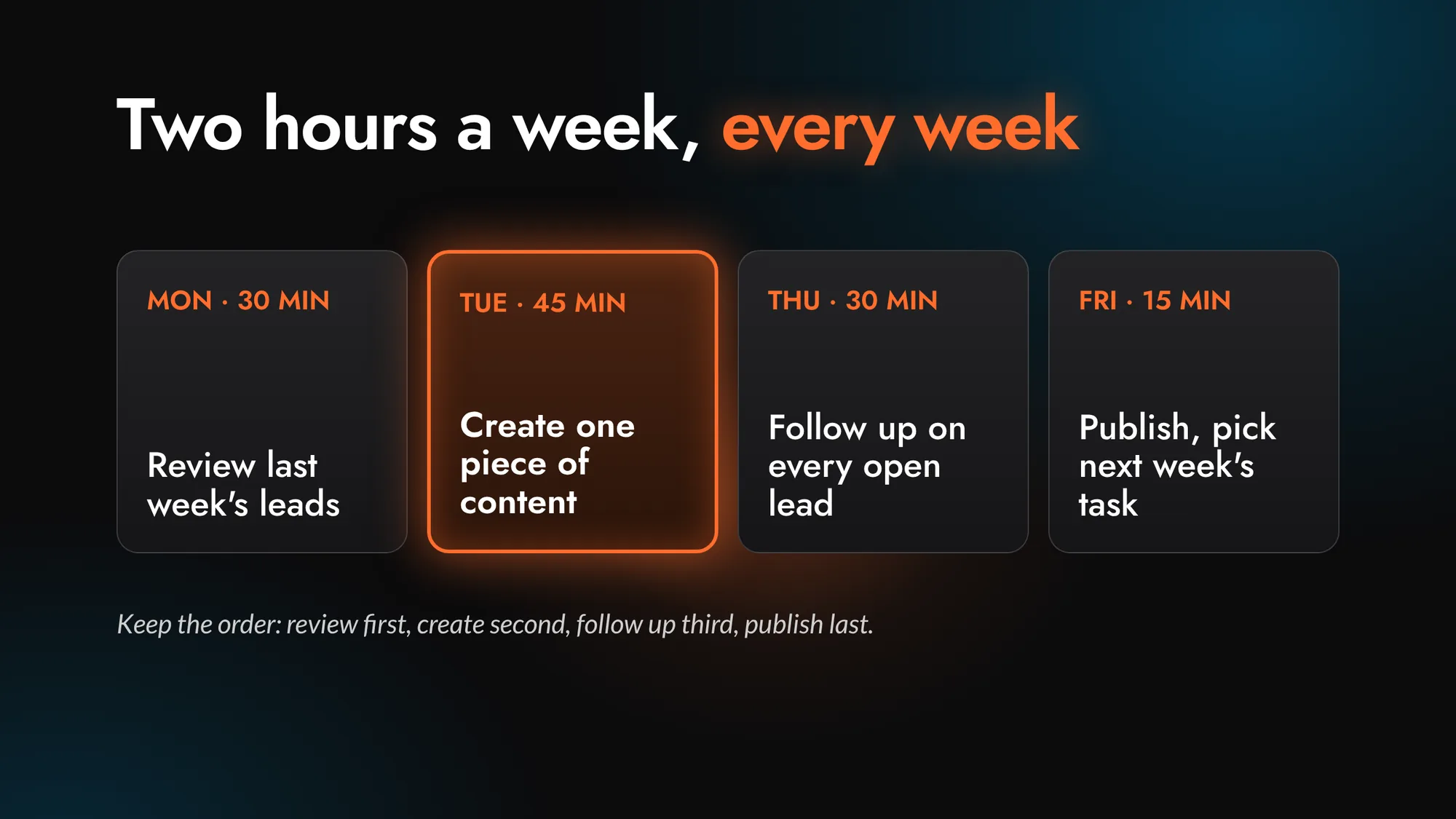
| Day | Time | Task | Output |
|---|---|---|---|
| Monday | 30 minutes | Review last week’s leads and sales | One updated Scoreboard line |
| Tuesday | 45 minutes | Create one piece of content, such as a post, email or short video | One piece ready to publish |
| Thursday | 30 minutes | Follow up on every open lead | A next step for every lead |
| Friday | 15 minutes | Publish, then choose next week’s one task | A decision made before the weekend |
Two hours is small on purpose. A routine you keep for a year beats an ambitious one you drop in week three. Small also makes it easy to restart after a bad week, because the whole thing fits in one afternoon. Pick days suiting your own calendar and keep the order: review first, create second, follow up third, publish last.
How do you choose the one lead source?
Choose the source already sending you customers. Check where your last five customers came from. If referrals lead, spend your Tuesday block on a referral ask. If search or ads lead, make it the focus. Spreading across five channels guarantees five half-finished routines.
Add a second source only after the first runs on its own for a quarter.
How do you keep the routine alive when a hard week hits?
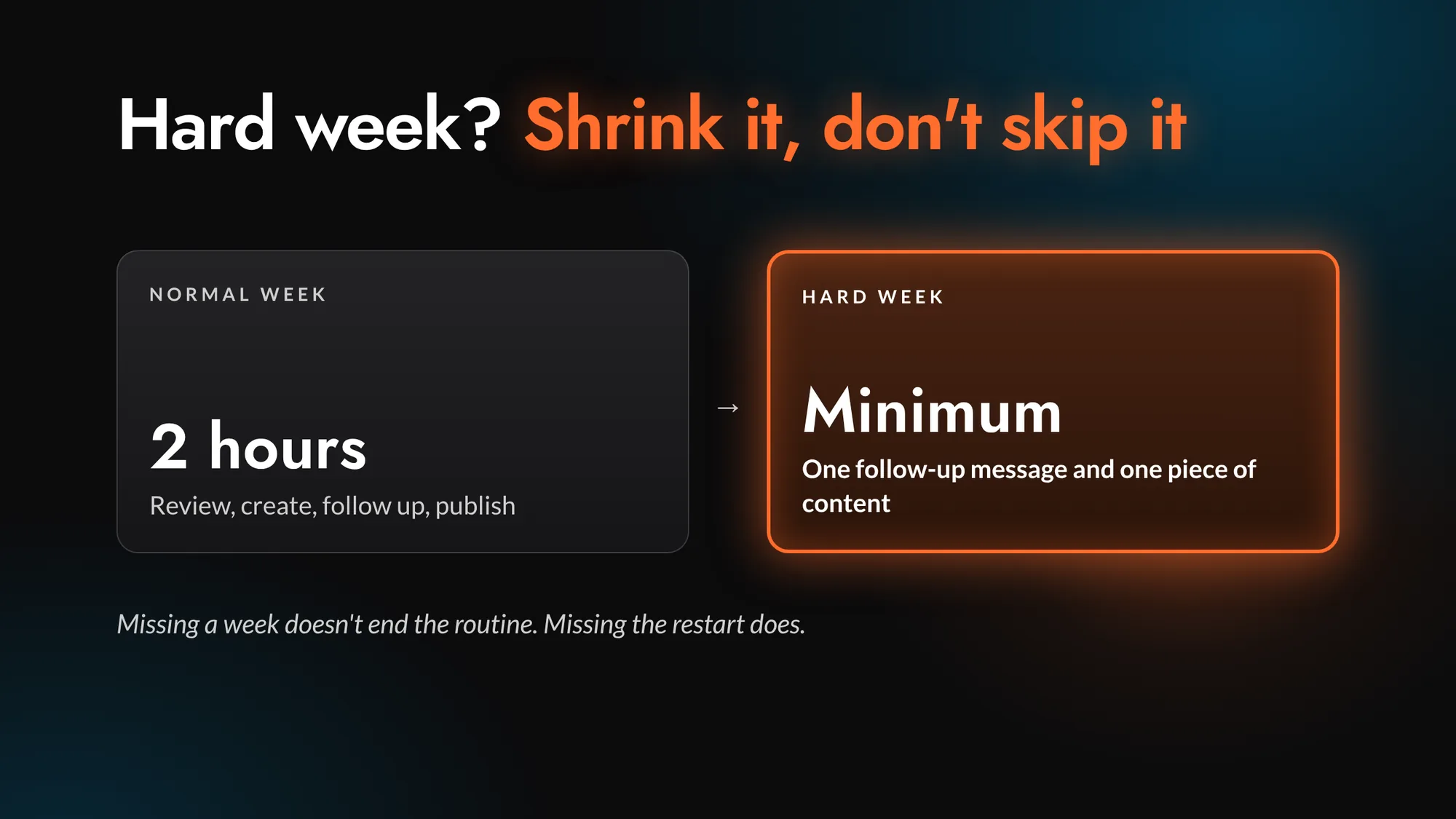
Keep a minimum version: one follow-up message and one piece of content. A hard week gets the minimum instead of a skip.
Put the blocks in your calendar as appointments with a customer. Move them when you must, but never delete them. A simple board in Trello is enough to track the four blocks. Missing one week doesn’t end the routine. Missing the restart does, so the first block after a gap is the one to protect.
Look at your numbers every Monday. A routine feels pointless without proof, and a weekly lead count provides it. How to track every ad dollar shows a simple way to count.
How do you stop marketing from consuming your life?
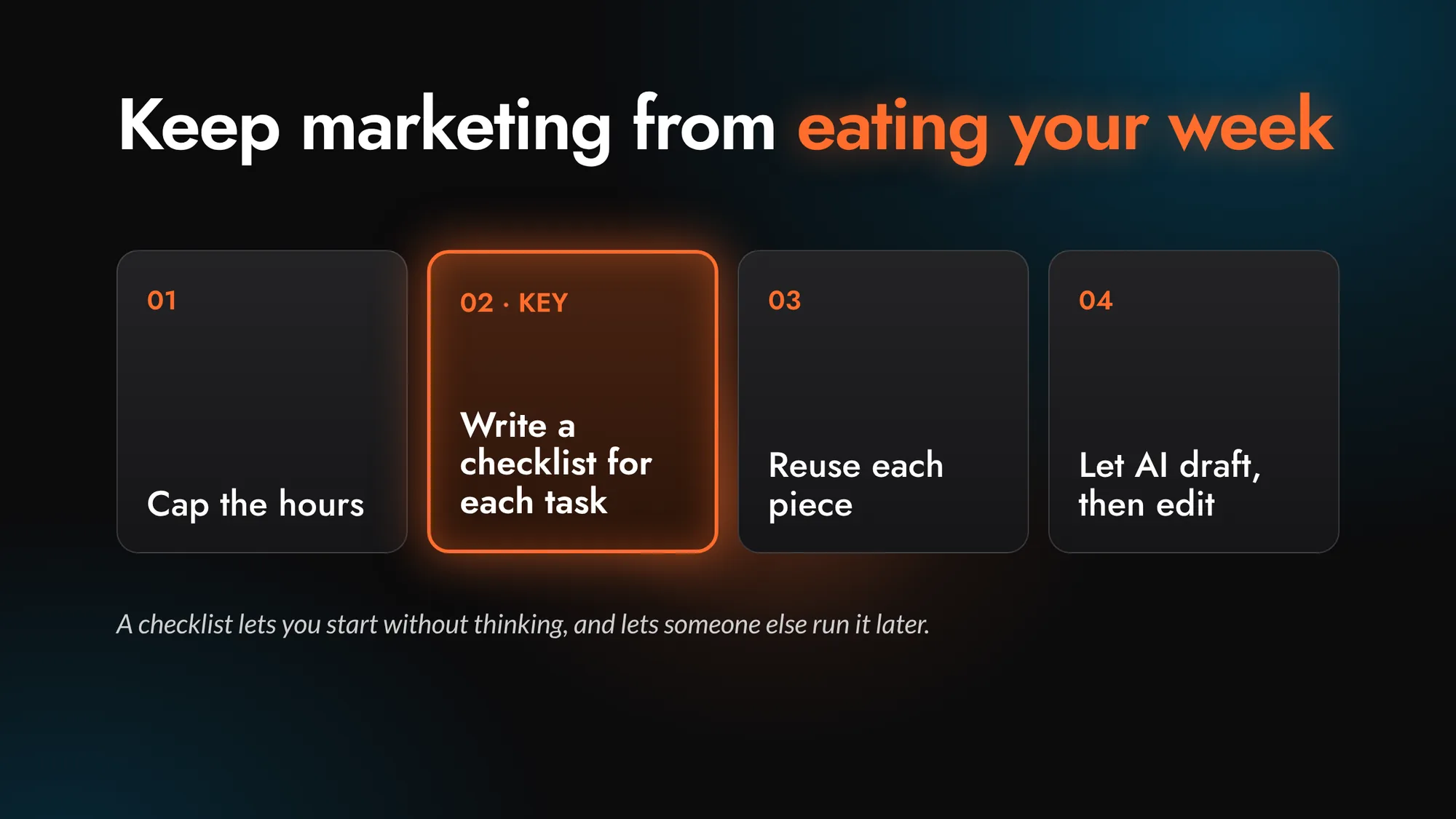
Cap it, write it down and reuse everything.
- Cap the hours. Two hours a week is the ceiling until the numbers justify more.
- Write a checklist for each task. Steps, tools and where the finished piece goes. A checklist lets you start without thinking and lets someone else run it later. A follow-up checklist might read: open the lead list, message anyone silent for three days, log the reply, set the next date. Four steps and ten minutes.
- Reuse each piece. One idea becomes a post, an email and a short video.
- Let AI draft, then edit. A first draft in minutes leaves your time for judgment and your own voice.
Owners who skip the checklists end up carrying every task in their head, which is how burnout starts. Why owners burn out from marketing explains the pattern, and how a marketing system lowers the founder load shows the fix.
Who is this for?
- Owners whose marketing runs in bursts between client work
- Founders doing their own marketing with no spare hours
- Anyone ready to protect two hours a week
Who is this not for?
- Businesses wanting a full marketing team’s output from two hours
- Owners unwilling to track a weekly number
- Anyone without a clear offer to talk about
How does Lean Marketing help you market consistently?
This is an Operating Leverage question: Processes → AI → Team. The routine above is the Processes step. Once the checklists exist, AI drafts the first pass and a team member or helper takes over tasks, one at a time.
We help you build the one-page plan the routine points at: who you serve, what you offer and how buyers find you. With the plan on one page, each weekly block has a clear job.
Frequently asked questions about consistent marketing
How do you market consistently when you run the business?
Shrink the job to two fixed hours a week with one lead source and a written checklist. Keep a minimum version for hard weeks and track leads every Monday. A small routine you repeat beats a large plan you abandon.
How much time should a busy owner spend on marketing each week?
Start with two hours. Use them for a lead review, one piece of content, follow-ups and next week’s plan. Add time only after your numbers show the extra hours bring in leads and sales.
What should you do when a busy week wipes out your marketing time?
Run the minimum version: one follow-up message and one piece of content. Then protect the first block after the gap, because restarting matters more than any single missed week. Skip the guilt and pick up where you left off.
How do you manage marketing without burning out?
Cap the hours, write a checklist for each task and reuse every piece across channels. Moving the steps out of your head and onto paper is what lowers the load.
Does AI help with consistent marketing?
Yes, for first drafts and repurposing, with you editing for accuracy and voice. Write the checklist first so the AI has clear steps, then review each output before it goes out.
What is the best day to do marketing tasks?
Pick days you’re able to protect. Many owners put planning on Monday and content on a quiet midweek day. The best schedule is the one you keep through busy weeks, so test it against your three busiest days before you commit.
Ready to put your marketing on one page?
Consistency starts with knowing what to say and who to say it to. The 1-Page Marketing Plan Architect walks you through it, so every weekly block has a clear job.