
Here's a story we hear constantly. A founder signs up for an AI marketing tool. Maybe two. They're excited. Finally, something that'll write the emails, build the funnel, answer the support tickets.
Six months later, they're paying for three subscriptions, have used about 20% of the features, and their marketing looks exactly the same as it did before. Nothing's broken. Nothing's better, either.
That's not an AI problem. That's a "bought a tool instead of a system" problem.
AI marketing automation is powerful in 2026. But power without direction is just expensive noise. This guide gives you a straight framework for choosing AI marketing support that actually moves your business forward, covering email campaigns, lead capture, and rollout. Those are the three places most small businesses get this wrong.
Quick Answer: AI marketing support ranges from pure software you run yourself, to an agency that runs it for you, to a done-with-you model where AI tools are mapped to a sequence and installed in your own systems. The right choice depends on one question: do you already know what your business needs fixed, or do you need help figuring that out first? Most founders buying AI tools for the first time are actually missing the sequence, not the software.
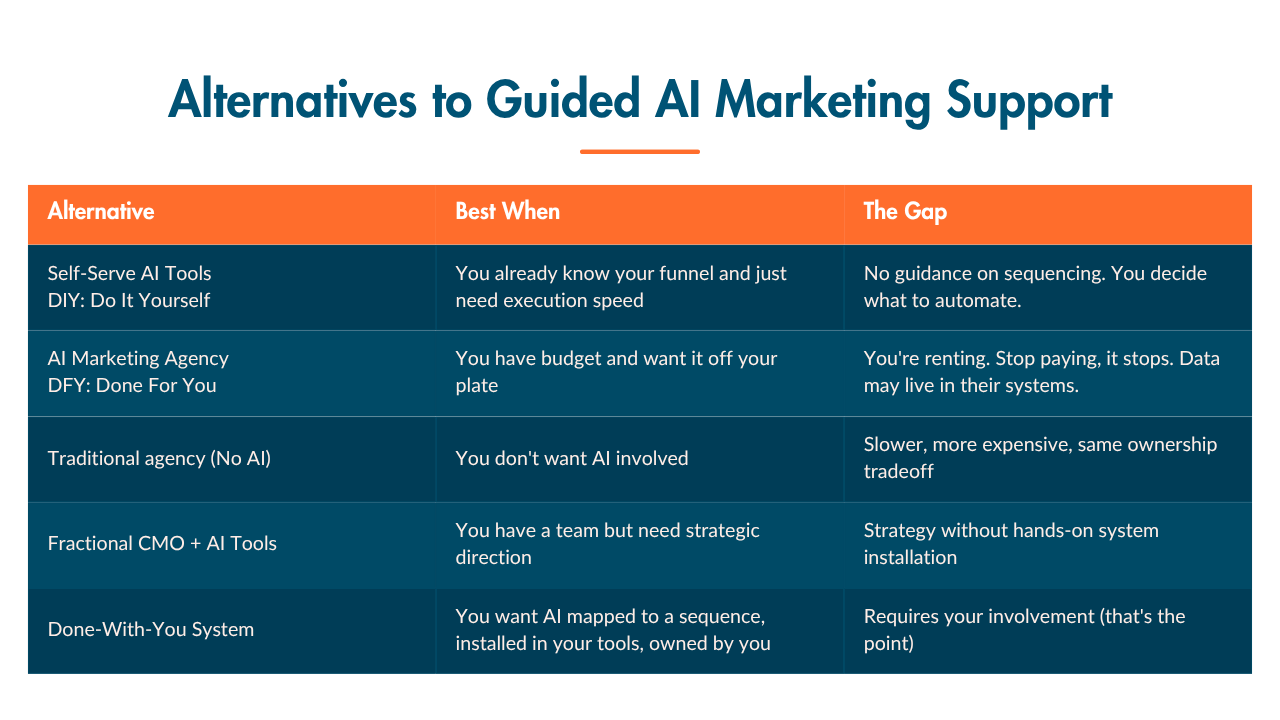
AI marketing support is any combination of AI marketing tools and human guidance that helps a small business plan, build, and run its marketing system. It sits on a spectrum:
The right choice depends less on budget and more on one question: do you already know what your business needs, or do you need help figuring that out too?
Most buying decisions get framed as "which AI marketing tool should I buy?" That's the wrong first question. The right one is "what am I actually trying to fix?"
Most founders who come looking for AI marketing support don't have a lead problem. They have a system problem. Revenue is a rollercoaster because every lead, sale, and follow-up still runs through the founder. Adding AI tools to that situation just automates the chaos faster.
If your messaging, conversion process, and CRM are solid and you just need execution speed, pure software works fine. Buy the AI marketing tools, point them at the gaps, and go.
If you have no time and no interest in running any of it, a pure service model might fit. But go in knowing you're renting, not building. When you stop paying, the automated email campaigns and lead capture flows usually stop too, because they live in someone else's account.
If you don't yet know which parts of your business are leaking (which is true for most founder-led businesses), done-with-you is the better starting point. You get a system that finds the leak, a build that fixes it, and AI that speeds up execution, all installed where you can keep it.
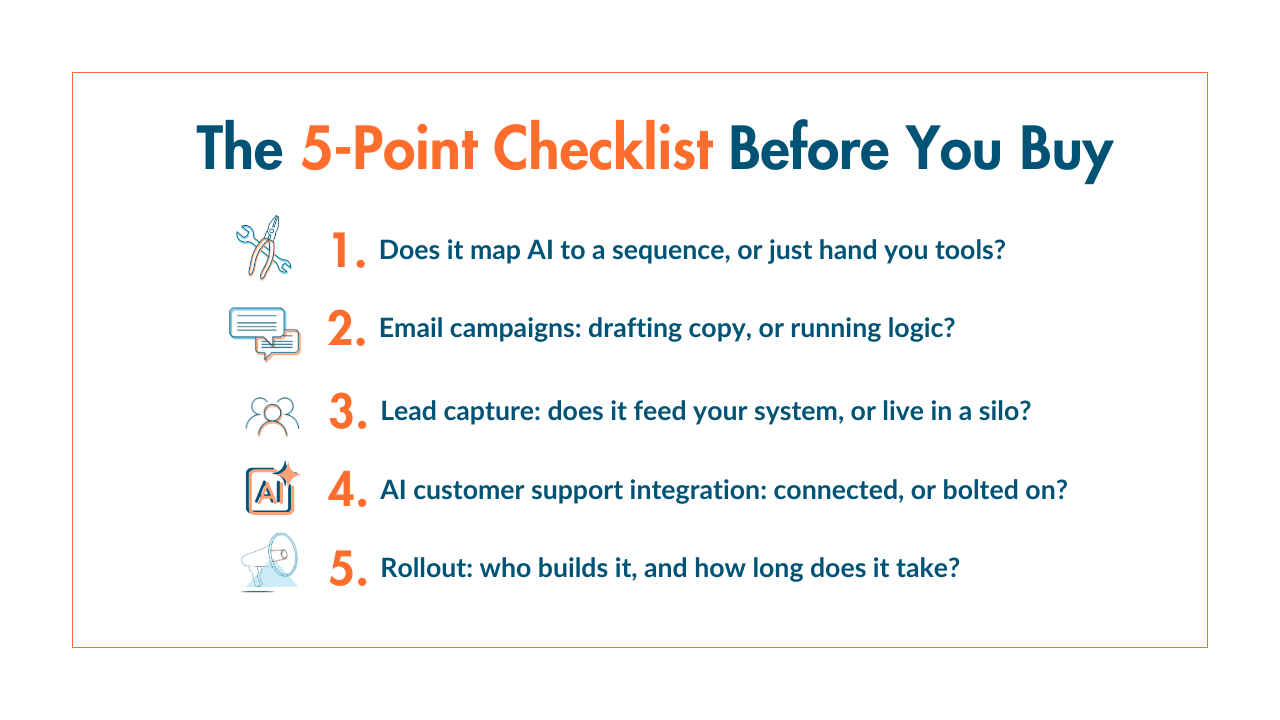
Run any option you're considering through these five questions.
Marketing system software that doesn't tell you what to automate first will default to whatever's easiest. Usually social content. The highest-value automation is almost always further down the funnel: follow-up, conversion, and retention. If the AI marketing automation isn't tied to a sequence, you'll automate the wrong things efficiently.
There's a big difference between "AI writes your emails" and "AI runs your email sequence." Drafting copy saves you an hour. Running the logic (who gets which automated email campaign, when, based on what behavior) is what actually moves leads toward a sale. Ask specifically: does this tool or service handle the sequencing logic, or just the words?
AI-powered lead capture is only useful if the leads land somewhere your team actually works from. If a tool captures leads into its own dashboard that doesn't sync with your CRM, you've just built a second system to check. And it'll get checked less, not more.
A chatbot that answers FAQs is nice. A chatbot that's connected to your CRM, flags hot leads to your sales process, and hands off cleanly to a human when needed is a system. Before buying, ask how support interactions feed back into your marketing and sales data, or whether they just disappear into a chat log nobody reads.
This is the question most buyers skip, and it's the one that determines whether you end up with shelfware. Ask directly: in week one, what gets built? In week four? Who's doing the building: you, your team, the vendor, or some mix? If nobody can give you a straight timeline, that's your answer.
"All-in-one" platforms with no onboarding plan. More features doesn't mean more value if nobody shows you which ones to turn on first. The feature list is a menu, not a meal.
Vendor lock-in disguised as convenience. If your automated email campaigns, lead data, and customer support history all live exclusively inside one platform's proprietary system, switching later means rebuilding from scratch. Ask where your data actually lives.
"AI" as the entire pitch. If the sales pitch is AI-first and strategy-second, the strategy is probably an afterthought. The AI should be in service of a system, not the headline that's covering for the lack of one.
No path to independence. If the only way the system keeps running is by continuing to pay the vendor every month, you haven't bought a system. You've bought a subscription to someone else's. No black box. No hostage situation. You should own the CRM, the data, the dashboard, and the SOPs.
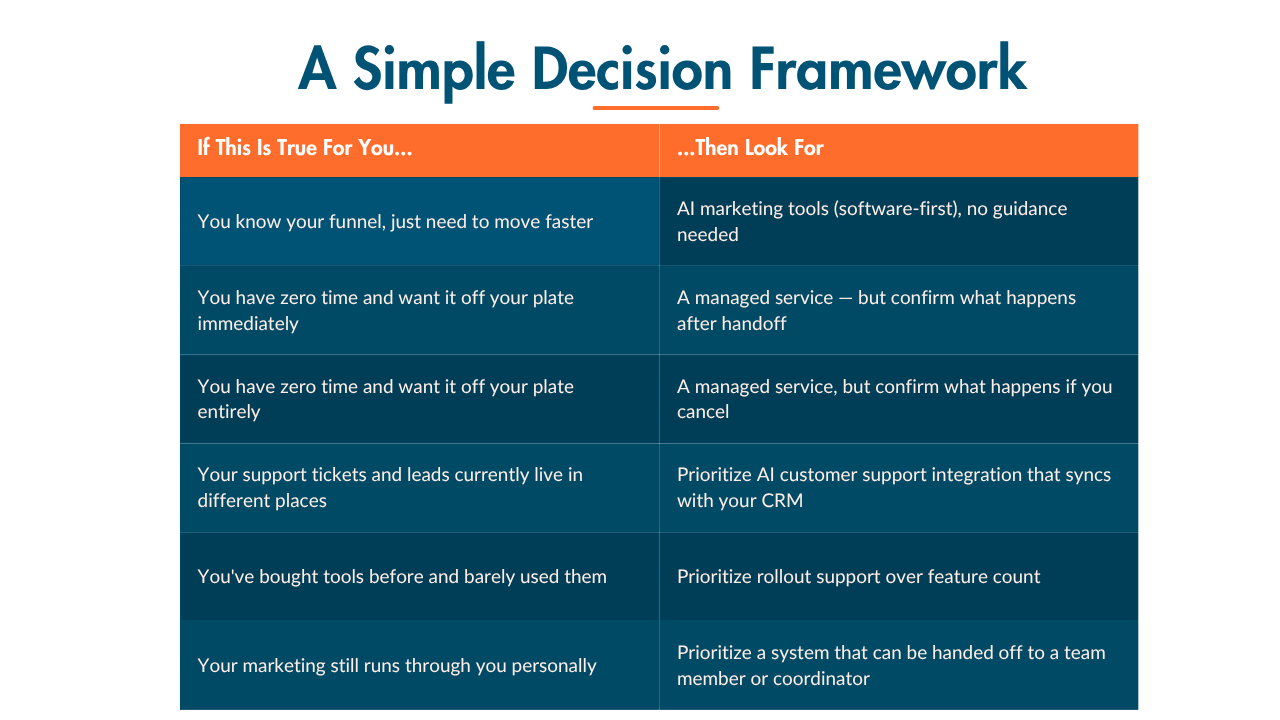
This framework is built for:
This isn't the right starting point if:
Start with your biggest bottleneck, not the tool with the most features. Identify the one part of your business (usually follow-up, lead capture, or nurture) that's costing you the most right now, then choose AI marketing tools that solve specifically that, with a clear plan for installing them into your existing CRM and workflows.
Done-with-you marketing combines AI marketing tools with guidance on how to sequence and install them in your business. Instead of buying software and figuring it out alone, or paying an agency to run everything in their systems, you get a framework, a build order, and a coach, while the system itself lives in your own tools. Lean Marketing's approach maps AI tools across the entire business lifecycle (before, during, and after the sale) and guides you through installing them in order, starting with conversion. You own everything when it's done.
Look past the copywriting features. Ask whether the tool can run sequencing logic (different automated email campaigns triggered by different behaviors) and whether it connects to your CRM so the data from those campaigns feeds back into your broader system, not just an isolated email dashboard.
The integration should connect to your CRM and marketing data, not operate as a standalone chat widget. A good AI customer support setup flags engaged leads back to your sales or marketing process and hands off to a human cleanly when a conversation needs one, turning support interactions into marketing signal instead of a dead end.
For most small businesses, the core pieces (one automated sequence, one lead capture flow, one support integration) should be live within a few weeks, not months. If a vendor or provider can't give you a week-by-week build plan, that's a sign the rollout isn't planned. It's improvised.
The best programs include a framework (what to build), a sequence (what order to build it in), AI tools mapped to each step, and a coach who walks you through installation in your own CRM and tools. Look for programs that cover the full business lifecycle (lead capture, nurture, conversion, retention, and tracking), not just one piece. Programs that only teach you how to use AI tools without connecting them to a system leave the hardest part (sequencing) up to you.
In most cases, no. AI marketing tools amplify whatever you point them at. If you don't have a sequence, they'll amplify the wrong things faster. The exception is if you're building the system and adding AI simultaneously with a guide who knows the order. Otherwise, get conversion and nurture working first, then layer AI on top to speed up execution.
Track the same numbers you'd track without AI: conversion rate, cost per lead, lead-to-customer ratio, and revenue per campaign. If those numbers aren't moving, the AI is automating the wrong step, or the right step in the wrong order. The tools should make your existing metrics better, not just generate more activity. If you can't see what's working and what's not, that's not an AI problem. That's a dashboard problem.
Everyone has access to it. The differentiator is whether the AI is plugged into a system that finds where your business is leaking, fixes the constraint that matters, and runs in tools you control with a rollout plan you can see before you buy.
You don't need more marketing. You need a system the whole business runs on.
Choose the system first. Let the AI execute it.
You'll get new articles delivered straight to your inbox, plus special subscriber-only content such as podcasts, videos and live training events.

Get free weekly emails that make you smarter at marketing and help you grow your business