
Quick Answer: Before scaling marketing spend, a founder needs a marketing system already installed: a defined target market, a message that differentiates the business, a website built to convert, lead capture, a nurture sequence, and a weekly scoreboard. Adding budget or headcount on top of a system that doesn't exist yet doesn't produce more growth. It produces more expensive chaos.
More than a quarter of small businesses plan to spend nothing on marketing this year, according to UENI's 2026 survey of over 7,400 owners. The founders who do spend often make the opposite mistake. They scale budget, headcount, or tools before there's a system for any of it to run through.
Neither approach builds a brand that shows up reliably. One starves the business of marketing entirely. The other pours resources into a gap that was never closed.
The average marketing team now runs 121 tools, up from 91 in 2022 and just 24 in 2014, according to 2026 MarTech stack research. Only about a third of what businesses buy ever gets used. The average tool now lasts 18.4 months before it gets replaced, down from 27.1 months in 2022, and over a third of tools churn out within a year.
That's not a tooling problem. It's a sequencing problem. Founders buy software to fix a system that was never built, the tool can't compensate for a target market that isn't defined or a message that doesn't differentiate, so it gets abandoned and replaced with the next one.
A marketing system isn't the software stack, and it isn't the org chart. Marketing operations, the dashboards, reporting lines, and workflows, exist to run a system. Without a system underneath them, operations has nothing to operate.
Marketing infrastructure is the strategy layer that comes first: who you're for, what makes you different, and the path that turns a stranger into a customer. Reliability comes from that structure existing before you add fuel, not from adding more fuel to a structure that isn't there yet.
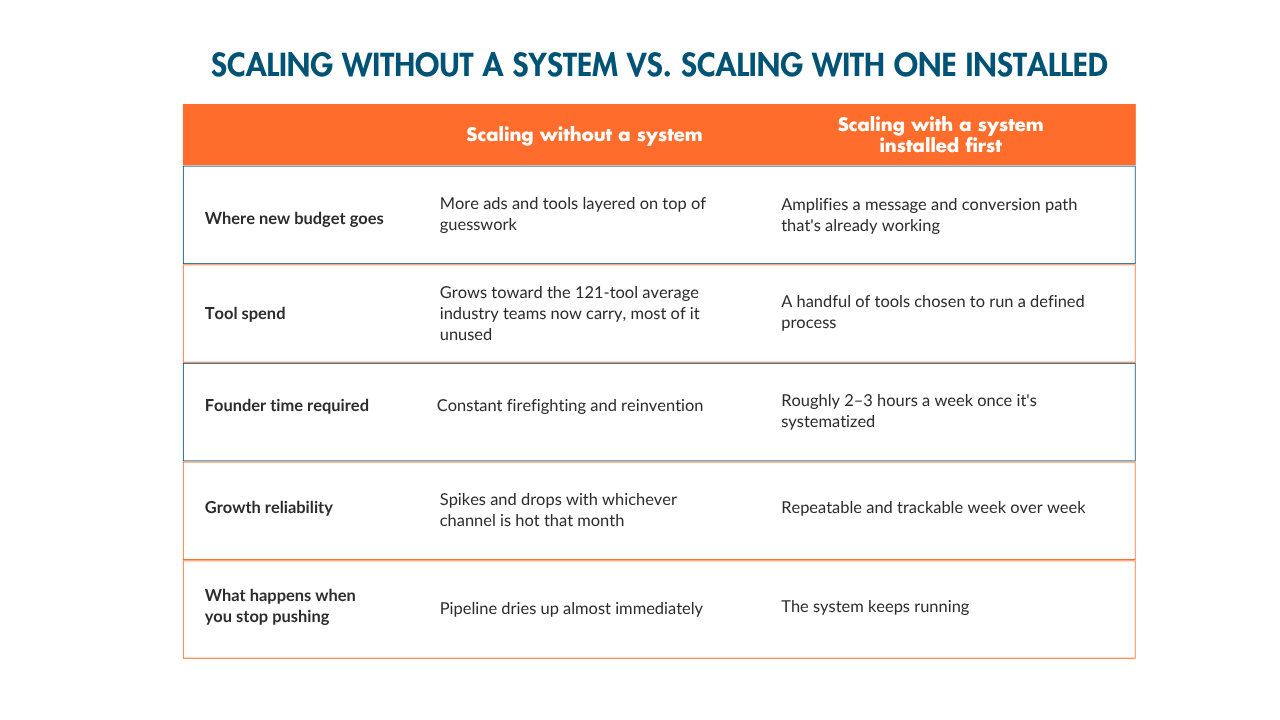
Founder marketing doesn't have to consume the founder. 2026 research on founder-led marketing found that once it's systematized, most of it fits into 2 to 3 hours a week: one longer session to batch content, short daily windows to engage, and a pass at the end of the week to repurpose what already got made.
The same research points to the most common founder mistake: over-promoting. Founders who constantly pitch see engagement drop off fast. The fix is the 90-10 rule, roughly 90 percent of what a founder puts out should be genuinely useful, with only 10 percent asking for anything in return.
Less than most benchmarks suggest, if the system isn't built yet. A defined target market, message, website, and nurture sequence cost time and focus more than they cost ad dollars. Save the bigger budget for after the system exists to amplify, not before.
Marketing infrastructure is the strategy: who you serve, what makes you different, and the path from stranger to customer. Marketing operations is the layer that runs it day to day, the tools, dashboards, and reporting. Operations without infrastructure underneath it is just a well-organized version of nothing.
Around 2 to 3 hours once a system is in place, split between creating, engaging, and repurposing. Founders spending far more than that are usually compensating for a system that doesn't exist yet.
The website, and the message behind it. Sending traffic to a page that doesn't convert just makes the gap in the system more expensive to discover.
If you can name your target market, your differentiated message, and last week's lead-to-customer numbers without checking three different tools, it's ready. If you can't, that's the system to build before the budget increases.
A bigger budget won't make an undefined market clearer. A new tool won't write the message that's supposed to differentiate you. What makes marketing reliable is the system underneath it: a target market, a message, a conversion path, and a scoreboard, in that order.
The 1-Page Marketing Plan lays out that order, and Lean Marketing's Accelerator Program installs it with a founder's team so growth stops depending on whichever channel happens to be working this month.
You'll get new articles delivered straight to your inbox, plus special subscriber-only content such as podcasts, videos and live training events.

Get free weekly emails that make you smarter at marketing and help you grow your business