
Ask most small business owners if they have a marketing plan and you'll get one of two answers.
The first: "We had one. I think it's in a folder somewhere."
The second: "We've never really formalized it. We just do what seems to be working."
Both answers point to the same underlying problem: the traditional marketing plan doesn't fit how small businesses actually operate.
The 1-Page Marketing Plan was built to fix that.
Quick Answer: A traditional marketing plan is a long-form strategy document, often 20–50 pages, covering market analysis, competitive positioning, channel strategies, and campaign timelines. Most small businesses write one, file it, and never look at it again. The 1-Page Marketing Plan (1PMP) maps the entire customer journey on a single page, focused on three stages: before the customer knows you, during the sales process, and after they become a customer. For small businesses, the 1PMP isn't a smaller version of the same document. It's a different category entirely: an operating tool, not a planning exercise.
A traditional marketing plan is a comprehensive strategy document, typically produced by a consultant, agency, or internal marketing team, that outlines a company's marketing objectives, target market analysis, competitive positioning, channel strategies, budget allocation, and campaign calendar.
In its full form, a traditional marketing plan might run 30–60 pages. It covers the SWOT analysis. The buyer personas. The messaging matrix. The channel mix. The KPIs. The quarterly roadmap.
For large enterprises with dedicated marketing departments and long planning cycles, this format makes sense. Strategy can be separated from execution because different teams handle each. For a small or medium business, it almost never works as intended. The plan takes weeks to produce. By the time it's done, the business has already moved. And even when it's accurate, a 40-page document isn't something a small team opens every week to stay aligned.
The plan sits in a drawer. The team does whatever feels urgent. Nothing connects.
The 1-Page Marketing Plan, developed in my book of the same name, maps the entire customer journey on a single page, organized around three stages and nine squares.
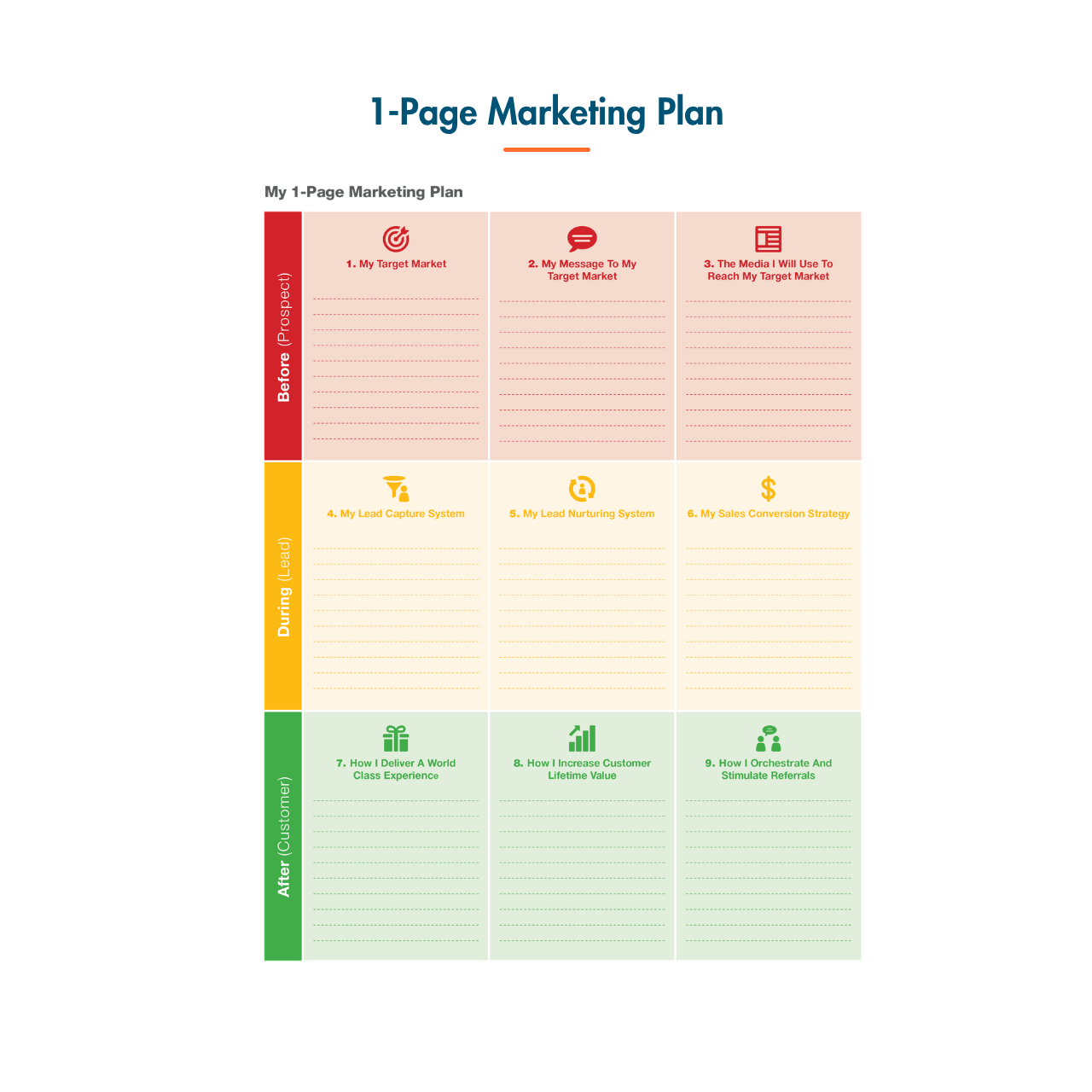
The three stages:
Each stage has three squares, one for each key decision a business needs to make. Nine answers on one page, something a small team can actually put to work.
The goal is clarity. A plan that fits on one page is one people actually use.
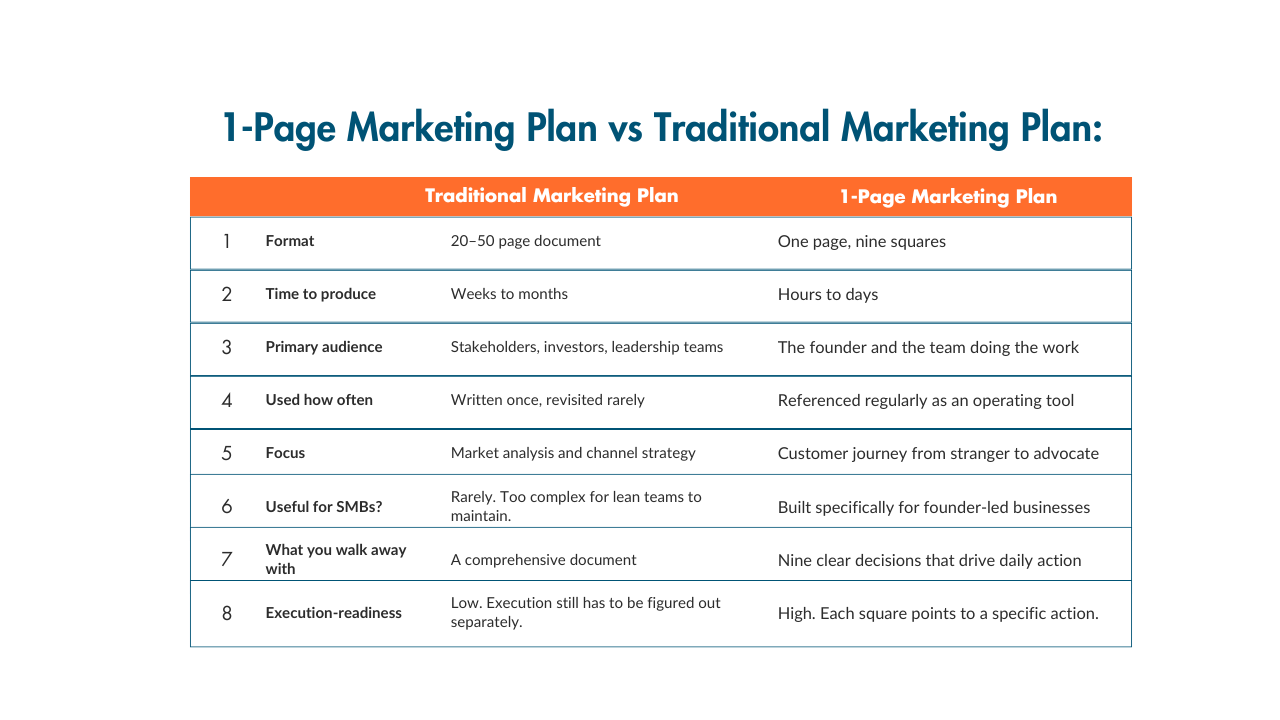
The problem isn't that traditional marketing plans are wrong. They're built for a context that most small businesses don't have: large teams, long time horizons, and the separation of strategy from execution.
In a small business, the person who writes the plan is usually also the person executing it. That person doesn't need a 40-page document. They need nine clear answers to nine clear questions, in a format they can carry into next week's work.
Here's what goes wrong with the traditional approach:
When a founder fills out the 1-Page Marketing Plan, they're answering questions most businesses never make explicit:
These are business questions dressed up as marketing ones. The 1PMP is the tool that forces a small business to answer them, clearly, in a format that fits on a desk instead of a filing cabinet.
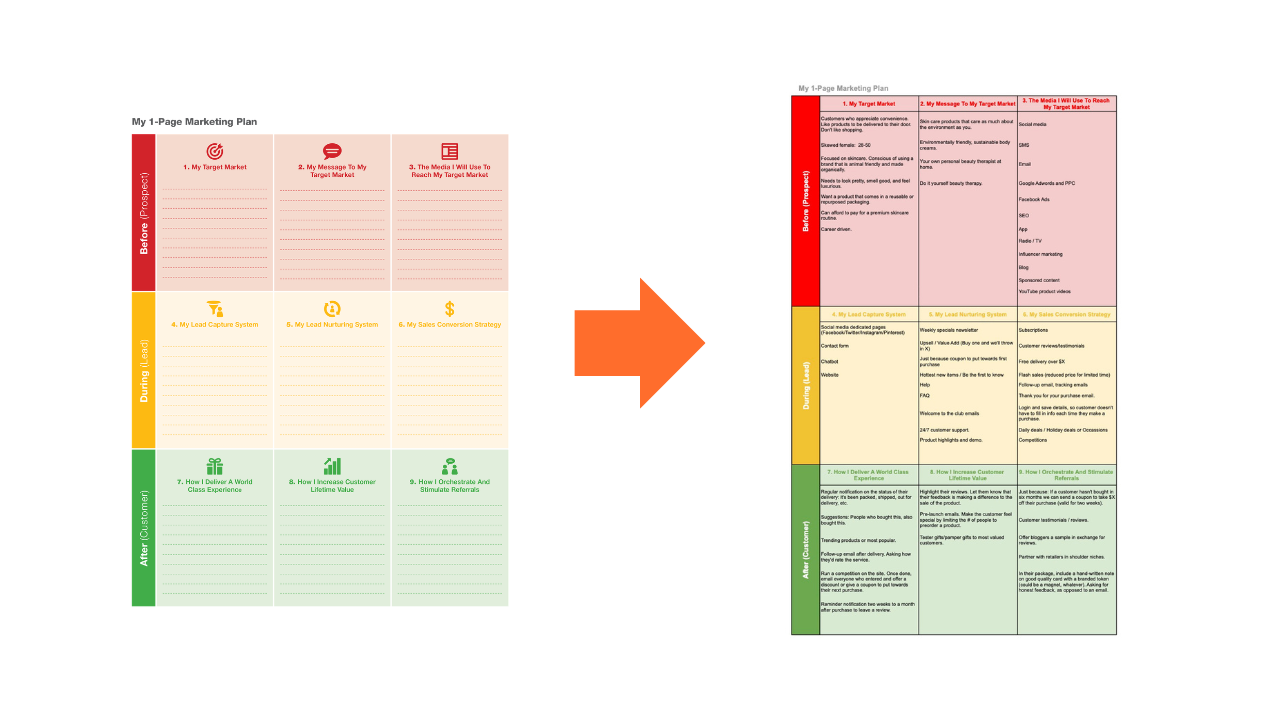
A 1-Page Marketing Plan is where the work starts, not where it ends.
The nine squares give you the strategy.
The Minimum Viable Marketing Engine (MVME) is how that strategy becomes a working piece of infrastructure: website copy, a CRM, a conversion system, a welcome sequence, an opt-in mechanism, and sales tracking, installed in your tools, in the right order.
Lean Marketing takes that map and builds the system that actually runs on it.
Full Traditional Marketing Plan: A comprehensive strategy document covering market analysis, competitive positioning, channel strategy, and campaign calendars. Appropriate for enterprise businesses with dedicated marketing teams. For most SMBs, the upkeep cost (time, revision, team alignment) exceeds the value.
Business Model Canvas: A one-page framework for mapping business model elements, including customer segments, value propositions, revenue streams, and key activities. Broader than the 1-Page Marketing Plan (covers the whole business, not just marketing) and less focused on the customer journey from stranger to advocate.
OKRs (Objectives and Key Results): A goal-setting framework widely used in tech companies. Useful for keeping teams aligned on outcomes. This differs from a marketing plan in that it doesn't address the message, offer, or the customer journey specifically.
Channel-by-Channel Planning: Planning each marketing channel separately (social media plan, email plan, content plan) without an overarching customer journey framework. Common in SMBs. The gap: each channel can look active while the overall marketing still doesn't convert, because the channels aren't connected to a unified message and journey.
The 1-Page Marketing Plan is a one-page framework that maps the entire customer journey across nine squares, organized into three stages: before (reaching prospects), during (converting leads), and after (turning customers into advocates). It's designed to be a daily operating tool for small and medium businesses, not a comprehensive strategy document.
A traditional plan's comprehensiveness is designed for enterprise businesses with separate strategy and execution teams. Small businesses need a framework that the same people who write it can also use every week. The 1-Page Marketign Plan fits in a day's work to produce and on a single page to maintain. That's not simplicity for simplicity's sake. It's the format that founders and small teams actually use.
For most small businesses, yes. The 1-Page Marketing Plan addresses the questions that actually drive marketing results: who you're targeting, what your message and offer are, how you convert leads, and what happens after someone buys. A 40-page traditional plan covers more ground but typically produces less clarity and less action.
It takes about an hour to fill out the template. The thinking behind it, particularly the message, target market, and offer, can take days to get right. That's intentional. The one-page format forces you to choose what actually matters instead of documenting everything that might matter.
The 1-Page Marketing Plan maps your marketing strategy across the customer journey. Lean Marketing is how that strategy becomes a working piece of infrastructure in your business by installing the system that runs it. Most founders start with the 1-Page Marketing Plan and then use the Lean Marketing team to install the Minimum Viable Marketing Engine as the implementation framework.
Yes. The 1-Page Marketing Plan is a strategy tool, not a service. You can complete it yourself, share it with any agency or vendor you work with, and use it as the brief that governs their work. Agencies that don't ask for something like this before launching campaigns are working from their own assumptions about your market and message, which often produces work that's well-executed but misaligned.
The template is the core tool inside Allan Dib's book The 1-Page Marketing Plan. The book explains the thinking behind each of the nine squares in detail, including why most businesses get their message wrong, how to define a target market narrowly enough to be useful, and what a real conversion system looks like. The template is the tool, the book is the manual for using it.
Installation. Once your nine squares are clear, the next step is building the six pieces that turn your 1-Page Marketing Plan into a working system: website copy built on your message, a CRM as the hub, a conversion system, a welcome sequence, an opt-in mechanism, and sales tracking. That's the Minimum Viable Marketing Engine, installed in the right order starting with message and offer.
The 1-Page Marketing Plan gives you the strategy. We install the system that runs it, in your tools, with your team, in the right order.
Your first step is to fill out The 1-Page Marketing Plan with your business details. You can download it for free on our homepage.
You'll get new articles delivered straight to your inbox, plus special subscriber-only content such as podcasts, videos and live training events.

Get free weekly emails that make you smarter at marketing and help you grow your business