
Quick Answer: Marketing system installation means replacing the cycle of hiring and firing agencies with the nine squares of Allan Dib's 1-Page Marketing Plan installed in-house: target market, message, and media before the sale; lead capture, nurturing, and sales conversion during it; delivery, lifetime value, and referrals after it. A coordinator who owns all nine, not an agency renting out one or two of them, is what makes the system run without a new vendor search every eighteen months.
Every agency relationship starts the same way. A proposal, a kickoff call, a round of excitement about the quarter ahead. Most of them end the same way too, with a client quietly shopping for the next agency.
If you've fired an agency, or you're circling the decision now, the agency probably isn't your real problem. Your real problem is that there was never a system for that agency, or any agency, to plug into. Tactics were running. A plan wasn't.
The 1-Page Marketing Plan is my #1 global bestseller, rated 4.7 out of 5 across more than 10,000 reviews, now in a fully updated 2025 edition. Building a marketing plan has always been slow enough that most business owners never actually finish one. The book turns that process into a single page any owner or marketing coordinator can fill in and run. It's referenced here because it's the actual system this post is describing, not a stand-in for "get organized."
The shift away from agencies isn't a mood. It shows up in the numbers. Forty-five percent of marketing agencies describe their own business as struggling, and fewer than one in ten survive their first three years, according to Marketing Department Inc.'s 2026 analysis. 60 percent of senior marketing leaders say they're spending less on agencies this year, and roughly a third of agencies are cutting junior staff as AI takes over the execution work that used to justify the retainer.
On the client side, Focus Digital's 2026 churn report puts average annual churn at 18 percent for retainer clients and as high as 49 percent for pay-per-click accounts, with the average project-based relationship lasting about 24 months before the client moves on. Unmet performance and communication breakdown top the list of reasons clients leave, and delivery dissatisfaction alone now drives 48 percent of departures, up 14 points from the year before.
None of that means agencies are useless. It means most small businesses were buying execution when what they needed was infrastructure.
Marketing system installation is the process of building the specific pieces every business needs before it spends another dollar on execution, whether that execution comes from an agency, a freelancer, or an employee. It's marketing infrastructure in the literal sense: the plumbing that has to exist before traffic, ads, or content can do anything useful.
That infrastructure isn't complicated, and it isn't the same thing as business marketing automation. Automation is the software that runs parts of the system once it exists. A system is the strategy, the sequence, and the ownership that automation has nothing to plug into without.
The 1-Page Marketing Plan splits a business's marketing into three phases, Before, During, and After, with three moves inside each one. These are the nine squares that "marketing system installation" actually refers to.
.png)
Most agencies get hired to run one or two of these nine squares, usually Media or Lead Capture, without ever touching the other seven. That's why results stop the moment the retainer ends: the agency was renting out a square, not installing the plan.
Most local and regional businesses pay between $2,500 and $10,000 a month in agency retainer fees, according to 2026 pricing data from ClicksGeek, and that's before ad spend. An installed system runs on a different cost structure: the average marketing coordinator in the U.S. earns $57,135 a year, according to Indeed's 2026 salary data, or roughly $4,760 a month, with no markup on ad spend and no re-onboarding every time a contract lapses.
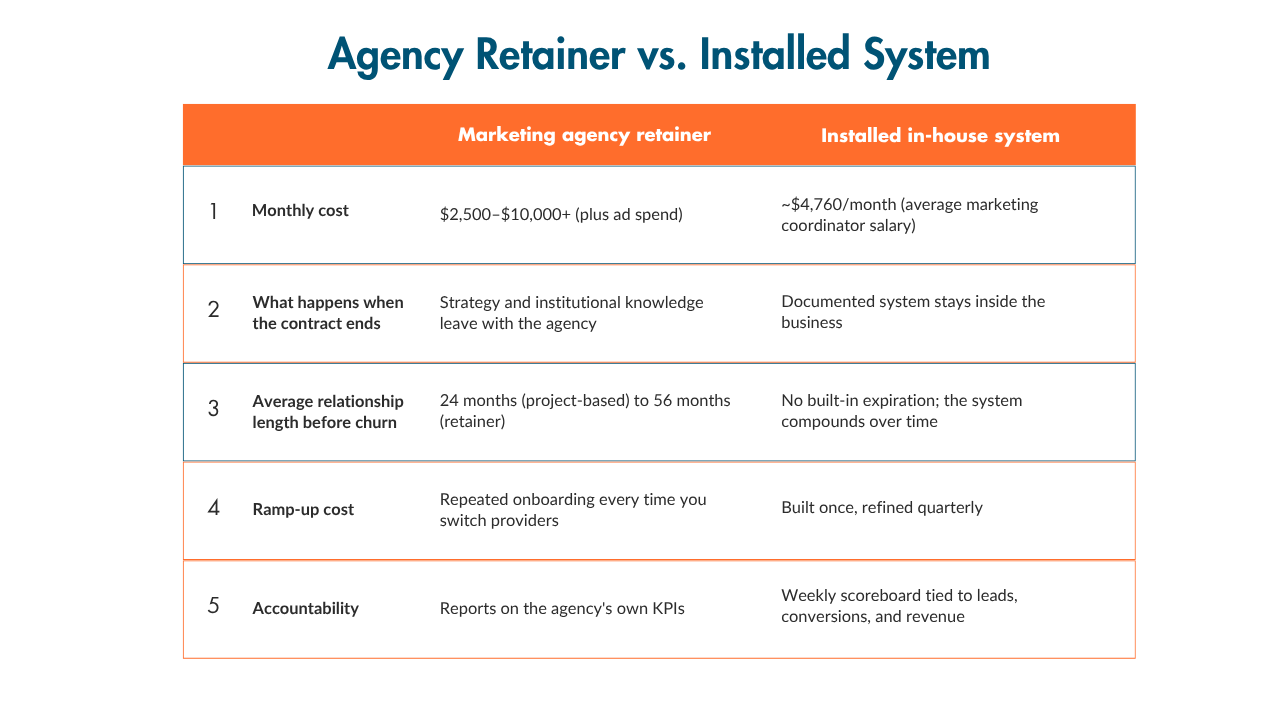
The bigger difference isn't the invoice. It's what happens to the knowledge. When an agency leaves, the strategy leaves with them. When a coordinator runs a documented system inside your business, the strategy stays no matter who's executing it that quarter.
You don't need all nine squares running at full strength on day one. Six essentials get the Before and During columns installed, which is where most businesses are losing the most ground right now:
Once those six pieces exist, the question of who executes them gets a lot smaller. The After column, delivery, lifetime value, and referrals, is the next layer to install once the front end is reliably bringing in customers. Skipping straight to referrals and retention before the front end works is how businesses end up optimizing a leak instead of fixing it.
You're a good fit for marketing system installation if:
It's not the right move yet if you're still validating demand for your product or service. A system amplifies something that already works. It doesn't create a market that isn't there.
No. Install the system first, then decide what to keep outsourcing. Agencies perform better once they're executing inside a documented system instead of guessing at strategy on your behalf.
The core six pieces typically take 120 days to build properly. What takes longer is the habit of running the weekly scoreboard and treating the system as infrastructure rather than a one-time project.
No. Automation software runs steps inside a system that already exists. Installing the software first, without the target market, message, and conversion path defined, is why so many automation tools go unused six months after purchase.
Yes, once it's documented. A coordinator who inherits a clear system executes against it. A coordinator who inherits chaos becomes another person you have to manage instead of delegate to.
Budget for a marketing coordinator's salary, roughly $57,135 a year on average in the U.S., plus whatever software and ad spend the system calls for. Most businesses spend less running an installed system with one coordinator than they spent on a single full-service retainer.
A better content calendar won't fix agency dependence. Neither will a bigger ad budget. What fixes it is a documented marketing system your own team owns, with a coordinator who runs it and a scoreboard that tells you whether it's working.
That's what the 1-Page Marketing Plan's nine squares and Lean Marketing's Accelerator are built to install: a target market, message, and media strategy; a lead capture, nurturing, and sales process; and a delivery, retention, and referral engine, run by a coordinator who owns all nine, together, so the business stops rebuilding its marketing from scratch every time a vendor relationship ends.
You'll get new articles delivered straight to your inbox, plus special subscriber-only content such as podcasts, videos and live training events.

Get free weekly emails that make you smarter at marketing and help you grow your business