It’s 11pm and you’re refreshing Ads Manager. Spend is up, orders are flat, and the cost per purchase has doubled since last month. You’ve swapped the creative. You’ve changed the audience. Nothing sticks.
Now comes the question you haven’t said out loud: do you shut this down and move on?
Before you answer, know what you’re answering. Ad results are one report from one platform. Your business is bigger than this report.
Quick Answer: A drop in Meta ad results doesn’t mean the business is done. Compare real orders, margin and cash flow to what the ad platform reports. Then check tracking, your landing page, your offer and your creative. Set a maximum test budget and a deadline before you decide to pause ads, change channels or close the business.
Does a drop in Meta results mean your business is finished?
No. A drop tells you one channel got more expensive or less effective. It doesn’t tell you whether people still want what you sell.
You’ve put real money in and you’re looking at nothing to show for it. The frustration is fair. Money down the drain feels personal. The way out is to stop reading the platform’s numbers and start reading yours.
What should you check before you decide?
Compare Meta’s report with your own records, then work down the places a drop usually hides.
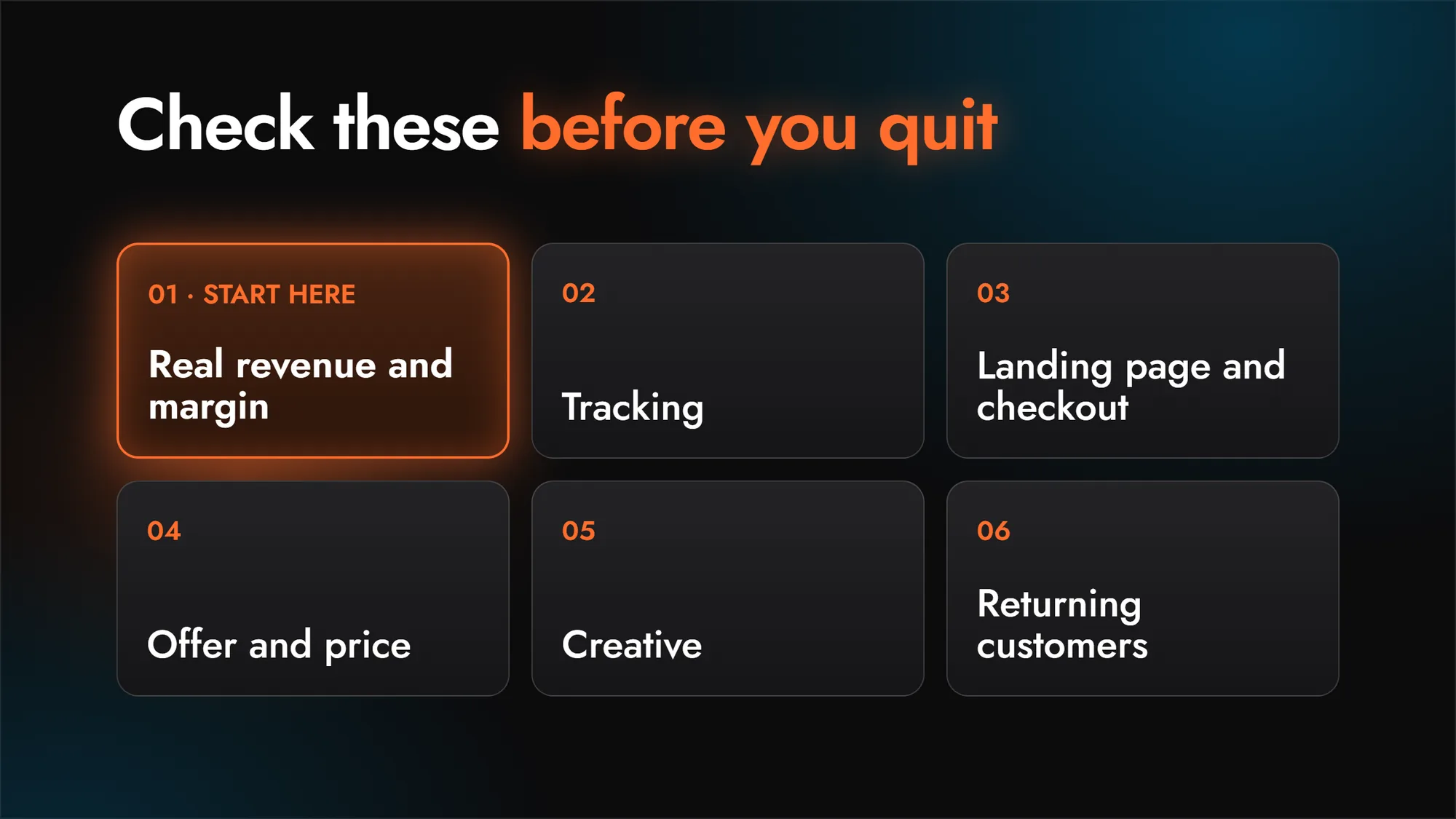
- Real revenue and margin. Pull orders, revenue and gross margin for the last 90 days from your bank, store or CRM. If sales held steady while reported results fell, the gap is often tracking, not demand.
- Tracking. Check your pixel, your conversion events and any recent change to your site, checkout or cookie banner. A broken event makes good ads look bad. Meta’s own ads tools are where you confirm your account settings.
- Landing page and checkout. Look at the rate from visit to purchase in Google Analytics or your store reports. A slower page or a changed form cuts results with no change to the ad.
- Offer and price. Ask what shifted for your buyer. Price, shipping, stock, season and competitor deals all count.
- Creative. Ads wear out. If one ad has run for weeks, your audience has seen it.
- Returning customers. Count the sales from people who already bought from you, and the ones who came by referral. Ad reports ignore these, so they show what your business holds without ads.
Skip the urge to blame a platform update. Owners across forums report wild swings, but those are stories, not proof.
This week: export last month’s orders. Write down revenue, gross margin and the number of customers before you touch a single ad.
How do you set a stop-loss for your ads?
A stop-loss is a spending limit and a deadline you set before you test, so the decision doesn’t get made at 11pm.
Budget becomes a formula, not a feeling. Here’s the formula:
- Work out what a new customer is worth to you: average order value times gross margin, plus the repeat sales you expect in their first year.
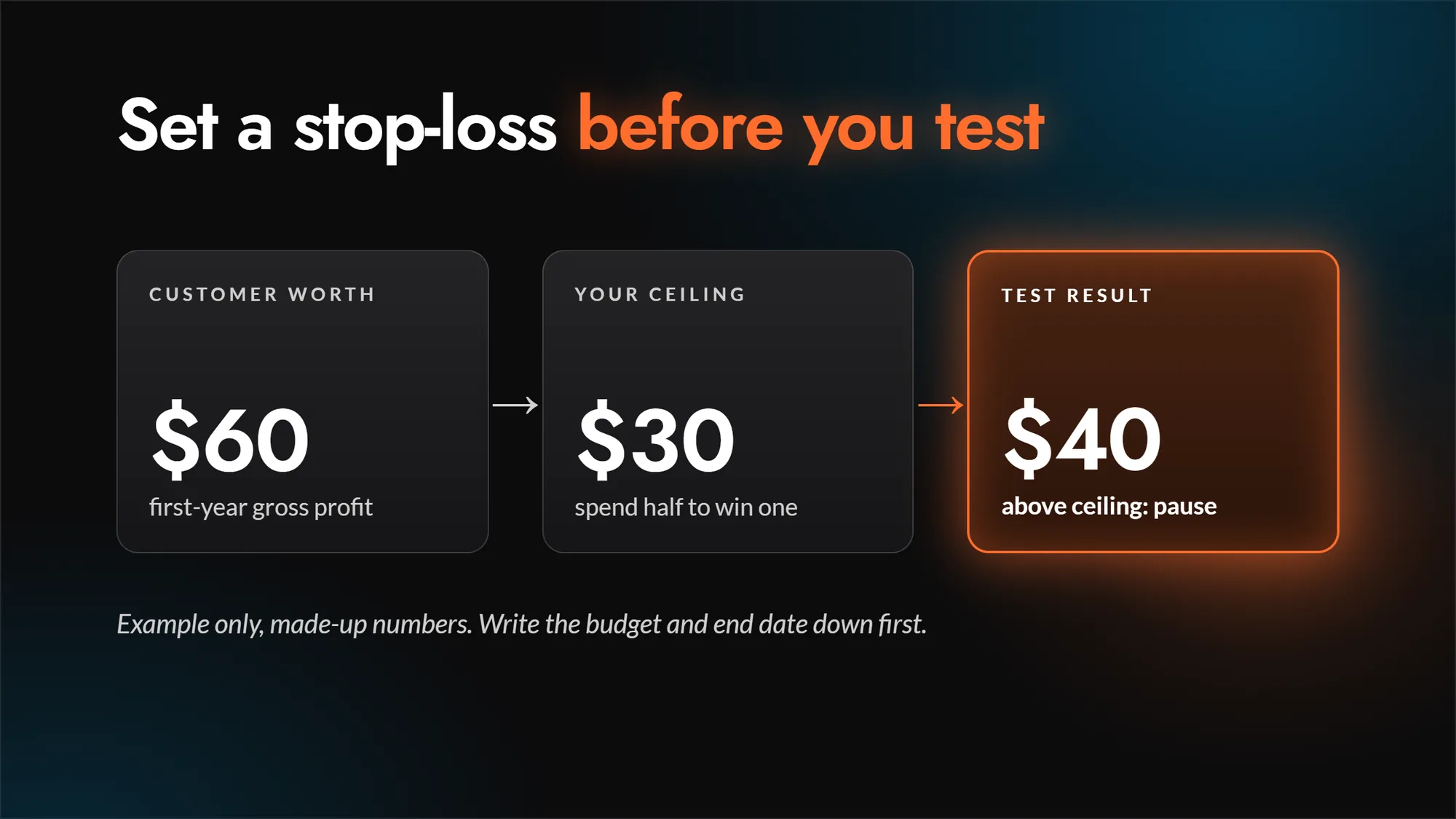
- Choose the share of this profit you’re willing to spend to win them. This is your ceiling for cost per customer.
- Pick a maximum test budget and an end date. Write both down.
- When the date arrives, compare your real cost per customer to your ceiling. If it’s above, pause the test. Don’t keep adjusting.
Example only, with made-up numbers: a customer’s first-year gross profit is $60, and you’ll spend half of it to win them. Your ceiling is $30 per customer. If a test of 40 new customers cost $1,600, you paid $40 each, and the test fails your own rule.
What do your numbers say about pausing, pivoting or closing?
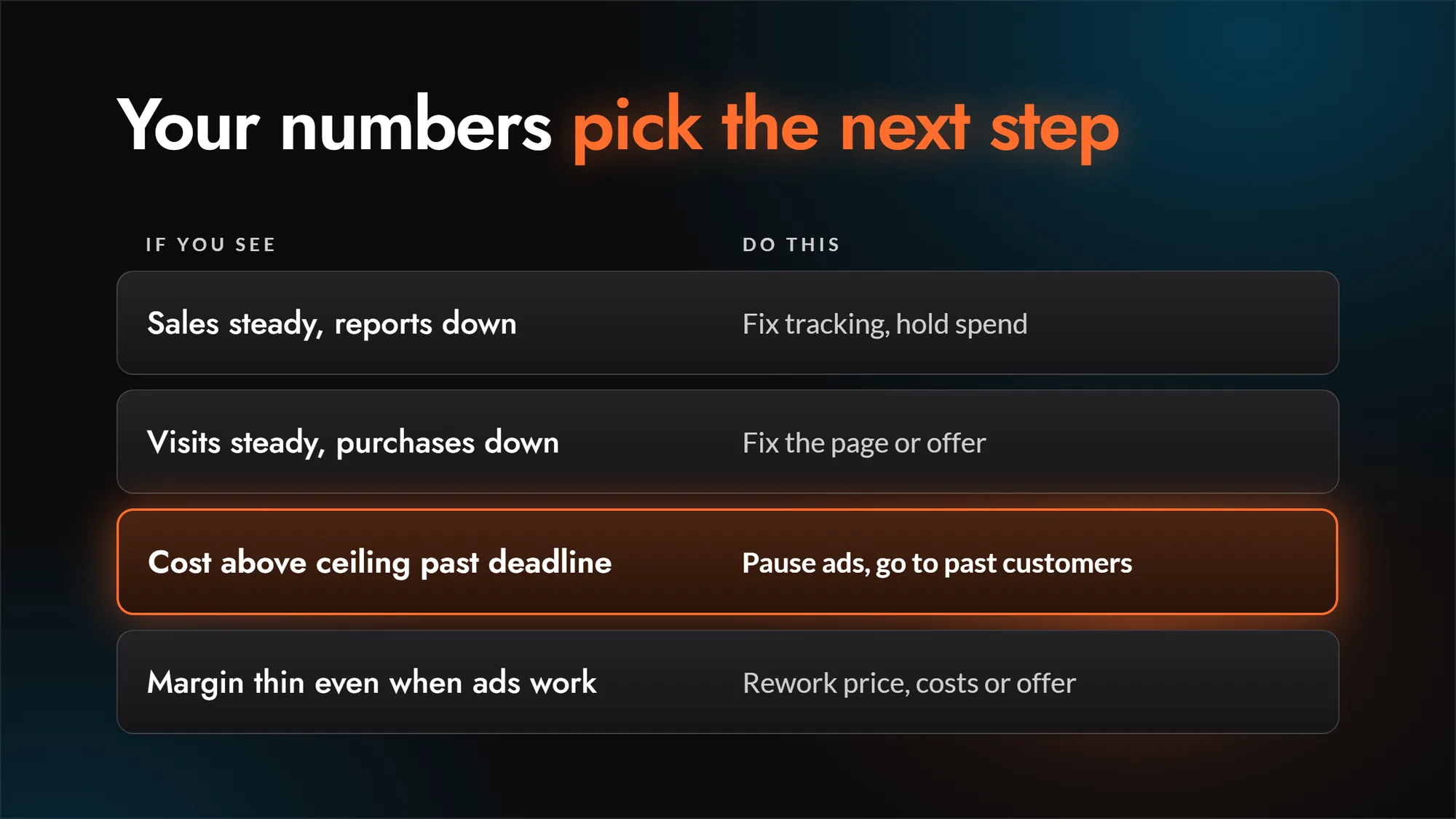
Match what you see in your own records to the next step.
| What your own numbers show | What it points to | Next step |
|---|---|---|
| Sales steady, platform reports down | A tracking gap | Fix tracking and hold spend flat |
| Visits steady, purchases per visit down | Landing page, offer or price | Fix the page or the offer before more ad spend |
| Cost per customer stays above your ceiling past the deadline | The channel no longer pays | Pause ads and move budget toward your own customers |
| Margin or cash stays thin even when ads work | The business model | Rework price, costs or offer before choosing any channel |
Close the business only when the full economics fail: demand, margin and cash together. Ad cost alone doesn’t settle it.
What if Meta is your only source of customers?
Then the real risk is concentration. When one platform supplies most of your sales, any change there hits your whole month.
The fastest second source is the one you’ve already paid for: past customers. Contact them, ask what they’d buy again and ask who they’d refer. Turning existing clients into a growth engine walks through how.
Then measure every source the same way. How to track every ad dollar and what marketing attribution means for owners show how to see which customers came from where.
Who is this for?
- Owners whose paid results dropped and who don’t know whether the ads or the business is the problem
- Founders spending real money on Meta with no second source of customers
- Anyone able to pull orders and margin from a bank account, a store or a CRM
Who is this not for?
- Businesses with no sales records to compare against
- Owners who want a platform to guarantee results
- Anyone still deciding what to sell, who needs customer conversations before any ad test
How does Lean Marketing help when your ads stop working?
We start with Logical Decisions: Feedback → Scoreboard → Budget. Feedback tells you what buyers say. The Scoreboard is the handful of numbers showing whether you’re winning. Budget becomes a formula for what you should spend to win a customer profitably, so one bad month stops feeling like a verdict.
We’re the GPS and you’re driving. Your team builds the Scoreboard in your own tools, with a coach guiding and reviewing, and you own the numbers when we’re done. Frank Schaner’s review ends with this line: “…removes the ‘are we on the right track or not’ problem.”
Frequently asked questions about Meta ads that stopped converting
Should you shut down when your Meta ads stop converting?
Not on ad results alone. Compare real orders, margin and cash flow with the platform’s numbers first. Check tracking, landing page, offer and creative. Then set a maximum test budget and a deadline. Pause ads or change channels if your cost per customer stays above your ceiling. Consider closing only when the full economics fail.
Why did my Meta ads stop converting?
Common causes are broken tracking, a slower or changed landing page, a worn-out ad, a shift in your offer or price, and changes in who’s buying. Check your own sales records first. Owners report swings across the platform, but those reports are stories, not proof of a platform change.
How long should you test Meta ads before stopping?
Set the limit before you spend. Pick a window long enough to collect a meaningful number of purchases at your current volume, write down the end date and the maximum budget, and judge the result against your cost-per-customer ceiling. Stop adjusting once the date arrives.
What should you track instead of ad platform returns?
Track orders, revenue, gross margin, cost per customer, returning customers and cash in the bank. The platform’s return-on-ad-spend figure is one input. Your own records show what the business keeps after ads, refunds and costs.
What if Meta is your only source of customers?
Treat it as a concentration risk. Start with past customers and referrals, since you already paid to win them. Then add one more source of leads and measure it the same way. A second source makes any one channel’s bad month survivable.
Does a drop in ad performance mean you should change your product?
Not by itself. If demand holds in your sales data, look at tracking, your page and your creative first. If demand falls across every source, talk to recent customers about what changed for them before you change the product.
Ready to see where your growth is leaking?
If you can’t tell whether your marketing is worth the money, start with your own numbers. The calculator shows where growth leaks across leads, sales and retention, so you know what to fix before you spend another dollar on ads.