Every owner asks this question in private. What should I be spending? A friend says ten percent. A forum says five. The agency says whatever you’ve got.
Nobody knows your margins. A budget pulled from the air gets cut at the first slow month, and then marketing stops right when you need leads.
Quick Answer: Build your marketing budget from your own numbers instead of a fixed percentage. Work out what a customer is worth, what you’re willing to pay to win one and how many customers you want. Start small, test, then move money toward channels returning more than they cost. Large-company averages are context only.
Is there a standard percentage a small business should spend on marketing?
There are rules of thumb. They differ by industry, margin and stage.
For context, Gartner’s 2026 CMO Spend Survey, covering 401 marketing leaders surveyed from January to March 2026, found marketing budgets averaging 7.8% of company revenue, up from 7.7% in 2025. The sample is larger-company marketing leaders. Treat the number as a reference point and leave it out of your plan as a target. Annual benchmark reports such as HubSpot’s State of Marketing give more context, and your own numbers still outrank them.
A percentage tells you what others spend. It says nothing about what your customers are worth or what you’ll pay to win one.

How do you build a budget from your own numbers?
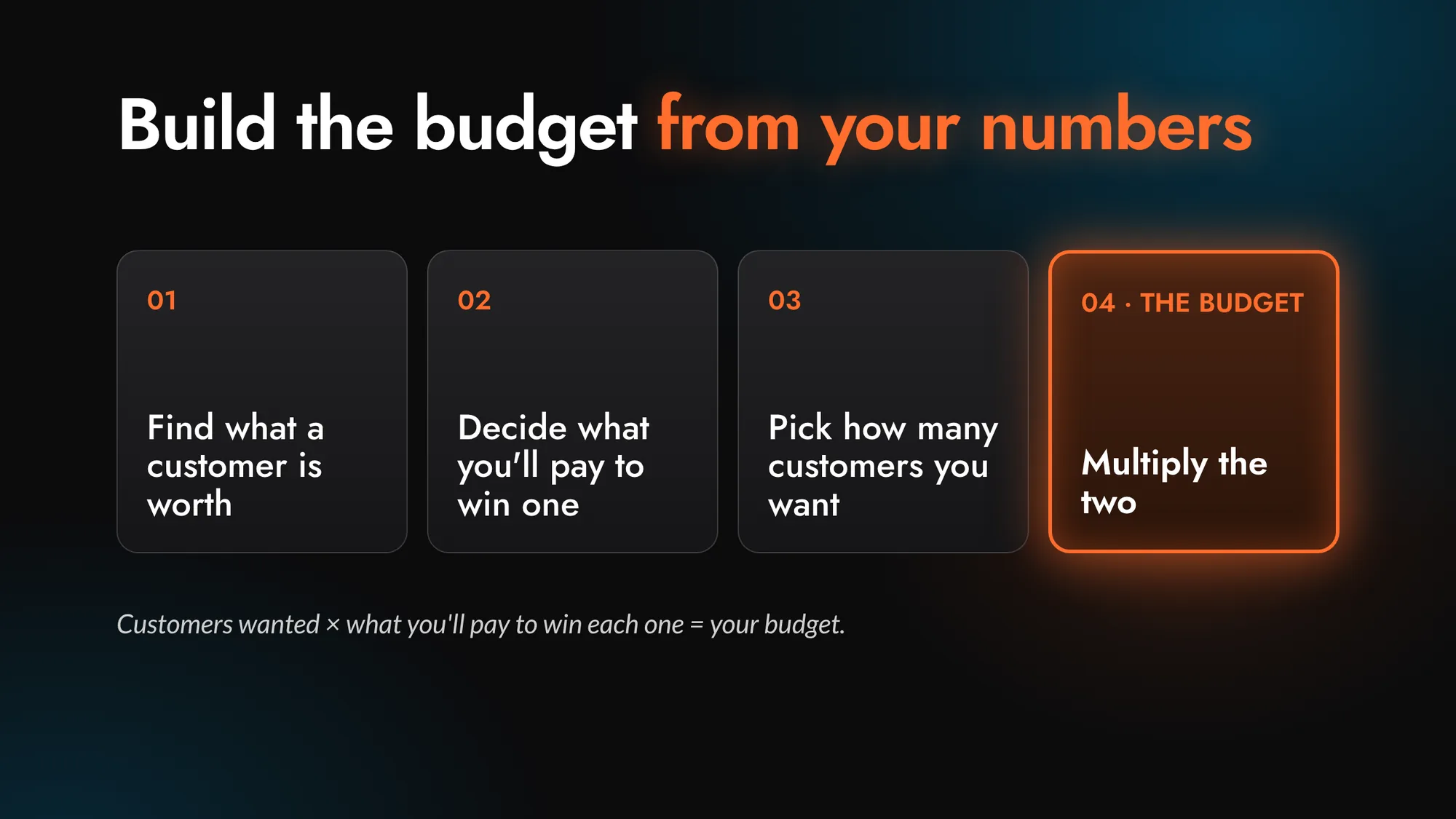
Four steps.
- Find what a customer is worth. Use the average gross profit per customer over the first year.
- Decide what you’ll pay to win one. A share of this profit, such as a third, leaves room for profit and for mistakes.
- Pick the number of customers you want. Base it on your capacity to serve them well.
- Multiply. Customers wanted times the cost you’ll pay to win each one gives you the budget.
Example with made-up numbers: a customer brings $3,000 in gross profit in the first year. You’re willing to pay up to $1,000 to win one. You want 10 new customers, so the budget is $10,000 across the period.
If $10,000 is more than you have, aim for fewer customers and keep the same cost per customer. Cutting the cost per customer by starving a channel usually costs more than it saves. Fewer customers at a sound cost keeps the math honest, and you grow the number once the first batch pays back.

Where should the first dollars go?
Start where the odds are best. Existing customers and referrals cost the least, so ask them first. Then pick one paid channel, such as Google Ads, and test it small.
Spending thinly across five channels tells you nothing about any of them. A budget split five ways rarely reaches enough buyers in any one place to show a result, and you end up guessing again. One channel with enough money to produce a clear result teaches you more.
How do digital and traditional channels compare?
| Channel | Best when | Cost to start | How to measure |
|---|---|---|---|
| Digital ads | Buyers are reachable by search or interest | A small test budget | Cost per lead from your own count |
| Email and follow-up | You have a list or open leads | Mostly your time | Replies and sales |
| Flyers and direct mail | Your buyers live in a defined local area | Printing and delivery | An offer code, or asking how they found you |
| Referrals and partners | You have happy customers | Time and a thank-you | A count by source |
Flyers still work for local buyers when the offer is clear and you track the response with a code or one question at checkout. The channel matters less than whether you count what it brings.
How do you know whether the budget is working?
Check two numbers every month: cost per lead and cost to win a customer. Compare the second against the limit you set in step two.
When cost to win a customer sits under your limit, add money. When it rises above, cut spending or fix the offer, the message or the follow-up before you add more. The only marketing metrics worth watching explains why these two matter most, and how to track every ad dollar shows the setup. For the bigger picture on measurement, read what marketing attribution means for owners.
Who is this for?
- Owners setting a marketing budget for the first time
- Founders whose budget feels pulled from the air
- Anyone willing to track cost per lead and cost to win a customer
Who is this not for?
- Businesses wanting a guaranteed return on every dollar
- Owners who prefer a fixed percentage over testing
- Anyone without any record of what customers pay
How does Lean Marketing help you set a budget?
Budget is the last step in Logical Decisions: Feedback → Scoreboard → Budget. It comes last for a reason. Feedback shows what buyers respond to, the Scoreboard shows what each result costs, and the budget follows from both.
We help you build the Scoreboard first, so the spending decision rests on your numbers instead of a guess.
Frequently asked questions about small business marketing budgets
How much should a small business spend on marketing?
Build the budget from your numbers: what a customer is worth, what you’ll pay to win one and how many customers you want. Start small, test and move money toward channels returning more than they cost. Review the results monthly and adjust.
What percentage of revenue should go to marketing?
It varies by industry, margin and stage. Gartner’s 2026 survey of 401 marketing leaders found budgets averaging 7.8% of company revenue, but the sample leans toward larger companies. Use it as context and set your own target from your numbers.
Should you cut marketing when sales are slow?
Cutting stops the flow of leads at the moment you need them. Trim spending on channels with a weak cost to win a customer, and protect those showing a good one.
How much should you spend on ads versus other channels?
Start with referrals and existing customers because they cost the least. Add one paid channel with enough budget to give a clear result, then compare cost to win a customer across channels.
Do flyers and direct mail still work?
For local buyers with a clear offer, yes. Add an offer code or ask how people found you, so you count the response and compare it with your digital channels.
How often should you review your marketing budget?
Review the numbers monthly and the budget quarterly. A monthly check on cost per lead and cost to win a customer shows trouble early, while a quarterly review gives results time to show.
Ready to see where your growth is leaking?
Before you set the budget, check the numbers it rests on. The calculator shows where growth leaks across leads, sales and retention, so your spend goes where it pays back.